
 Subscriptions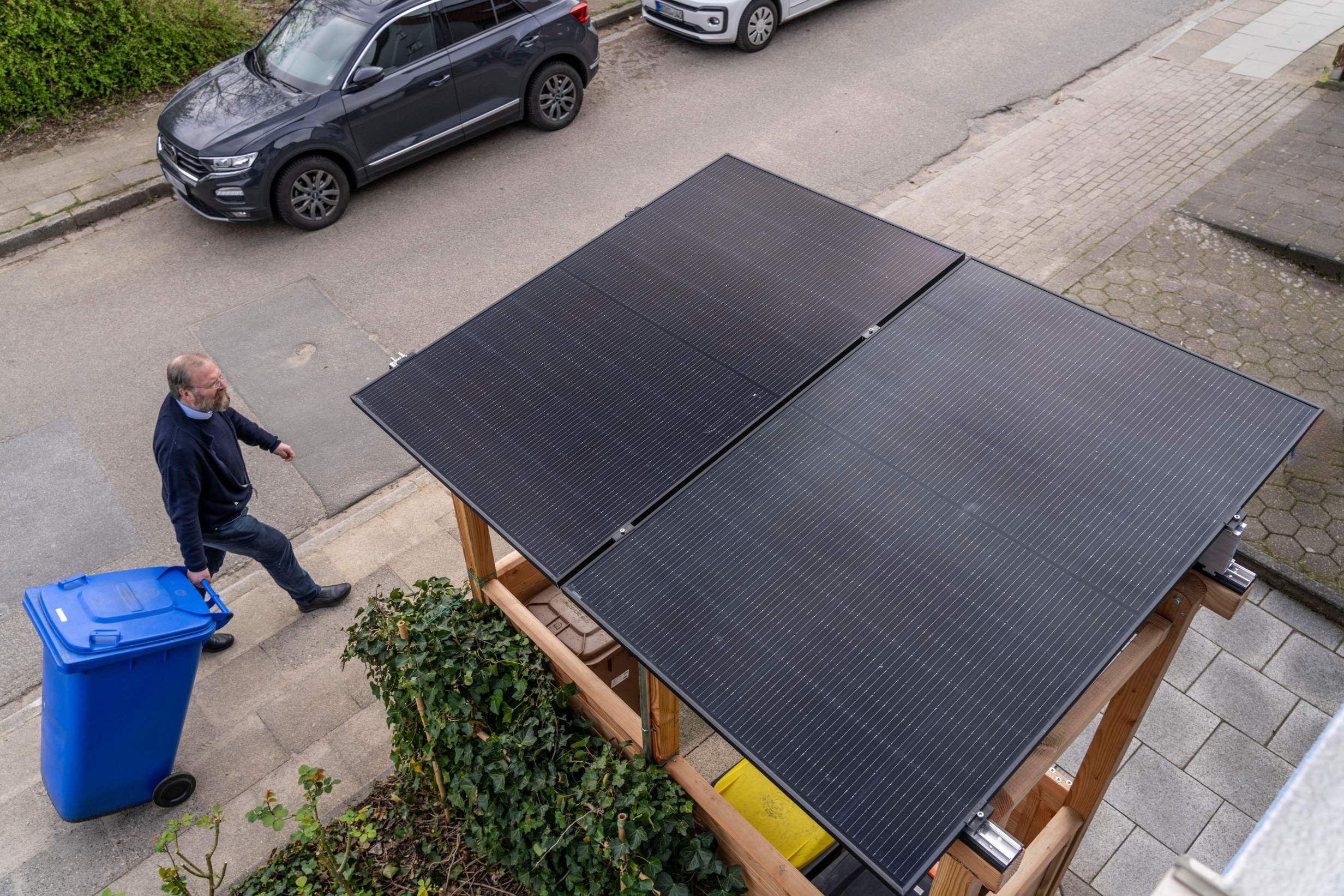

Read our Monthly Magazine
And support our mission to provide fearless stories about and outside the media system
The moment renewable energy nerds like me have been waiting for has arrived: plug-in solar, plug-and-play solar, balcony solar – whatever you want to call it – is now permitted in the UK.
That means you can now install a solar panel kit and plug it straight into your mains socket, to reduce your bills and reliance on the grid. It’s undeniably good news.
However, much of the reporting has missed out very crucial pieces of information.
I will try not to rain on any parades, because today is a step forward. But consumers need to have the right information to avoid being taken for a ride.
First, some background. The plans, largely copying Germany where balcony solar has been a huge success, could save households up to £110 a year on their bills through “clean, homegrown power” the Department for Energy Security and Net Zero says.
Each plug-in solar kit produces up to 800W of power. The Government estimates it’s enough to provide up to 20% of an average home’s electricity use. It’s probably easier to see it as comfortably covering your ‘baseload’ energy usage. A typical fridge, television, Wi-Fi router, laptop, phone charger and so on.
What has changed today is that you no longer need sign-off from an electrician to install the systems, and the planning rules have changed meaning they constitute ‘permitted development’ and reducing the chance of fights with your local council. (Fights with neighbours aren’t dealt with by the legislation).
So the benefits. No installation cost, less energy taken from the grid, lower costs, renewable power at home. Good timing ahead of the 4% energy price cap increase too.
Don’t miss a story
Ministers say the legal changes follow rigorous, independent safety testing, covering all key electrical elements, which shows that compliant panels are safe and compatible with UK wiring. Officials say the UK safety specification is more stringent than that of Germany, where around half a million new devices were plugged in last year.
But the key is in the word ‘compliant’. Almost none of the coverage directs people to see what devices are actually compliant that are for sale in Britain (not Northern Ireland, it’s not permitted there yet).
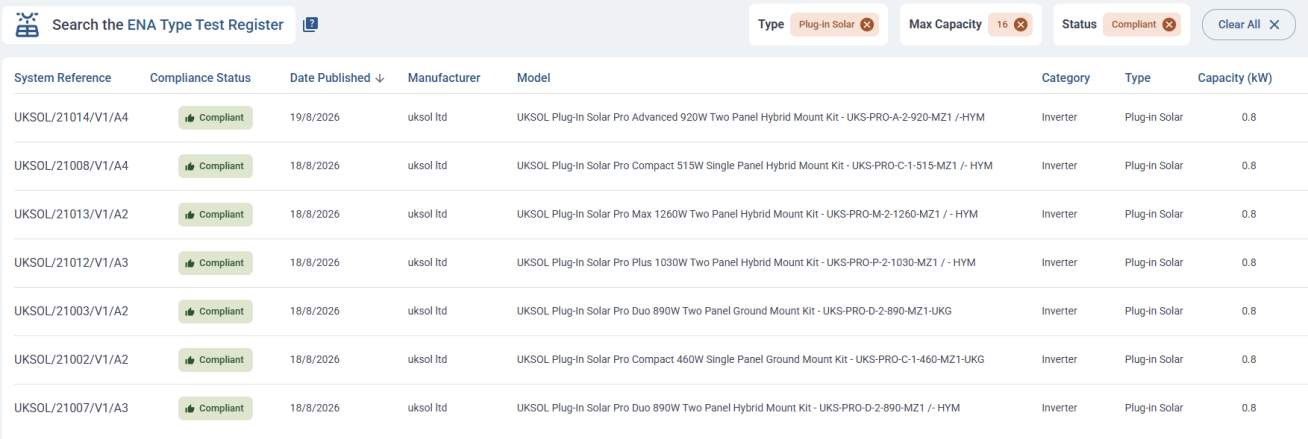
We’ve had a look. At time of writing, just seven – seven – kits can be sold legally in Britain today, to plug-in without an electrician’s approval. Officials have not denied this. It’s no wonder the Government appears slightly coy about pointing people to the official dashboard monitoring this stuff (ENA Connect). It tells you if products meet the new ‘Plug-in Solar Device Interim Product Specification’.
Every retailer – and there are many – that fails to make clear whether their devices are compliant for installation without an electrician is failing the public.
If you buy any other kit, it will need sign-off from an electrician to be compliant. So that’s seven permitted devices, from just one company. More products are expected to be signed off over the next week, I’m told, but at present a firm called UKSOL has the monopoly on compliant kits.
Competition is not there yet (at least not legally). Therefore, prices will remain high.
ENJOYING THIS ARTICLE? HELP US TO PRODUCE MORE
Receive the monthly Byline Times newspaper and help to support fearless, independent journalism that breaks stories, shapes the agenda and holds power to account.
We’re not funded by a billionaire oligarch or an offshore hedge-fund. We rely on our readers to fund our journalism. If you like what we do, please subscribe.
Or rather, prices for compliant kits will remain high. I’ve seen countless testimonies on forums and social media in recent weeks from people simply buying their own panels and microinverters (the bit that connects the solar panels to your electrical circuit) and installing them themselves.
You can do this for much cheaper than the all-in-one kits – roughly £330 vs £600 – but without the all-clear from an electrician, it wouldn’t be compliant with the new regulations. Something home insurers will no doubt be watching closely.
Officials have also confirmed to Byline Times that people need to notify their local grid within 28 days after installing a plug-in solar system, so the network operators know how much power is flowing around, and how demand might change. Again, that is nowhere in the official announcement or the media coverage about the changes. (There is though, as of this afternoon, an easy website to register your solar kit and notify the grid operator.)
We received a briefing today from a renewable energy advisory firm, which should know better, which failed to include any of these basic details.
Like, for instance, what renters’ rights are. Plug-in solar is often sold as a boon for renters. But there is nothing in the legislation ensuring that tenants have a right to install it. Hostile or skittish landlords and management agents can (and often will) say no. Permission is needed if you’re a leaseholder or a renter, and it can be denied.
Plug-in systems must be capped at 800W going into your property. Your panels can exceed that, but the microinverter must ensure it doesn’t go above that. Of course, you can find thousands of microinverters above that limit, being sold in the UK, which contain no reference to this.
Batteries are largely a no-go. You can’t have a home battery hooked up to your plug-in system unless an electrician signs it off. There are expectations this could change next year, but right now, the rules are strict.

Britain’s Solar Revolution Is Here and We Should Be Shouting It From the Rooftops
Ed Miliband is helping to turn the country into a nation of ‘solar zealots’ and Josiah Mortimer is enthusiastically along for the ride
The Planning Rules Explained
Little of the coverage mentions that planning rules do still exist, and we’ve pulled them from the actual legislation. Skip this section if it’s too in the weeds for you.
The table below covers England – Wales and Scotland are set to have their own rules, but for now the likely position is that they will fall back on existing regulations on permitted development rights for solar, which weren’t drafted with plug-in solar in mind.
There are two different planning classes for plug-in solar now in England.
Class A covers equipment on the building or a building in its curtilage (associated structures like sheds). Class B covers stand-alone equipment in the garden. Different rules apply.
Class A — on the house
Protrusion limits:
| Location | Maximum protrusion |
|---|---|
| Wall abutting a highway | 0.2m |
| Any other wall | 0.4m |
| Balcony or roof enclosure abutting a highway | 0.2m |
| Any other balcony or roof enclosure | 0.4m |
| Pitched roof | 0.2m beyond the slope, and no higher than the ridge (excluding chimneys) |
| Flat roof | 0.6m above the highest part of the roof |
Not allowed under permitted development rights (i.e. without planning permission) under the rules in England:
- Panels on listed buildings — any solar PV on the dwellinghouse or a building in its curtilage
- In a conservation area or World Heritage Site: panels on a wall, balcony or ‘roof enclosure’ that fronts a highway. A ‘roof enclosure’ is defined to include balustrades, railings and parapets.
- Panels on any wooden wall, balcony or enclosure, or on any timber-clad part of the exterior
So no putting plug-in solar set-ups on your wooden shed, without speaking to the council first.
Class B — stand-alone in the garden
Here are the height limits in England, measured from ground level, with the lowest applicable limit being the one you need to pay attention to:
| Scenarios: If your panels are… | The height limit is… |
|---|---|
| Within 5m of the curtilage boundary and forward of the principal elevation | 1m |
| Within 5m of the curtilage boundary | 2m |
| In a conservation area and nearer to a bounding highway than the house is | 2m |
| Any other case | 4m |
Again, no panels allowed on any wooden: fence, gate, wall or other means of enclosure.
And even where free-standing solar is permitted, if you’re in a conservation area and the set-up is “nearer to a bounding highway than the house”, you have to check with your council whether prior approval is needed.
Rules are stricter if you’re in a World Heritage Site or it’s a listed building. Get advice from the council if you’re in a conservation area, listed building or a World Heritage Site (like Bath, Saltaire, or the Lake District). (If you’re in a World Heritage Site, garden-mounted systems are almost always not classed as permitted development — anything within 5 metres of a boundary is excluded.) You can read the full planning regs here, if you’re so inclined.

From Steel Nationalisation to Plug-In Solar: Keir Starmer’s Final Acts in Government
The outgoing PM sneaked a lot of significant announcements out just before he left office
Gaps in Official Guidance
The Government announcement points people to the Energy Savings Trust’s checklist when installing plug-in solar. Respectfully to them, it’s clear as mud. It says: “Don’t buy plug-in solar panels before getting relevant permissions.” There is no detail whatsoever on when ‘relevant permissions’ might be needed.
Perhaps most bafflingly for a guide promoted by the Government, it also says not to install panels on wooden fences “unless you get advice from a professional to ensure that it’s safe”.
The new regulations are very clear. Plug-in solar on a wooden fence, gate, wall or other means of enclosure is not permitted development at all. In other words, it’s banned without council permission. No professional advice, however good, can get around that.
Finally, you’re only allowed one plug-in solar device per property. So you can’t have one system on your shed and another on your garden wall. The cap is 800W per household.
All this information is pretty crucial and should be explained to people. We have buried ourselves in secondary legislation to find it out.
Many people will not know about all these rules, and simply install non-compliant (and arguably less safe) systems, or end up with angry letters from their freeholders and landlords.
The Government may have decided to roll this out and make all that clear later. They may have the calculation that it is simply better to get this done to help with the cost of living, and handle teething-issues further down the road. There are certainly trade-offs involved here.
In the meantime, buyer beware. May the solar revolution continue. Safely.
Got a story? Get in touch in confidence on josiah@bylinetimes.com
holding farage to account #reformUNCOVERED
While most the rest of the media seems to happy to give the handful of Reform MPs undue prominence, Byline Times is committed to tracking the activities of Nigel Farage’s party when actually in power




 Contribute to our #ReformUncovered crowdfunder
 Subscribers Get More from JOSIAH
 Subscribers Get More from JOSIAH
Josiah Mortimer also writes the On the Ground column, exclusive to the print edition of Byline Times.
So for more from him…
