
 Subscriptions
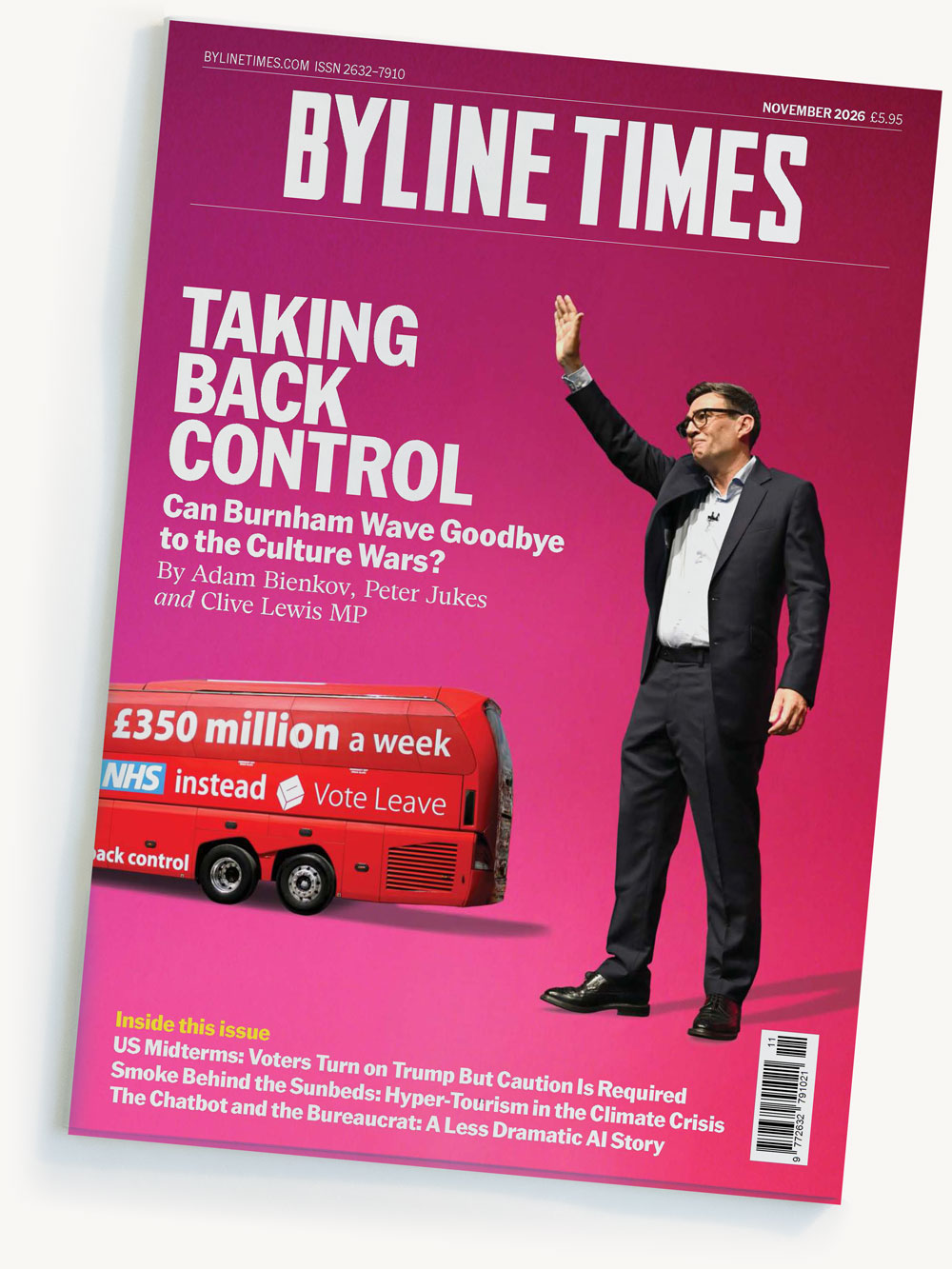
Read our Monthly Magazine
And support our mission to provide fearless stories about and outside the media system
The network of wealthy crypto investors, political fixers and opaque financial arrangements that has long surrounded Nigel Farage and Reform UK is now coming under sustained public examination from journalists and regulators alike.
The newfound scrutiny this week centres around ‘Posh George’ Cottrell, a convicted fraudster, crypto entrepreneur and Reform insider that Byline Times revealed as the Brexit Party’s de facto treasurer back in 2019. Are we beginning to see the broader picture?
In recent days, authorities have confirmed that there are ongoing investigations into Cottrell’s financial relationship with Reform UK. The Met Police have reportedly spent over a year now probing at least £500,000 in donations from Fiona Cottrell (mother of George) to the party, following suspicions that she could be a proxy for an impermissible source of funds.
On top of that, the National Crime Agency (NCA) has reportedly received multiple suspicious activity reports relating to millions of pounds in transactions to organisations operated by deputy leader Richard Tice. Cottrell himself is reported to have loaned Tice’s company Tisun Investment £80,000, and Fiona Cottrell gave £1 million to Tice’s think-tank ‘Britain Means Business’ in June 2024 – just over a month before Farage ran for Parliament in Clacton.
Pressed with questions about the Met’s investigation, Tice has presented himself and his party as being victims of a “politically motivated smear campaign.”
While arguing that “this is about the establishment trying to kill off a disruptive political party,” Tice ironically pivoted to touting the blue-blooded lineage of the Cottrells. “My family have known the Cottrell family for 50 years,” he said. “They’re a very successful aristocratic family.”
According to the Guardian’s City Editor Anna Issac, Tice also threatened to injunct the paper to stop it publishing details of the NCA flagging. He appears to have swiftly sent over the newspaper’s allegations put to him – without answering any queries – directly to The Telegraph, who promptly wrote them up as an apparent spoiler of their story.
ENJOYING THIS ARTICLE? HELP US TO PRODUCE MORE
Receive the monthly Byline Times newspaper and help to support fearless, independent journalism that breaks stories, shapes the agenda and holds power to account.
We’re not funded by a billionaire oligarch or an offshore hedge-fund. We rely on our readers to fund our journalism. If you like what we do, please subscribe.
Isabel Oakeshott, Tice’s partner and the international editor of Murdoch-owned Talk TV, looked very uncomfortable live on air when she was informed of the Met investigation. Describing the revelations as “concerning,” Oakeshott was hesitant to comment. She reiterated Tice’s same line that “Richard has said that he has known the Cottrell family for some fifty years.”
This week’s bombshells follow on from explosive revelations in The Times about Cottrell secretly providing security accommodation and staffing for the Reform leader. Back in 2019, Byline Times exposed the convicted fraudster Cottrell as a key fundraiser for Farage’s Brexit Party – also revealing that the party was flagged as “high risk” by the elections watchdog for receiving illegal and untraceable foreign donations via PayPal.
In truth Cottrell – described in The Sunday Times as a “fixer-cum-financier to the ultra-rich in Mayfair” whose wealth “derives from crypto” – is just one tile in a much larger dark money mosaic.
The other five-alarm fire for Reform is the Parliamentary investigation into Nigel Farage’s undeclared £5 million tax-free gift from Christopher Harborne, which coincided with a massive pro-crypto policy push from Reform and apparently an effort to directly lobby the governor of the Bank of England towards policies that would benefit the crypto industry.The standards investigation looms over Farage’s abrupt resignation and decision to stand again in Clacton (against Count Binface).
Another non-dom crypto billionaire, founder of BitMEX trading platform Ben Delo, has also given Reform UK £4 million. Delo pleaded guilty to wilfully violating US anti-money laundering rules before being pardoned by President Trump. As this newspaper revealed in an exclusive special investigation this week, he’s also wrapped up in the tight circle of Reform policy architect James Orr and his intellectual ‘dark enlightenment’ pipeline at Cambridge University.

Palantir Co-Founder Peter Thiel and Reform UK’s Cambridge University Recruitment Pipeline Project Revealed
The world-renowned academic institution has nothing to say in response to a six-month investigation by Byline Times raising serious concerns about the safeguarding of students and foreign influence at Cambridge University. Why?
Navigating the labyrinth of influence and financial connections beneath the surface of Reform UK, cryptocurrency really does seem to appear at every turn. The industry on its facade promises to usher in the utopian and democratic future of finance, but in practice it has become a magnet for opaque wealth, regulatory arbitrage and clandestine political influence.
Earlier this year, Farage invested £215,000 in Stack BTC, a UK-listed bitcoin treasury firm where former chancellor Kwasi Kwarteng serves as executive chair. Farage took a 6.3% stake, later fronting a £2m corporate bitcoin purchase in a promotional video, which prompted the Liberal Democrats to demand a Financial Conduct Authority (FCA) probe.
And of course Nathan Gill – Farage’s confidante sentenced to ten and a half years in prison for taking pro-Kremlin bribes – was arrested en route to a conference of “political technologists” in Moscow. Byline Times exclusively revealed that Gill had prepared a presentation about the electoral role of cryptocurrencies for his Russian sponsors.
A political movement promising to take on “the establishment” has become unusually reliant on an industry built around borderless capital, fragmented regulation and financial opacity.
While Reform is a stand-out example, Britain has more broadly been inundated by a flood of money into our political system. Over the last decade, private donations from companies and individuals giving more than £1m have surged, from 1% of the total in 2015 to more than 33% in 2024. According to Transparency International, one in every ten pounds comes from unknown or questionable sources.
It’s having a real impact on public trust. According to new polling from YouGov, 77% of the public feel British governments are generally sleazy, and 73% of Britons describe Nigel Farage as sleazy, including 56% who think he is very sleazy. Even 40% of Reform UK voters now see Farage as sleazy.
Off the back of the Rycroft review, the Government has announced what they say are “tough new rules to crack down on foreign money in UK elections.” It includes a new timebound cap on donations from those who move to the UK from overseas (potentially impacting donors like Harborne and Delo who may seek to return to Britain in light of other rules limiting donations for non-doms), tougher checks on company donations to ensure only “legitimate UK-linked” businesses can donate, and new requirements for candidates to prove funding comes from legitimate sources.
Campaigners have concerns, however, that this whack-a-mole approach of targeting specific donors and types of donations (while welcome) will still allow money to slip through the cracks. The Good Law Project, Transparency International, Unlock Democracy, and other democracy orgs are endorsing Stella Creasy MP’s amendment to the Representation of the People Bill that would holistically cap all donations from any one individual in a calendar year at £100,000.
Andy Pryce, a recently retired diplomat who spent a decade tracking Russian influence operations, warned in Byline Times that it would only cost roughly £25 million for a hostile foreign state to buy an election.
Reform has so far raised more than £30 million in declared donations since 2024. It is vital that the party should be able to demonstrate exactly where all of that money originated from.