
 Subscriptions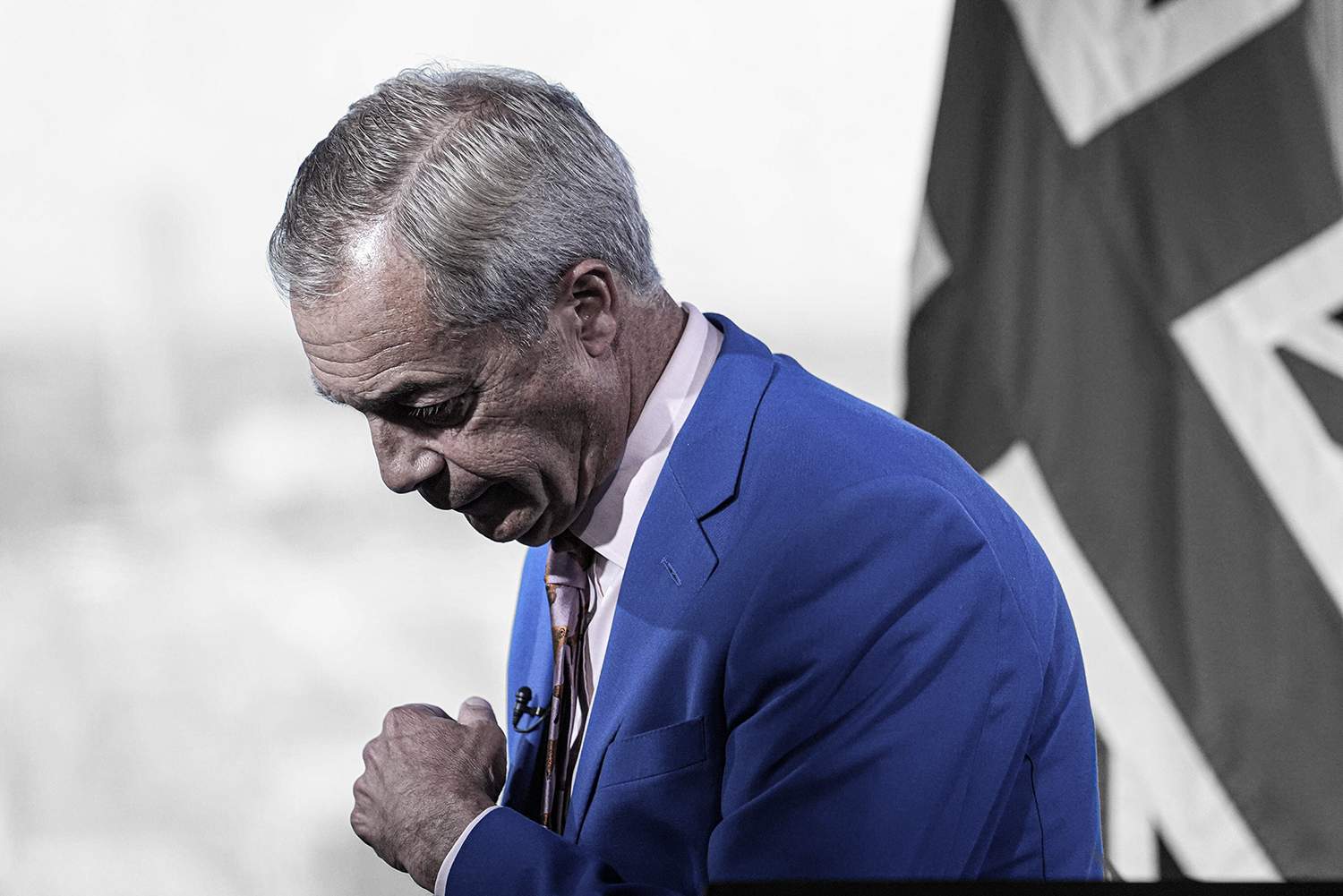
Read our Monthly Magazine
And support our mission to provide fearless stories about and outside the media system
There are normally only a couple of reasons why Members of Parliament who are otherwise in a state of good health resign their seats mid-term.
The most common reason is that they are guilty of some crime or misdemeanour that is so damaging to their reputation that they feel they have no choice but to do the honourable thing and step down.
The alternative reason is that there is some issue of great principle that they care so passionately about that they feel they have to trigger a by-election in order to win a mandate for tackling it.
Nigel Farage falls into neither camp. Not only is he completely un-ashamed of having taken millions of pounds in undeclared funds from a foreign-based crypto-billionaire, whilst also bagging undeclared support from a convicted fraudster, but he is now planning to hold a by-election with the express purpose of validating that decision.
This is a genuine first in UK politics. Never before has a politician announced their intention to run for re-election on an explicitly pro-sleaze, anti-transparency ticket. Never before has a politician gloried in having enriched themselves by breaking the rules, and then demanded a mandate to continue doing so indefinitely.
It is tempting for the gullible to applaud this as a political masterstroke. The BBC’s Chris Mason was among those declaring that Farage’s resignation had “seized back the agenda” from his critics.
“Having tantalised Westminster with a teasing social media post about his “future in public life”, he took to Reform’s stage, in front of Reform’s camera and without journalists in the room, to set out how he would again try to seize the limelight and the initiative” Mason wrote.
Yet the truth is that far from “seizing the initiative” it is Farage who has been seized. His resignation as an MP is not a sign of political strength, but of terminal weakness.
ENJOYING THIS ARTICLE? HELP US TO PRODUCE MORE
Receive the monthly Byline Times newspaper and help to support fearless, independent journalism that breaks stories, shapes the agenda and holds power to account.
We’re not funded by a billionaire oligarch or an offshore hedge-fund. We rely on our readers to fund our journalism. If you like what we do, please subscribe.
Jumping Before the Push
As the Guardian later revealed, Farage’s resignation came within an hour of a deadline they had given him to respond to new claims that he was reported by bankers to the National Crime Agency over concerns that his five million “gift” from Christopher Harborne was money laundering.
The paper reports that the bankers felt forced to go to the authorities as they were “not satisfied they could trace the ultimate origin of the funds.”
By calling the election now, Farage is hoping to distract from a growing political firestorm over his personal finances that could ultimately end his career in politics.
That end is unlikely to come at this by-election, however. Clacton is the safest Reform seat in the country and the decision by all other major parties to withdraw from the contest means that Farage’s constituents are now likely to face a straight choice between their current representative, or a man best known for wearing a bin on his head. And while we cannot entirely rule out the possibility of the funniest political outcome of all time, the chances are that the person currently representing the deprived Essex seaside town will be the same person representing it after all votes are counted.
Yet the fact that we are even set to have this by-election shows what a weak position Farage is now in.
In the run up to his announcement there were multiple reports, based on apparent briefings from senior Reform figures, that Farage could be about to step back from politics. Whispers about unspecified health problems and concerns about his recent extended absences from the media and parliament, combined with suggestions that he required a further “break” from politics, added up to the impression of a man whose career had passed its peak.
Those reports didn’t come from nowhere. In recent weeks multiple Reform figures have issued barely-concealed criticisms of his handling of the Harborne scandal, with the party’s former Chair David Bull even going so far as to suggest Farage should now take a “break” from the frontline, adding that “the party is way bigger than Nigel”.
In his resignation speech Farage suggested that he had considered doing just that, but was so “angry” about a journalist doorstepping his daughter that he decided he had to make a stand.
Footage later released by Reform of this supposedly scandalous incident showed a Sky News journalist briefly appearing at the door of a property owned by Farage, only to disappear as soon as his daughter refused to engage. If this is really what angered Farage to the point of calling a potentially career-ending by-election at massive public expense, then perhaps those internal critics suggesting he needs to take a break have a point.
Yet the truth is that far from being driven by protective paternal outrage, Farage’s decision to call this by-election is based on a combination of ego, vanity and sheer desperation. Faced with the prospect of being publicly branded by the parliamentary authorities as corrupt and dishonest, Farage has opted to instead run away before they can deliver their verdict.
This is not a sign of a principled, self-confident politician bravely “seizing the initiative” but more the sign of a trapped and wounded animal baring its teeth before the inevitable.
And despite his claim in his resignation speech to being “the most physically and verbally attacked public figure or politician of modern times” who has suffered “constant demonisation by the press”, the truth is that Farage has been handed an incredibly easy ride by the British media for an incredibly long period of time.
For many years the widespread portrayal of him as a pint-swigging man of the people who ‘tells it as it is’ has obscured the darker truth of his dishonesty, bigotry and shady associations. Not everyone went along with this portrayal of course. At Byline Times we have spent many years seeking to expose the real Nigel Farage behind the media facade. Yet in the past year there has been a definite shift as other media organisations have turned their focus onto a man who looked on course to become Prime Minister. That shift is welcome, however late it may be. Yet the idea that Farage is now being disproportionately targeted for scrutiny is utterly laughable.
What is actually happening is that a man who is clearly deeply unsuited for high office is finally being exposed for who he really is.
That Farage is now responding to this scrutiny by revealing what former UKIP politician Patrick O’Flynn described as his true “snarling, thin-skinned and aggressive” manner, shows exactly why it was so essential in the first place.
Farage’s future remains in the balance. With journalists and regulators still pursuing multiple others lines of inquiry about Farage’s finances and associations, it is highly possible that it all becomes simply too much, even for the professionally shameless Reform leader to bare.
Yet even if he does cling on, the media-driven facade that has surrounded Farage for so many years is clearly now broken beyond repair.
And with Labour’s poll ratings climbing, ahead of Andy Burnham’s elevation to Prime Minister, and Kemi Badenoch also receiving the increasing support of the right-wing press, Farage’s long day in the sun now looks likely to finally set.