
 Subscriptions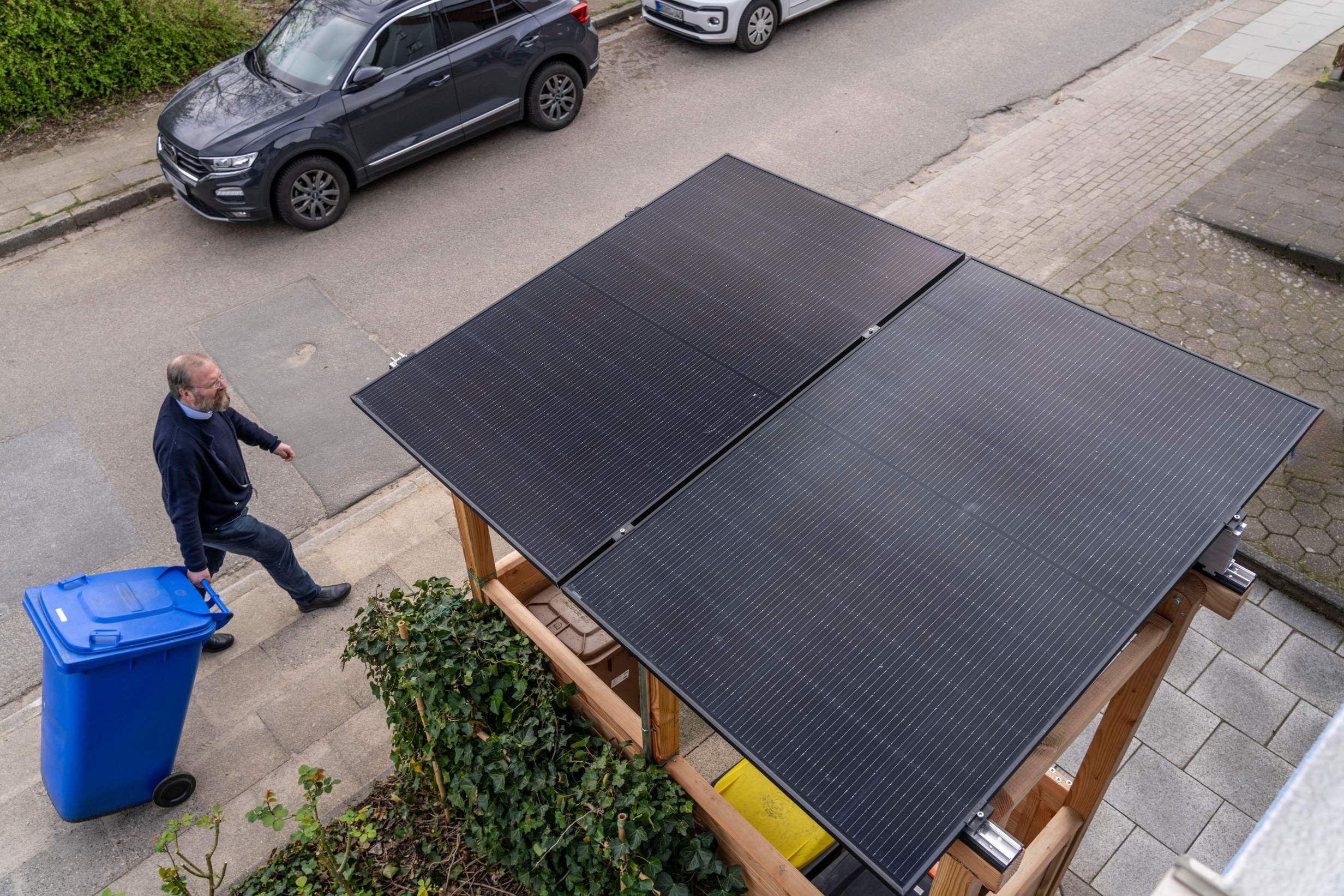

Read our Monthly Magazine
And support our mission to provide fearless stories about and outside the media system
In March, the UK Government announced that plug-in solar power was “months away” from hitting the shelves across the country. As a self-confessed solar fanatic, it’s exciting.
The change, which takes a lot of inspiration from its runaway success in Germany, will allow people to mount relatively cheap solar panels on their balconies and in gardens, to plug them straight into their mains, taking money off their bills.
Now we have a lot more detail on the plans, as ministers have launched a consultation on getting the product specifications right for the UK market. There is good news and there is bad news here.
Here’s where we’re at right now. Previously plug-in solar panels couldn’t be legally sold or used in the UK because our rules on electrical plugs didn’t allow them to be used for power-generating equipment. While the Government has updated some rules on this, it hasn’t yet finished the job.
Ed Miliband’s department DESNZ proposes amending the plug and sockets safety rules to allow an exemption for compliant devices.
Alongside that, ministers will introduce an ‘interim product specification’ setting out safety standards for what can be sold to consumers, modelled on Germany’s (for speed) until we’ve got our own.
The consultation on all this closes on 30th June, suggesting ministers want to move relatively fast, now that they’ve got going. But it still suggests that plug-in solar products are highly unlikely to be widely-available on the shelves this summer, when they would be most effective in cutting bills.
ENJOYING THIS ARTICLE? HELP US TO PRODUCE MORE
Receive the monthly Byline Times newspaper and help to support fearless, independent journalism that breaks stories, shapes the agenda and holds power to account.
We’re not funded by a billionaire oligarch or an offshore hedge-fund. We rely on our readers to fund our journalism. If you like what we do, please subscribe.
What the Consultation Tells Us
We’ve been rummaging through the documents to set out what has not been covered in the press.
Firstly, there’s a big one. Batteries are explicitly excluded and will remain illegal to sell or be used for plug-in solar.
This is a blow for many, because batteries allow you to make use of cheap overnight tariffs. The solar charges your battery in the day, the sun sets, and then you run your home on that power until say 11pm or midnight, when the battery recharges on a low-cost tariff overnight. Without that, the economics are a lot worse (though still worthwhile).
DESNZ has confirmed to Byline Times that allowing batteries as part of the set-ups “would need its own decisions and approvals”, and they’ve given no timeline given for that. So battery-connected plug-in solar is a while off yet.
Output from the solar panels into your home will be capped at 800 VA (800 watts in practice). Most panels come in around the 470 watt mark. Put simply, if you install two on your balcony (giving, say, a 900-ish watt output potential), the energy it puts into your mains will be capped at 800W (which is fine, as panels rarely provide 100% of their stated potential).
The overall size of the set-up will be capped at 2,000W. So you could have four plug-in panels theoretically, but it’s unlikely to prove cost-effective as you’d only get max 800W going into your home.
For reference, my home of three people usually has a ‘baseload’ (the constant hum of fridges, devices on standby, chargers, a few lights etc.) usage of about 350W. On a good day, one well-placed panel could cover a lot of that.
Don’t miss a story
It will also be capped at one device (plug-in set-up) per household. But several footnotes flag this may change to “per circuit” depending on consultation responses. Under that version of the plans, you might be able to have one plug-in set-up for your shed, and another for your house. Or even several in your house if you have a few circuits.
The department has published a safety study as part of this work. The headline findings were positive. But the details show a bit more nuance. One product tested – a supposed 400W device – exceeded its supposed rating at every single voltage point tested.
To be clear, there are plug-in solar products on the market right now, and forums are full of people with their own set-ups. I hesitate to call them illegal, but…they are probably illegal.
The Government’s safety study is clear that not all devices currently sold in the UK meet the standards they claim to be certified against. Buyers beware.
What the Docs Don’t Tell Us
There are big unresolved questions over the planning status for balcony or external-wall mounted units, under Permitted Development Rights. There is a risk (small-c) conservative councils will come down on visible plug-in solar set-ups like a ton of bricks, not least in conservation areas. No planning changes seem to be in the pipeline to get around that.
The study also notes that a dedicated fire safety assessment for blocks of flats (particularly ones with fire-prone cladding) has not been done. It is flagged as “priority follow-on work”. But again, it’s not clear when that will be done. Byline Times was told by officials it will be in “due course.” Those living in high-rises may be in limbo for a while.
The tax question also looms large. Currently, no VAT is applied to solar products that are professionally installed – in other words, nearly all current roof-mounted solar installations. That’s a 20% saving.
Britain’s Solar Revolution Is Here and We Should Be Shouting It From the Rooftops
Ed Miliband is helping to turn the country into a nation of ‘solar zealots’ and Josiah Mortimer is enthusiastically along for the ride
But we don’t know yet if VAT will be applied to plug-in solar products bought and installed by ordinary punters.
Why does this matter? If plug-in kits go on sale at B&Q or Currys (or wherever) at the standard 20% VAT, while equivalent rooftop installations are zero-rated, Miliband’s department will be simultaneously promoting and taxing the same underlying technology at different rates, depending solely on whether an installer was involved. It would feel a little unfair, if the Government really does want to incentivise this technology.
DESNZ says details on the VAT rate on plug-in panels will be provided ahead of them being made available in stores.
Another point of contention is that these changes apply to Great Britain, not to Northern Ireland.
NI’s position is unresolved, largely because of Brexit. The reason for this is that Northern Ireland remains in the EU single market for goods, and so the EU is involved with any products that could end up in the European market via Northern Ireland. DESNZ says it is “engaging closely with officials in Northern Ireland” but has given no timeline.
Need for Speed
How fast will the Government move on all this? The Government says the responses from the consultation will be carefully considered before any final decisions on next steps are made. Which doesn’t fill one with hope, particularly with a change of Prime Minister coming.
A DESNZ spokesperson said: “Plug-in solar panels can help households save money on bills and make the UK less reliant on global fossil fuel markets.
“The easy-to-install panels can be put in any suitable outdoor space, providing free solar power that can be used directly through a mains socket like any other device, without an installation cost.
“And [last] week, flagship retailers such as B&Q, Currys and Amazon joined Government plans to bring the clean energy technology to UK homes within months.”
A cynic might say that 1,000 months is “within months.” But we will park that for now.
These changes, when they happen, will be welcomed by millions of renters, roofless residents and listed-property dwellers who have so far had to take a backseat in the solar revolution.
We can only hope these rule changes are sorted before the blistering sun hides away for the winter.
Got a story? Get in touch in confidence on josiah@bylinetimes.com
holding farage to account #reformUNCOVERED
While most the rest of the media seems to happy to give the handful of Reform MPs undue prominence, Byline Times is committed to tracking the activities of Nigel Farage’s party when actually in power




 Contribute to our #ReformUncovered crowdfunder
 Subscribers Get More from JOSIAH
 Subscribers Get More from JOSIAH
Josiah Mortimer also writes the On the Ground column, exclusive to the print edition of Byline Times.
So for more from him…
