
Outside the system

The Fossil Fuel System Is Collapsing – and Taking Civilisation’s Safety Net With It

The Iran war is accelerating an irreversible breakdown of a system on which every hospital, harvest and factory depends – and only a rapid transition to energy superabundance can save us, argues Nafeez Ahmed, Divyesh Desai and Sandrine Dixson-Decleve

Read our Monthly Magazine

And support our mission to provide fearless stories about and outside the media system

The world has crossed a tipping point into an era of permanently declining fossil fuel supplies — and unless governments and industry act on that reality now, the result will be a full-system breakdown across every sector on which modern civilisation depends.

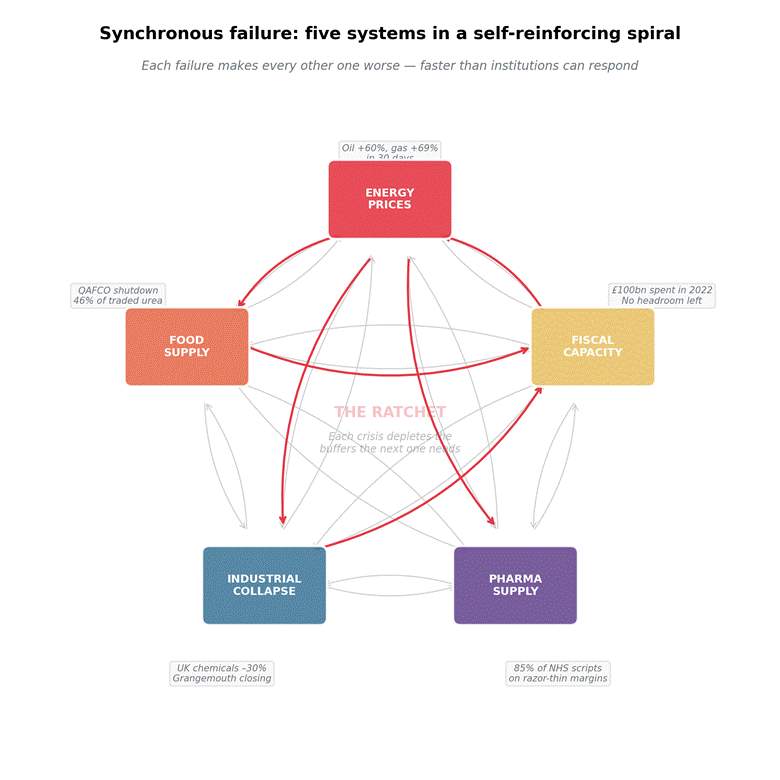
The war on Iran has broken five critical systems at the same time — energy, food, industry, pharmaceuticals and government finances — and each failure is feeding every other in a self-reinforcing spiral. The fossil fuel system driving it all was already in structural collapse before the first missile was fired. The war has accelerated a process that physics and geology had set in motion long before it. There is no return to normal.

The components of the crisis are being reported in isolation — the oil price spike, the fertiliser shortage, stagflation, pharmaceutical supply chains — but what the fragmented coverage misses is that they are faces of a single systemic fracture.

Our new working paper published by the Club of Rome’s Earth4All initiative, co-authored with energy and finance specialists with experience across Shell, Lightsource BP, the World Economic Forum and the Energy Transitions Commission, maps the full architecture of this crisis – and the exit route.

EXCLUSIVE

Why the Iran War Could Last Far Longer Than Either Side Wants to Admit

With the Strait of Hormuz closed and US munitions dwindling, it is Iran that will ultimately be able to set the price of peace, argues US defence analyst Brynn Tannehill


How Civilisational Collapse Works

In 2002, systems analyst Thomas Homer-Dixon mapped how modern civilisations break down. He chose an Israel–Iran war closing the Strait of Hormuz as his example. A quarter of a century later, the process he described is now unfolding in real time.

Complex societies do not collapse from a single blow. They collapse when multiple systems fail at once and each failure makes every other one worse – faster than institutions can respond. Homer-Dixon called this “synchronous failure”.

The mechanism is a ratchet: each crisis depletes the buffers – savings, fiscal headroom, political trust, industrial capacity – that the next crisis would need. Eventually the gap between the scale of the problem and the institutional capacity to respond becomes too wide to bridge.
Source. Foundation for Civilisational Renewal

Consider where Britain and Europe stand right now. The same Gulf disruption pushing up energy bills has shut down the Qatar Fertiliser Company (QAFCO) – the world’s largest single producer of urea, the most widely used nitrogen fertiliser. The Gulf supplies nearly half the world’s traded urea.

The shutdown arrived just as farmers were preparing to plant. Fertiliser that was not applied in March and April means smaller harvests this autumn and unstoppable food price rises over the winter – landing at the same moment that higher energy bills hit households from July.

The same shock is degrading pharmaceutical supply chains. Generic medicines make up 85% of NHS prescriptions and operate on razor-thin margins. Freight costs are running 45% above pre-war levels. Within months, medicines for chronic conditions – cardiovascular, diabetic, psychiatric – may become too expensive to supply. These are the daily medications on which millions of people depend.

The same petrochemical disruption is accelerating the collapse of European industry. UK chemical output had already fallen 30% from 2019. The UK’s last major ethylene cracker at Grangemouth is on government life support. Once it shuts, the country will have no domestic polymer production of scale. Facilities closing under current cost structures are unlikely to be able to attract the capital to reopen. There is a serious risk that the industrial base on which any future recovery depends is being permanently destroyed.

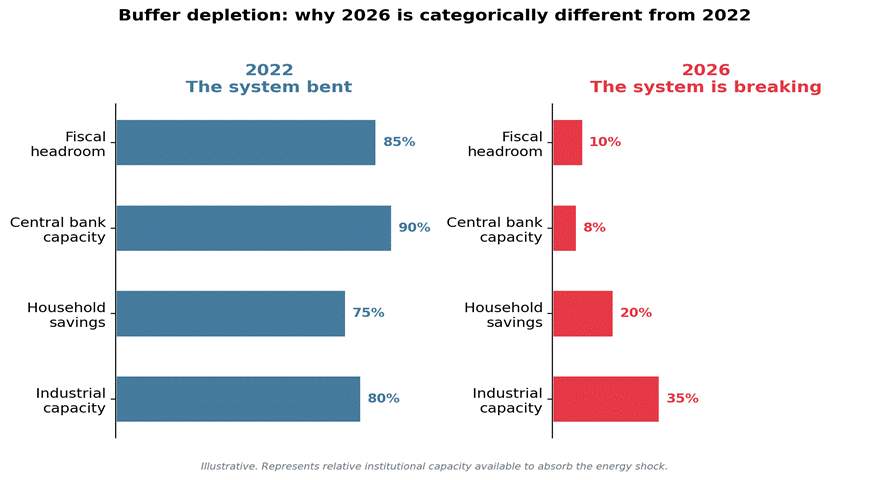
And the UK Government has already spent much its capacity to help. More than £100 billion went to supporting households through the 2022 energy crisis. That capacity is gone. Inflation is forecast at 4% for 2026, potentially above 5%, so the Bank of England cannot cut interest rates, let alone keep rising rates at bay. Raising rates pushes up mortgage costs for people already paying more for energy and food. The two instruments that governments normally use to soften a downturn – fiscal spending and central bank rate cuts – are being crunched at the same moment. There is no institutional cushion left.
Source: Foundation for Civilisation Renewal

This is Homer-Dixon’s ratchet in action. In 2022, every buffer available was deployed to cushion the crisis impacts, and the conditions were still destabilising. Governments could borrow. Central banks could lend. Households had savings. Industrial capacity was intact. The system buckled, but it held.

In 2026, the load is higher across every channel and every buffer has been depleted by the last crisis. Each failing system degrades the environment in which every other system must operate.

The Government’s inability to borrow at scale means it has limited means to cushion the coming food and energy shock. Industrial closures destroy the tax base and skilled employment that would fund recovery.

The food and energy price spikes, landing on a population with depleted savings, generate the political conditions – short-termism, demands for immediate relief, fragmented mandates – that make any longer term structural response difficult to sustain.

The crisis may well consume the political capacity that would be needed to solve it. The danger of looming synchronous failure is hanging over UK and European economies like heavy clouds ready to unleash the storm.

ENJOYING THIS ARTICLE? HELP US TO PRODUCE MORE

Receive the monthly Byline Times newspaper and help to support fearless, independent journalism that breaks stories, shapes the agenda and holds power to account.

We’re not funded by a billionaire oligarch or an offshore hedge-fund. We rely on our readers to fund our journalism. If you like what we do, please subscribe.


The Engine Behind the Collapse

The experts are sounding the alarm. But they don’t really understand the stakes.

Fatih Birol, Executive Director of the International Energy Agency (IEA), called this “the greatest energy security threat in history.” The IMF’s chief economist Pierre-Olivier Gourinchas described it as a “classic negative supply shock.” Jeff Currie of the Carlyle Group warned that the world will have the energy transition “forced on us in a very painful way.” US Treasury Secretary Scott Bessent pressed for fossil fuel expansion as the answer. They are all right about the severity. They are all wrong about the cause.

Birol’s prescription – diversify suppliers, diversify fuels, diversify trade routes – assumes a functioning fossil fuel system that can be rerouted. Gourinchas’s IMF assumes a “short-lived conflict” and therefore a temporary disruption. Bessent’s argument assumes US production can expand to fill the gap. All three share a hidden premise: that the global fossil fuel system is recoverable.

Our assessment is that this is simply not the case. The war has accelerated the collapse of a system that was already dying. The window into the realisation comes from a concept called “Energy Return On Investment” (EROI).

Every energy source requires energy to produce. Oil must be drilled, pumped, refined and transported – all of which consumes energy. The critical measure is how much usable energy you get back for each unit you put in.

In the 1960s, the global oil industry got roughly 44 units of energy back for every one it spent. But that ratio has been declining, and by today, it has roughly halved. A study published in Nature Energy found that once you account for all the refining, transport and processing, the real return is as low as six to one – and falling.

By 2030 – in just four years – the oil industry is projected to burn through a quarter of all the energy it produces just to keep producing.

Everything in modern civilisation runs on the surplus energy that the fossil fuel system delivers. Every hospital, every harvest, every heating system, every factory, every supply chain depends on the margin between the energy the oil industry produces and the energy it consumes in producing it. That margin is collapsing.

As it shrinks, the energy system that sustains industrial civilisation loses the capacity to sustain it. The repeated crises of 2008, 2020, 2022 and 2026 are the symptoms of a system whose surplus is vanishing – each one arriving sooner and hitting harder, because the energy physics beneath the global economy are deteriorating on a curve no ceasefire can reverse.

Source: Foundation for Civilisation Renewal

US shale – which supplied 90% of the world’s oil production growth since 2015 — is plateauing before a peak and terminal decline, according to the US Government’s own Energy Information Administration. Nearly 90% of the money the industry has invested since 2019 has gone to stopping existing wells from dying, rather than opening new ones.

Production is declining simultaneously across the UK, Mexico, Nigeria and Europe. The world’s supply buffer – OPEC’s approximately 5.3 million barrels per day of spare capacity – sits behind the Strait of Hormuz, physically inaccessible because of the conflict causing the shock.

This reveals why the 1970s analogy that Birol and others reach for is so misleading: in 1973, the shock was a political embargo on a physically abundant system, and the solution — drill more, diversify suppliers — worked because the underlying resource base was rich. In 2026, the resource base itself is exhausted.

EXCLUSIVE

Trump Went to War With Iran to ‘Seize Oil’ as US Shale Enters Major Decline

The United States launched a war on Iran, not to eliminate a nuclear threat, but to seize control of the world’s last major accessible oil reserves

The damage is permanent because because both supply and demand are being destroyed at the same time, and neither can return to what it was. The oil and gas taken off the market by the Hormuz closure and the Gulf infrastructure strikes cannot come back for years: Qatar’s Ras Laffan LNG complex alone needs three to five years to rebuild, because the specialist gas turbines required sit behind global order backlogs of two to four years.

While that capacity is offline, production is already declining across every other major producer, with no one left to expand into the shortfall. And what does eventually come back will be restoring a fraction of what was lost into a global system whose total production base is structurally smaller than it was before the war.

On the demand side, households and industry are restructuring around scarcity — factories closing, supply chains rerouting, consumption patterns permanently reshaping. The IEA is now recording the first global oil demand drop since the COVID crisis.

But unlike that crisis, there is no route for these changes to reverse: the capital is gone, the infrastructure is repurposed, the demand is destroyed. The age of cheap, abundant oil is over, and it is not coming back.

EXCLUSIVE

The Oil Lobby Is Using the Iran War to Revive North Sea Drilling but Official Data Shows It Won’t Cut Bills

Fossil fuel funded think tanks, petrostate-linked policy institutes and oil market insiders are all being presented as impartial observers by the media, reports Nafeez Ahmed


The exit to superabundance

The scale of the threat demands an exit of equal scale. Thankfully, that exit already exists. We just need to walk through it.

Solar panels and wind turbines, once built, produce electricity at near-zero running cost with no fuel input. This is a fundamentally different kind of energy system – one whose costs are set by domestic infrastructure investment rather than global commodity prices, and whose output does not deplete with use.

In February 2026, an international scientific review by more than 25 expert teams, published through the IEA, confirmed that fully renewable electricity systems – delivering power around the clock, every day of the year – are achievable and affordable if we do one thing: design for superabundance.

We need to build a system that generates far more electricity than the country currently consumes. RethinkX modelling identifies an optimal UK system producing eight to 14 times current electricity output, at $747 per person per year over 20 years – roughly what the country already spends on energy.

That surplus electricity is itself the foundation of industrial revival: cheap, abundant clean power enables green hydrogen, synthetic fuels for aviation, ammonia for fertilisers, low-carbon steelmaking and data centres.

Countries that build this capacity first will host these new industries, protect their populations, and secure their sovereignty. Countries that do not will import energy from those that do, and remain exposed to every future fossil fuel shock.

Offshore wind delivered through Contracts for Difference at £37–50 per MWh already undercuts gas-fired generation at £80–120 per MWh.

Building the superabundant alternative costs less than what the Government spent on emergency fossil fuel support in 2022–2024. That £100 billion bought temporary fiscal relief and left the country just as vulnerable to the next shock. The same sum invested in clean energy infrastructure will deliver a permanent productive asset and removes the vulnerability for good.

But it’s not enough to build the new supply. Backwards thinking has meant that clean energy we are already producing is not being supplied where it’s most needed due to grid bottlenecks.

Our working paper sets out five immediate actions.

First, invoke energy security powers to fast-track planning for shovel-ready renewable and storage projects. Every month of delay is a month of continued exposure to gas-price shocks on household bills.

Second, force grid operators to clear connection backlogs within six months under regulatory penalty, and rebalance policy levies so heat pumps are no longer penalised against gas boilers despite being three to four times more efficient.

Third, end the marginal pricing rule that lets gas set electricity prices even when renewables dominate supply. This is the single most effective measure to shield households from the next fossil fuel shock.

Fourth, redirect UK pension capital — more than £2.5 trillion that remains systematically underweight in domestic clean energy while holding fossil fuel exposure — through reformed FCA and Pensions Regulator fiduciary guidance.

Fifth, build manufacturing capacity for solar panels, batteries and critical minerals by leveraging AUKUS for lithium and rare earths, and EU-India for solar.

Windfall profit taxes on oil and gas majors — currently running at €81.4 million a day in the EU alone — fund the transition.

This is the roadmap to rapid transformation – unlocking renewables as the route to what we call “electrified sovereignty”: industrial protection and national prosperity.

EXCLUSIVE

The British Tax Havens Shielding Big Oil’s Iran War Windfall

As Shell and BP prepare to pocket billions from Trump’s war in Iran, a Byline Times investigation reveals how British jurisdictions are quietly doing the work of protecting them


The Civilisational Stakes

The world has reached an inflection point. How governments respond in the coming weeks will determine whether the global economy undergoes a managed transformation to a fundamentally more powerful energy system, or an unmanaged breakdown. The window is narrowing with every shock. The question is whether policymakers recognise this in time to build the alternative — before the political capacity to act has itself been destroyed.


This article was filed under
, , ,