
 Subscriptions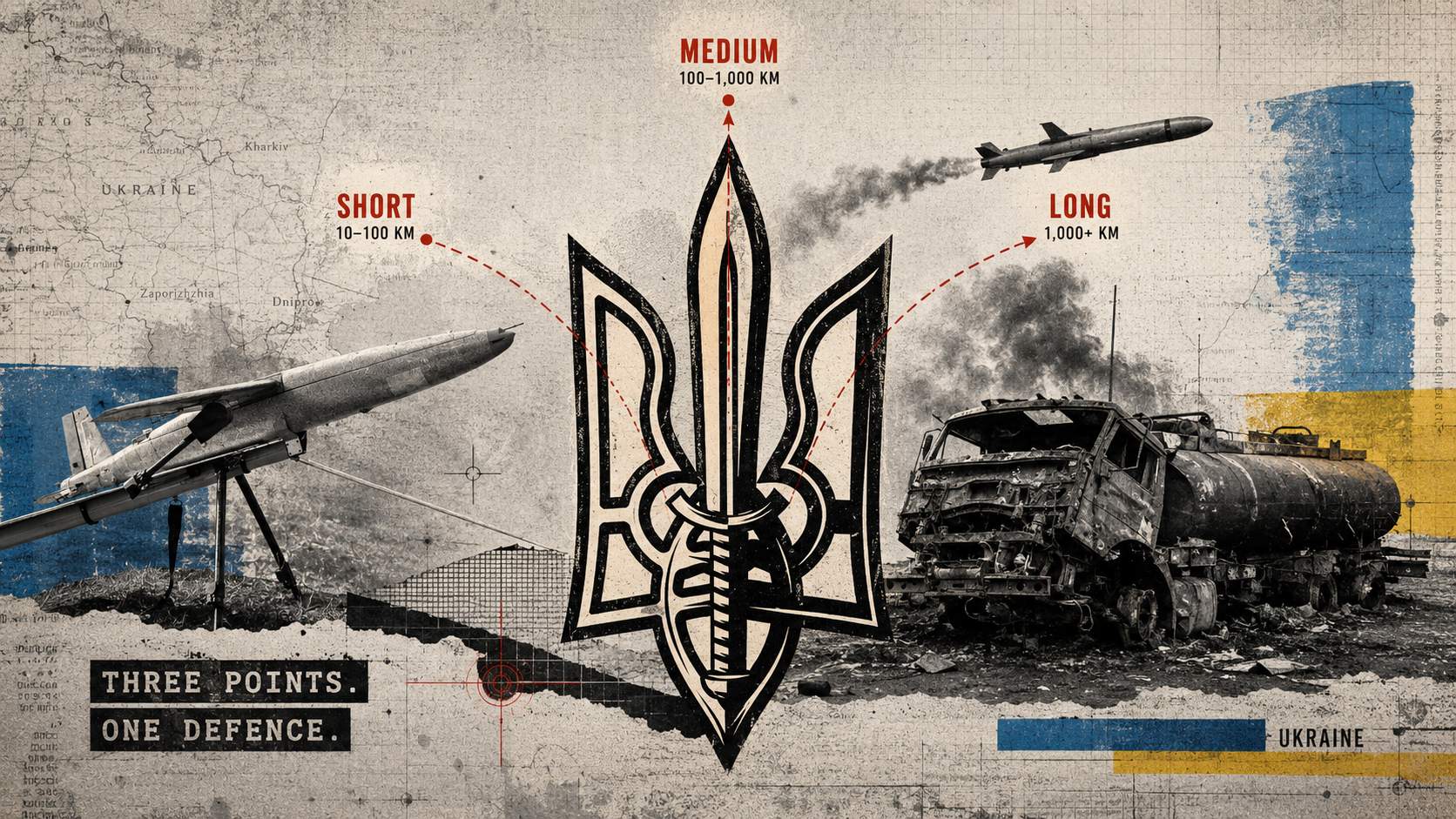

Read our Monthly Magazine
And support our mission to provide fearless stories about and outside the media system
The Ukrainian coat of arms, a national symbol often featured in tattoo art worn by patriots, is a trident. Similarly, Ukraine’s drone and missile warfare now has three distinct sharp points to it.
Long-range drones are already evading Russian air defence systems seemingly at will to wreak havoc with the oil and gas infrastructure that is the backbone of the Russian economy and thus the main source of their war funding.
The other two elements, the short-range and medium-range capabilities, are no less interesting and no less devastating to the Russian war effort. In fact, the medium-range drone capability may well be the sharpest of the three elements, as they tear into Russian logistics supply routes across the occupied parts of southern Ukraine in the oblasts of Kherson and Zaporizhzhia. But first, a brief look at how the short-range drones have changed the battlefield.
The Front Line Kill Zone
In the early days of the full-scale invasion, comparisons with the trench warfare of World War I were commonplace. Two enemies faced off across a no-man’s land, sometimes with only a hundred metres between their positions; sometimes the grey zone, or kill zone, between the sides was a kilometre or two. Any attempt to go “over the top” left attackers exposed and vulnerable, with catastrophic losses as a result.
With Russia possessing both a numerical advantage — its population is roughly three times Ukraine’s — and an utter indifference to the numbers it was losing (now closing in on 1.4 million dead and maimed), there was an assumption that, in a war of attrition, Russia would eventually prevail. That assumption had to be overturned.
This war forced Ukraine to innovate and adapt. The use of drones on the battlefield has allowed Ukraine to do two things in parallel that will change how wars are fought in the future: monitor the vast frontline, 1,200 km in length, for signs of Russian troop or hardware movement; and immediately launch hunter-killer drones to neutralise those threats. Before the Russians can move, they are being eliminated.
The kill zone is no longer a thin strip between two lines of trenches; it can now be up to 50 kilometres deep. As Ukraine has invested in producing these hunter-killer drones at scale and at a reasonable cost, the chances of any significant Russian advance from current positions are now close to zero.
Blunting the possibility of further Russian advances is not enough to win the war on its own. Russia could simply hold the territory it seized in the blitzkrieg of the first week of the full-scale invasion and hope the narrative of “no military victory possible for either side” hardened into permanent fatalism “no military victory possible for either side”.
To win, the other two teeth of the trident must work in concert with the short-range systems. The long-range drones are destroying the Russian economy and, with it, Russia’s ability to continue financing the war.
Ukraine’s ‘Frozen’ Frontlines Are Shifting Significantly
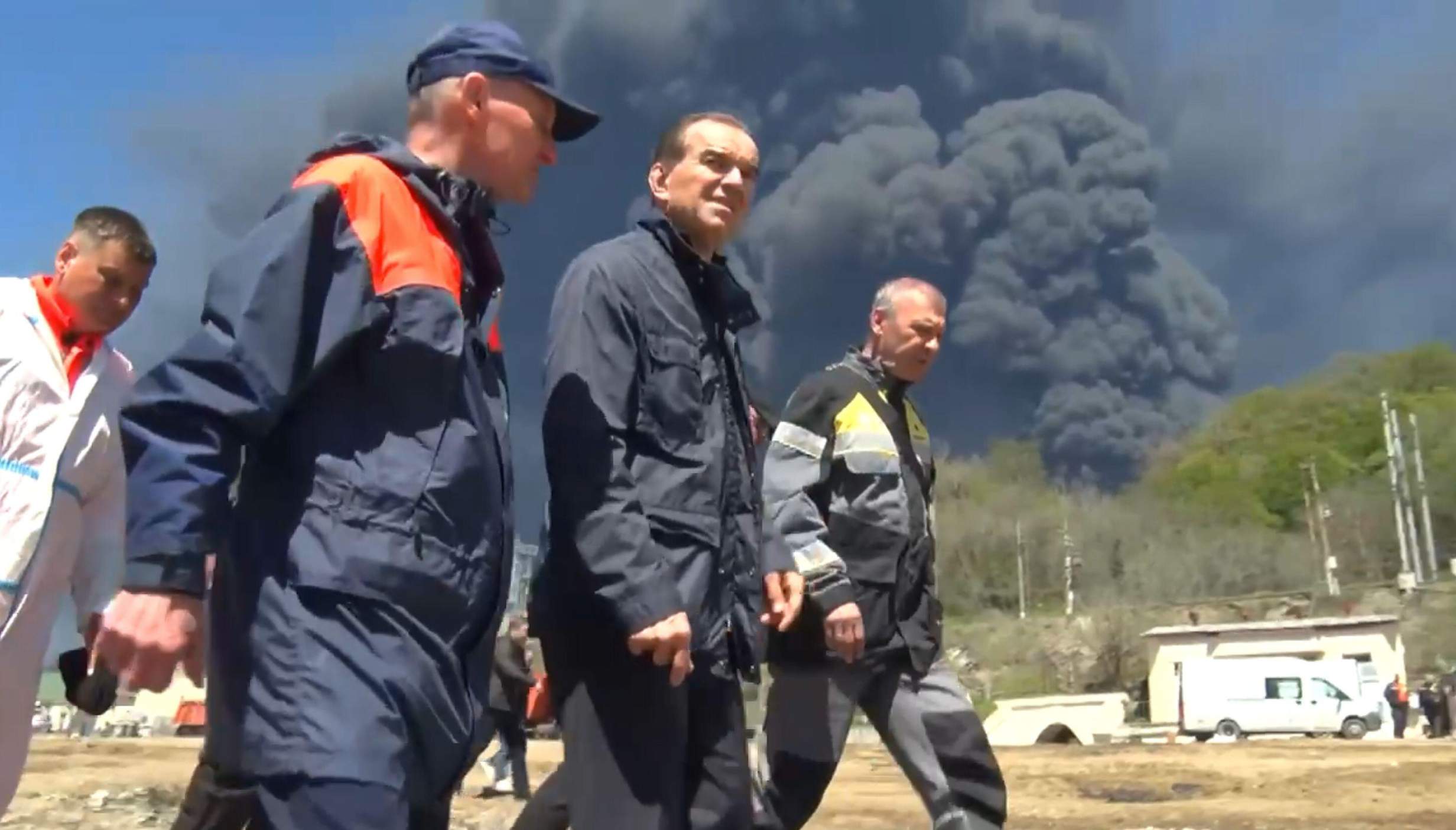
A series of drone attacks on Russian oil facilities by Ukraine been a more significant blow to Putin’s war machine than Western sanctions
Fire Control Over Crimean Supply Routes
The medium-range drones, used from roughly 50 km to 200 km from Ukrainian positions, are rapidly establishing fire control over the highways and supply routes that run through Kherson and Zaporizhzhia, and with that, they are undoing the only strategic gain Russia can boast of from this phase of the war: the land bridge to Crimea.
Step back to 2014. Russia seized the Crimean peninsula just five days after the Revolution of Dignity forced former president Viktor Yanukovych into exile in Moscow. There are many possible explanations for the Kremlin’s timing, but there is no evidence that it happened at the request of the local population.
That rash decision and the rushed, faked referendum that followed left Russia with an acute logistical problem: how to keep Crimea supplied with water, food, fuel and ammunition.
A stopgap was the construction of a physical bridge across the Kerch Strait, connecting the illegally seized Crimean peninsula to the Russian mainland; President Putin opened the bridge in 2018, and its capacity was expanded in 2019 with rail freight lines. But the literal foundations of the Kerch bridge are as unsound as Russia’s legal justifications for its seizure of Crimea.
The waters of the Kerch Strait can be violent, and the seabed does not provide a secure anchor for a hastily constructed 12-mile strip of concrete and tarmac built to Russian standards. The only sustainable way to maintain control of Crimea was to create an overland route from Russia itself — hence the occupation of a narrow coastal strip through the oblasts of Kherson and Zaporizhzhia along the Sea of Azov.
As in Crimea in 2014 and in parts of Luhansk and Donetsk the same year, there was no call from the inhabitants of Kherson and Zaporizhzhia to be incorporated into the Russian Federation before or in 2022.
In Kremlin rhetoric, these land seizures have been justified after the event by a series of referenda; any referendum organised by the Kremlin is as flawed as any election spectacle in Russia itself. Russia has taken the land and pretended that the locals wanted it, that this is not open to negotiation — none of which is remotely true.
Rhetorical Counterattacks
Another success of Russian manipulation has been to trick observers into thinking the only sticking point for a peace deal is a small part of Donetsk; that is a red herring. The February 2022 offensive was plainly a naked land grab of roughly 40,000 km2 and an attempt to colonise the people who lived there.
Short-range drones have halted any notion of further Russian advances. Long-range drones are dismantling the Russian economy and pushing it towards a tipping point. Medium-range drones are unravelling the only strategic gain from this phase of the war — the land route to Crimea — and the operational evidence is visible on the ground, unravelling the only strategic gain from this phase of the war.
The Russian investigative site Dossier Center says it has obtained what it claims to be an internal Kremlin discussion document on how to sell, or control the narrative of, an end to the war in Ukraine without having achieved its stated objectives.
According to The Spectator, “The main achievements the Presidential Administration plans to emphasise are territorial gains, a land route to Crimea, and the acquisition of millions of new Russian-speaking citizens.”
When the land route to Crimea is essentially the only major gain Putin’s spin doctors can tout, it makes sense for Ukraine to deny them that prize. There will be no upside to trying to deceive a docile Russian population with hollow triumphalism.
The occupation of Crimea is already unsustainable. Its end will coincide with the fall of the Putin regime and the collapse of the Russian economy; those three elements — political, territorial and economic — are interlinked, and together form another facsimile of the Ukrainian trident.