
 Subscriptions
Read our Monthly Magazine
And support our mission to provide fearless stories about and outside the media system
Reform-led Kent County Council’s decision to recite the Lord’s Prayer and sing the national anthem at every full meeting has been branded “virtue signalling” and a “farce” which will cut the opposition’s speaking time and eat into crucial council business.
Groups including the National Secular Society (NSS) and Humanists UK have expressed disappointment that a Kent council has voted to “impose” Christian prayer at meetings.
Amendments to have a moment of silent reflection instead, or for the prayers to be said prior to the official agenda beginning, were defeated last Thursday. Prayers have not been said at Kent County Council meetings since 1987, according to the NSS.
The changes were put forward by Reform UK councillor Christopher Hespe. It is the latest attempt to introduce Christian prayers into council meetings by Reform. Farage’s councillors also imposed prayers on Derbyshire County Council last year after the party took control of the council.
ENJOYING THIS ARTICLE? HELP US TO PRODUCE MORE
Receive the monthly Byline Times newspaper and help to support fearless, independent journalism that breaks stories, shapes the agenda and holds power to account.
We’re not funded by a billionaire oligarch or an offshore hedge-fund. We rely on our readers to fund our journalism. If you like what we do, please subscribe.
Opposing the amendment to have a silent moment of reflection, Council Leader Linden Kemkaran said she wanted the lord’s prayer to “take up the space” of that silence. She claimed the lord’s prayer was a “profound unifier”. And Reform councillor Spencer Dixon called the opposition to the plans “fake outrage”.
Fellow Reform councillor Terry Mole said that while he does not know if he’s a Christian and he doesn’t go to church, he does pray to win the lottery and said that councillors who do not want to listen to the lord’s prayer should just ‘bow their head’.
Cllr Mole said: “We are Christians at the end of the day.”
He went on: “Am I a Christian? I don’t know. I don’t go to church. I don’t pray every morning…But when I do the lottery, I still say, well, please God, let me win, okay?…I’m sure we all do it. Where are we going to get buried when we die? We’re going to be buried in a church, okay?”
In fact, 78% of people in Britain are now cremated.
The proposal was even controversial among Restore Britain councillors. One of them, Cllr Oliver Bradshaw, gave a conflicted speech noting that as a practising Anglican who supports the prayer, he was worried his own side was turning his religion into a political tool – the Lord’s Prayer being an act of worship and not about signalling or drawing political lines.
Conservative councillor Bill Barret said he “wasn’t elected to say prayers in this chamber”, adding that as an atheist, imposing prayers made him feel “slightly uncomfortable”.
Don’t miss a story
And Lib Dem councillor Mike Sole pointed to the potential bureaucratic absurdities of compulsory singing of the National Anthem. “Will scrutiny committees investigate insufficient enthusiasm? Will there be an anthem KPI [key performance indicator]?”
He told fellow councillors: “The resident waiting for the pothole to be fixed is not lying awake at night thinking, ‘I just wish my councillors would sing a bit more’. They are thinking, ‘could someone please stop my [vehicle] crashing into a crater?
“Our meetings are already theatrical enough. When the meetings end with a member of the Royal Family present, I will gladly stand up and sing with gusto. But until then, let’s finish with dignity, efficiency and the traditional British custom of quietly gathering our papers, nodding quietly to one another and muttering about the weather on the way out.”
The vote at the council’s annual meeting on 21 May saw 48 councillors back reciting the Lord’s Prayer and 45 back singing the national anthem – while approving a cut to all opposition leaders’ response time to make way for it. Opposition time will be cut by a minute each, leaving Labour’s Leader with only two minutes.
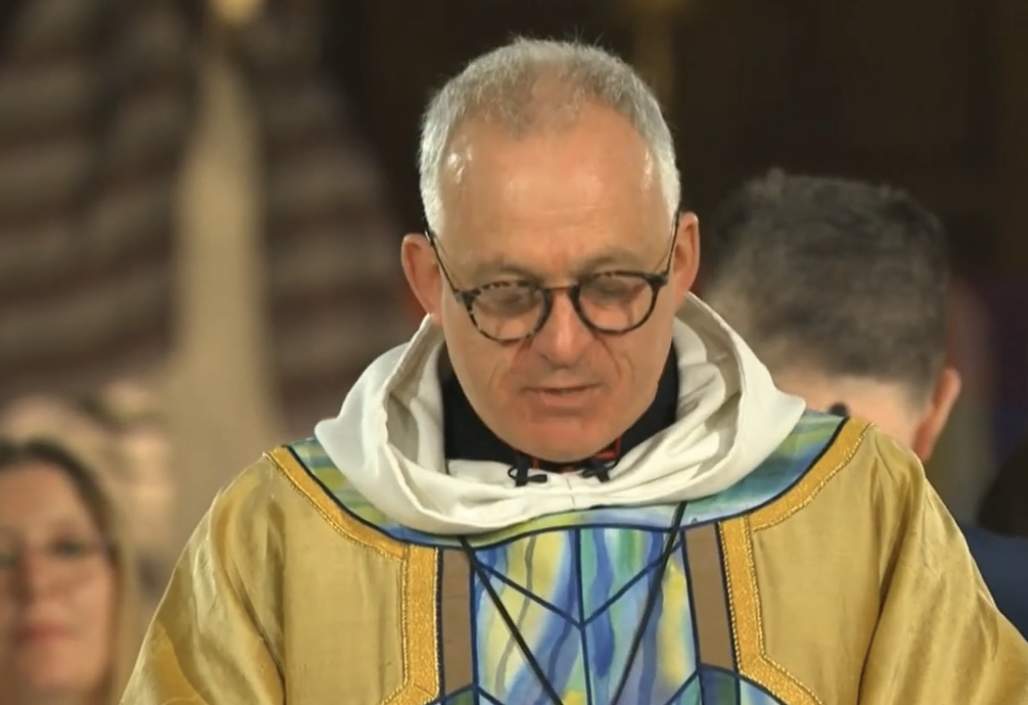
Reform Council Sacks Long-Serving Vicar as Standards Chief, in Wave of Cuts to Scrutiny
Reverend Canon Hilary Barber says he was given no warning or thanks by Nigel Farage’s party for his years of service
The Green Group suggested that any reduction in speaking time be reflected in the Leader’s speaking time, reducing from 16 minutes to 14, but that suggestion was rejected by the administration as unreasonable.
Many councils have stopped holding prayers before meetings to make them inclusive of people of all religions and beliefs. This includes St Albans, which voted last year to end prayers because they may “exclude or alienate individuals of different faiths or those without religious beliefs”. The prayers will be introduced at the next Kent council meeting on July 16th.
‘A Regressive and Divisive Move’
NSS head of campaigns Megan Manson said: “This is a regressive and divisive move which sends entirely the wrong message to the people of Kent.
“It places Christianity on a pedestal above all religions and beliefs, contradicting values like tolerance, inclusion and equality.
“It also serves a Christian nationalist agenda which seeks to equate Christian identity with Britishness, and further break down the separation of religion and state. This is not the way to foster community cohesion or equal citizenship.”
Karen Wright, Director of Human Rights and Advocacy at Humanists UK, told this outlet the move was a “step backwards” for inclusive local democracy.
“Council business should not exclude people on the basis of religion or belief. Kent is not a Christian county. The Council’s own Census analysis shows that fewer than half of residents identify as Christian, while more than four in ten have no religion, alongside significant Muslim, Hindu, Sikh, Buddhist, Jewish, and other belief communities. That diversity should be reflected in how the Council conducts its business.”
Paul Pettinger is a former councillor who never stood up for prayers when they were compulsory on Exeter City Council from 2004 to 2008. He now chairs Green Humanists, the Green Party’s secularist wing.
He told Byline Times: “I was threatened with expulsion if I so much as discussed the issue at a full council meeting. It was really quite unpleasant and nasty.
“Prayers are no longer part of formal business at Exeter. That’s what makes it strange that Kent County Council are now trying to reintroduce them. Most councils don’t have prayers; Exeter was one of the minority that did, and ev