
 Subscriptions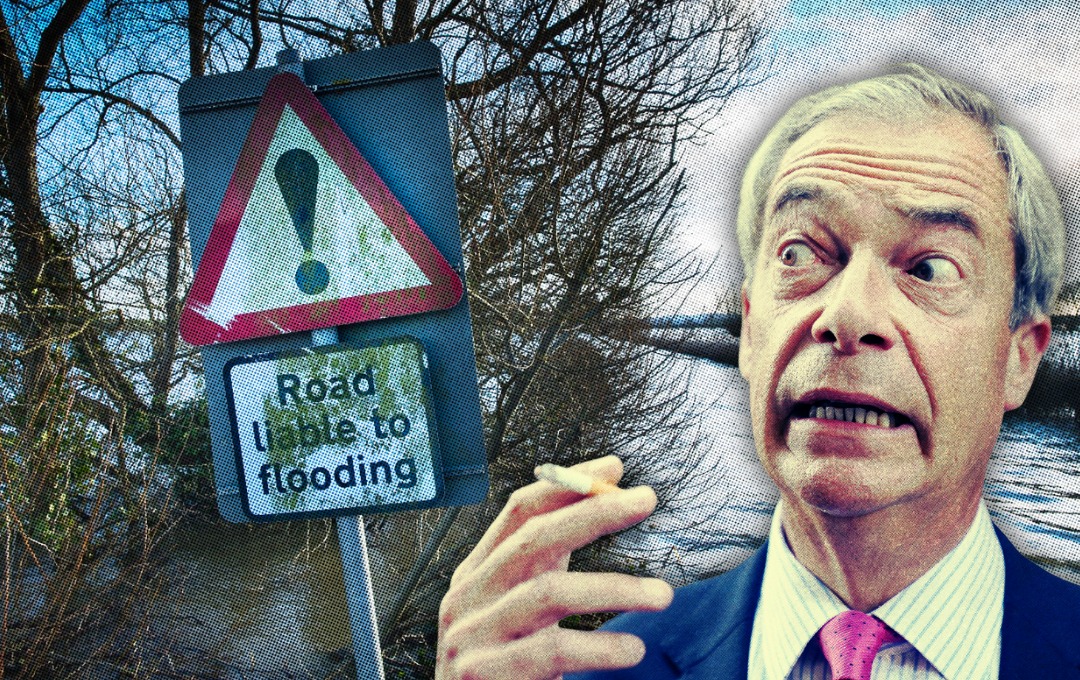

Read our Monthly Magazine
And support our mission to provide fearless stories about and outside the media system
Seven out of ten Reform UK controlled councils have scrapped their climate targets since being elected last May, while the party continues to push discredited ideas about the cause of man made climate change, according to new academic analysis.
Reform-run councils have removed content about climate change from strategy documents, and three have successfully moved to rescind Climate Emergency Declarations, the Grantham Research Institute on Climate Change and the Environment at the London School of Economics has found.
Climate change denial has also been expressed by Reform UK councillors in at least five councils (Kent, Durham, Nottinghamshire, Lincolnshire and Lancashire), the new briefing notes.
In September 2025, Kent County Council pointed to a supposedly “unproven view of anthropogenic (human-induced) climate change” in a motion to rescind the county’s Climate Emergency Declaration, citing several widely discredited sources.
Rescinding the KCC Climate Emergency Declaration last year, Reform councillor Chris Hespe claimed: “I’ve been involved in award-winning sustainability projects for 25 years, and I’ve never seen such nonsense as the anthropogenic global warming hoax.”
Their report comes after a recent Byline Times investigation showed that more than 700,000 homes across the ten English councils now governed by Reform UK are projected to face medium or higher flood risk by the middle of the century. It equates to roughly one in five households in the party’s local strongholds. Several Reform-run councils have faced protests from locals opposed to their climate stance.
ENJOYING THIS ARTICLE? HELP US TO PRODUCE MORE
Receive the monthly Byline Times newspaper and help to support fearless, independent journalism that breaks stories, shapes the agenda and holds power to account.
We’re not funded by a billionaire oligarch or an offshore hedge-fund. We rely on our readers to fund our journalism. If you like what we do, please subscribe.
Deputy Leader of Reform UK, Richard Tice, has referred to an “extreme cult of Net Zero” and much of the party’s local election literature in 2025 reflected this stance, promising to “scrap Net Zero to cut your energy bills” and “reduce waste and cut your taxes” in elecon leaflets. Every Reform council since, however, has raised council tax, many by close to the legal limit.
The authors conclude: “The promotion of climate change denial by both its national leadership and many of its local councillors indicates that Reform UK is failing to recognise the growing risks the British public face from climate change impacts, including rising sea levels, heavier rainfall and more intense heatwaves. It also demonstrates that the party does not accept the need for evidence-based policymaking.”
They state that “it is often unclear what Reform UK councils count as ‘net zero spend’ and how they account for savings supposedly achieved by removing climate-related targets.”
The authors say they were unable to obtain detailed estimates of projected savings associated with motions related to climate ambition rollback, and in some cases headline figures have been disputed. The LSE paper states: “Lessons from a year of Reform UK administrations, and the prospect that the party will win more seats in May 2026, indicate that national government should no longer assume voluntary ambition at the local level to progress national legislative and policy goals on climate change.”
Although Farage and Tice have made scrapping net zero a key part of the Reform UK national campaign strategy, the report points out that there is variation in how “scrapping net zero” is being implemented by Reform councils, “reflecting an apparent divergence of views within the party”.
Don’t miss a story
Kent has committed to keeping emissions reporting as a key performance indicator, while Lancashire County Council plans to stop voluntary reporting on the council’s carbon footprint.
Tice held a press conference in November 2025 to discuss over £300 million in savings apparently identified by councils run by Reform UK since that May. But he did not mention savings from net zero, despite the party’s emphasis on this alleged benefit.
Despite public support dipping in recent months, Reform UK has maintained its overall poll lead over the other parties. Reform are likely to take control of more councils in England in May 2026, with approximately 5,000 seats in 136 local councils up for election. It means this round is larger in scale than in 2025 and includes a greater proportion of unitary councils with responsibility for planning applications and housing.
The UK Government is likely to “face greater challenges in ensuring that local authorities contribute to the delivery of legislative and policy climate goals,” the authors say.
They recommend stronger “incentives to promote climate progress”, rather than assuming voluntary action by councils, and making standardised emissions reporting mandatory, to track progress of programmes that reduce emissions.
Eight Reform councils have replaced mention of climate change or decarbonisation in certain documents with language related to “the environment”, “sustainability” or “energy efficiency”. For example, Kent County Council has replaced its Net Zero Plan with an Energy Efficiency Plan and Staffordshire’s Climate Emergency Declaration has given way to a supposedly “broader more practical” Environmental Strategy.
The Elections Watchdog Doesn’t Know Where Reform UK’s Crypto Donations Are Coming From
The UK’s electoral watchdog tells Byline Times it wants tough new legal powers to prevent overseas donors from secretly bankrolling British political parties
Other examples of restructuring include Derbyshire’s removal of the Climate Change, Biodiversity and Carbon Reduction committee and North Northamptonshire’s dissolution of the Sustainable Communities Executive Advisory Panel (which included carbon reduction as a performance metric).
The report finds that Reform UK does not currently have a clear and explicit position on climate change overall – and statements denying the existence of anthropogenic climate change were removed from its voter ‘Contract’ in 2024 when Nigel Farage became leader. “However, there is evidence to indicate the party and its councils may be returning to the ‘denialist’ stance that rejects anthropogenic climate change.”
Cllr Sally Keeble, Labour group leader in Reform-run West Northants, told Byline Times: “Here they’ve scrapped the local net zero targets, which is just bizarre…They put out a news release recently boasting about how they were rolling out new EV buses, because they’ve got a grant from the government.
“They’re just all over the place on it. They want the cash…and they want to be seen as green and cuddly, but they don’t want to do the serious work on climate change.” It is a pattern alleged in several other Reform-dominated authorities.
Councils where Reform have revoked climate emergency declarations:
- Durham County Council
- Kent County Council
- Staffordshire County Council
Doncaster (which has a Labour mayor), Lancashire and West Northamptonshire retained theirs. Derbyshire, Lincolnshire, Nottinghamshire and North Northamptonshire didn’t have declarations to revoke.
Councils where Reform have removed net zero/carbon neutrality targets:
- Durham County Council
- Kent County Council
- Lancashire County Council
- Lincolnshire County Council
- Nottinghamshire County Council
- West Northamptonshire Council
- Staffordshire County Council
All the above but Staffordshire and Lincolnshire (which backed net zero by 2050 for the council) had ambitious targets to reach net zero for the council by 2030. Derbyshire and North Northamptonshire are listed as unclear. Doncaster, with its elected Labour mayor, retained its target (carbon neutral by 2040).
Reform UK Skip Mandatory By-Election Debate After Nigel Farage Called Defectors Who Avoid the Ballot Box ‘Disgraceful’
Nigel Farage previously said that defectors who refuse to hold by-elections are “disgraceful” and guilty of a “complete insult” to the electorate
Author Edward de Quay, Policy Analyst at the Grantham Research Institute on Climate Change and the Environment at the London School of Economics and Political Science, said: “Should Reform UK expand its council base [in May], we can expect further retreat from climate action. The Government must be alert to this challenge, given the importance of local authorities to the delivery of national climate goals.”
Pallavi Sethi, Policy Fellow at the Grantham Research Institute added: “It is concerning that some Reform UK councillors are using climate misinformation, including climate denial, in motions and debates to support policy decisions. This undermines evidence-based governance and is especially dangerous when household energy bills are set to rise due to the ongoing conflict in the Middle East.”
The key finding from the study is that councils led by Reform UK are “largely delivering on the party’s pledge to scrap net zero at the local level.”
“‘Scrapping net zero’ is not only a policy position but a signal of a broader retreat from taking climate change seriously.”

Reform Kent Council Suffers Walk Out After Party Declares ‘Immigration Emergency’ During Meningitis Outbreak
The motion by Nigel Farage’s party blamed the spread of “infectious diseases” on undocumented migrants
In their Sights
Voters – particularly those in increasingly flood-prone areas due to climate change – are advised to take note.
Reform is projected to take control of several county councils in May, in Essex, Norfolk, and Suffolk. East and West Sussex are also being watched closely as potential Reform targets.
Labour is also projected to lose heavily in northern metropolitan boroughs such as Tameside, Stockport, Bolton, and Oldham, all of which are currently Labour-controlled.
Last week, the progressive IPPR think tank found that progressive politicians risk making a serious electoral miscalculation if they “dilute climate ambition in response to populist right attacks.”
The research revealed that claims of a voter backlash against net zero are overstated, with political division among elites and distorted media narratives – not public opinion – posing the biggest risk to climate progress.
The British public remains consistently supportive of the UK’s 2050 net zero target – around 60 per cent of people support the goal, according to the IPPR and Persuasion UK.
Climate policy is not driving voter defections in any significant way: only 4 per cent of Labour-to-Reform switchers cite climate or net zero as a reason for changing their vote.
Reform UK was contacted for comment.
The City of Doncaster was mostly excluded from the LSE analysis as it has a Labour Mayor and cabinet, limiting the powers of the Reform UK majority on the council. It also perhaps explains why Reform has not managed to repeal climate policies on the council.
Got a story? Get in touch in confidence on josiah@bylinetimes.com
holding farage to account #reformUNCOVERED
While most the rest of the media seems to happy to give the handful of Reform MPs undue prominence, Byline Times is committed to tracking the activities of Nigel Farage’s party when actually in power

 Contribute to our #ReformUncovered crowdfunder
 Subscribers Get More from JOSIAH
 Subscribers Get More from JOSIAH
Josiah Mortimer also writes the On the Ground column, exclusive to the print edition of Byline Times.
So for more from him…
