
 Subscriptions
 Subscriptions
Read our Monthly Magazine
And support our mission to provide fearless stories about and outside the media system
Three political parties in the UK now accept donations in cryptocurrency, despite concerns about the potential for foreign interference from the unregulated currencies.
Reform UK made headlines when they became the first major party to begin accepting crypto donations in May 2025.
But it has now emerged that the far-right Homeland Party and a ‘direct democracy’ group called The Other Party are also accepting donations in the currency.
The far-right Advance party, the new outfit set up by former Reform UK deputy leader Ben Habib and seemingly endorsed by X owner Elon Musk, is also considering accepting donations in cryptocurrencies like Bitcoin and Ethereum.
On its website it states: “We are not currently accepting donations by cryptocurrency, but we will update our website in due course if we do…Any official cryptocurrency details we set up in the future will be posted here for validation.”
Don’t miss a story
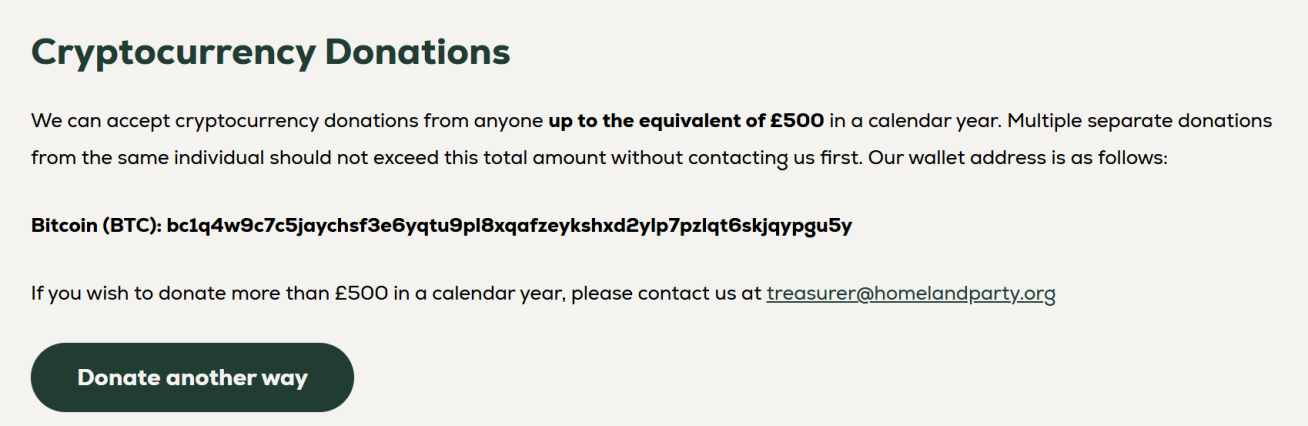
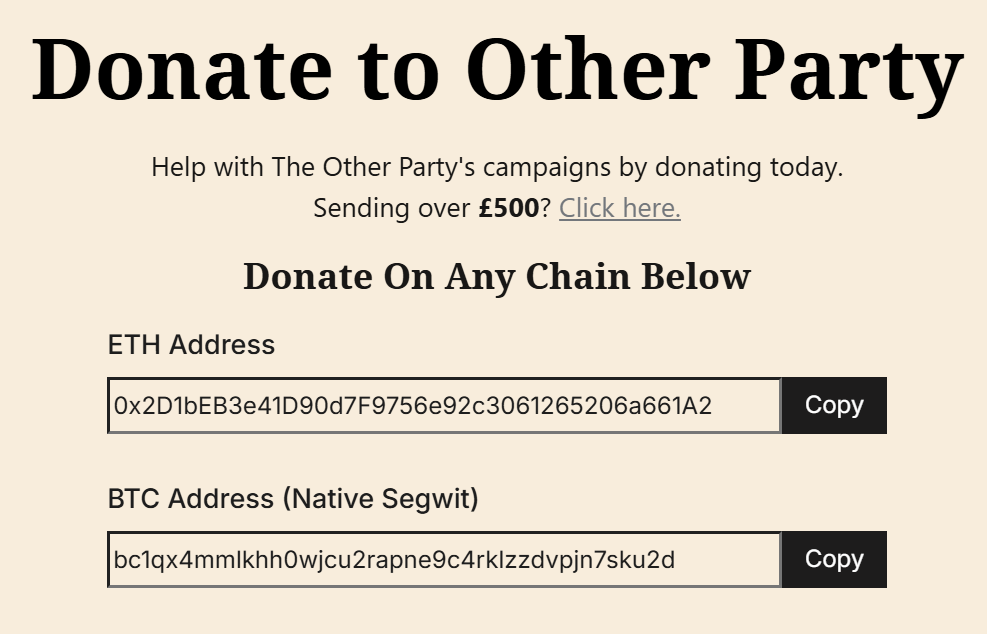
While Reform UK uses an external company, Polish firm Radom Pay, to process its crypto donations and check for donors’ permissibility, this does not appear to be the case for Homeland or The Other Party. Homeland only appears to permit crypto donations made under the value of £500, the legal threshold for checks having to be made on donors’ voting status. The Other Party asks donors to fill in a Google Form with their contact details if wishing to donate more than £500’s worth of crypto currency.
There are growing calls for Labour to ban crypto donations to parties outright as the Government’s Representation of the People Bill had its first parliamentary debate last Monday.
Anti-corruption and many Labour backbenchers groups fear that cryptocurrencies make it easier to hide the true source of donations, potentially further opening the door to foreign interference in UK politics.
The Other Party says it wants to “bind our representatives by law to the outcomes of the decisions reached by their constituents.” It has crypto wallets set up for donating to the party directly through various forms of the digital currency. There is a separate process for donations over £500.
The Homeland Party meanwhile says on its site: “We can accept cryptocurrency donations from anyone up to the equivalent of £500 in a calendar year.”

Reform UK’s Crypto Donations Put Under Spotlight as Experts Warn It’s ‘Impossible to Trace’ Foreign Cash
Anti-corruption campaigners raise the alarm over loopholes that could allow large sums of untraceable money to slip past checks
Money given under the value of £500 is not actually classed as a donation by the Electoral Commission and as such is effectively unregulated and unmonitored. It is understood that for crypto donations, this would be the current market value of the cryptocurrency. For example, £500 is currently worth around 0.00949 Bitcoins, however the value fluctuates constantly.
As the EC says on its website: “Under PPERA [the primary law governing political finance], a donation is money, goods or services given to a party without charge or on non-commercial terms, with a value of over £500…
“Donations of £500 or less are outside the scope of PPERA and you do not need to record or report them.
“However, you must be alert to situations where it appears that a donor is attempting to evade PPERA. It is an offence to attempt to evade the controls on donations. For example, if a number of donations of £400 are made from the same source in similar circumstances in an attempt to evade the permissibility rules.”
Spotlight on Corruption argues a major issue with crypto and micro donations is that it is feasible for a bad actor to donate £500 a significant number of times and go undetected by creating multiple crypto wallets. There is no suggestion that these parties have taken illicit donations.
While transactions using crypto are recorded on a public ‘legder’, in theory making them more transparent than cash, a briefing from the anti-corruption group adds: “Bad actors looking to undermine UK democracy, or to get around the rules, can conceal or obfuscate the true source of their crypto donations through the use of tools such as secrecy coins, mixer accounts, ‘smurfing’, ‘chain hopping’, and coin-swapping services.” The advent of artificial intelligence tools can plausibly automate this process to split large donations into many smaller ones.

Crypto Investor Donates £9 Million to Reform UK as Nigel Farage Plugs His Company and Tells Industry ‘I Am Your Champion’
The Reform leader recently used media interviews to back Christopher Harborne’s company while promising to cut taxes and regulations on crypto firms
Tim Picton, Senior Advocacy Advisor at Spotlight on Corruption, told Byline Times: “Crypto donations present a plethora of unique risks that could undermine our democracy. There are multiple ways that malign actors can funnel illicit money into UK politics through complex crypto transactions chains and obscure the true source of these funds.
“Only three political parties currently accept donations through crypto and none have yet been reported to the Electoral Commission. However, continuing to permit these donations, with a wild west regulatory framework in place, just stores up problems for the future.
“Spotlight on Corruption has long called for a ban on crypto political donations. We now hope to see broad, cross-party support for the amendment to the Representation of People Bill that has been tabled to this effect.”
A spokesperson for the Electoral Commission told Byline Times that the Commission “has highlighted areas of the existing legal framework that should be strengthened to prevent impermissible foreign funds entering the UK system”, and that cryptoasset donations “present particular challenges and risks in meeting electoral law requirements in identifying donors and ensuring they are permissible”.
ENJOYING THIS ARTICLE? HELP US TO PRODUCE MORE
Receive the monthly Byline Times newspaper and help to support fearless, independent journalism that breaks stories, shapes the agenda and holds power to account.
We’re not funded by a billionaire oligarch or an offshore hedge-fund. We rely on our readers to fund our journalism. If you like what we do, please subscribe.
Only two parties have publicly acknowledged receiving donations in crypto currency to date. The Homeland Party has received only minor donations, according to a briefing from Spotlight on Corruption, while Reform UK confirmed that it has received “a couple” of crypto donations, but without providing any details on their value or source.
As of February 2026, no crypto donations have been declared to the Electoral Commission, though as noted previously, only funds over £500 are classed as donations and only those over £11,180 from a single source within a calendar year are published.
The Government appears to be waiting for the outcome of the Rycroft review into foreign interference, due at the end of March, before adding amendments to clamp down on crypto donations in its flagship elections bill.
Reform UK and The Other Party were contacted for comment.
UPDATE: The Homeland Party’s elections officer told Byline Times it was the first party to accept crypto donations (not Reform UK as previously stated).
“The Homeland Party began accepting cryptocurrency donations on 26 July 2024, several months before Reform UK’s announcement in May 2025,” as evidenced on X.
Additional reporting by Nafeez Ahmed.
Got a story? Get in touch in confidence on josiah@bylinetimes.com
holding farage to account #reformUNCOVERED
While most the rest of the media seems to happy to give the handful of Reform MPs undue prominence, Byline Times is committed to tracking the activities of Nigel Farage’s party when actually in power






 Contribute to our #ReformUncovered crowdfunder
 Subscribers Get More from JOSIAH
Josiah Mortimer also writes the On the Ground column, exclusive to the print edition of Byline Times.
So for more from him…
