
 Subscriptions

Read our Monthly Magazine
And support our mission to provide fearless stories about and outside the media system
When US and Israeli forces attacked Iran on February 28th, conventional financial markets were largely closed for the weekend. But on Polymarket, an American cryptocurrency-based prediction market where users bet on future events, trading continued.
And in the hour before the first strikes, something unusual happened.
Between 05:00 and 06:00 UTC, large volumes of money flowed into bets predicting imminent US and Israeli attacks on Iran. The strikes began at 06:15 UTC, just 15 minutes after that trading window ended.
Polymarket is a cryptocurrency-based prediction market in which users buy and sell shares tied to the outcome of future events, ranging from elections and interest rates to sporting results and military action.
All markets are framed as binary questions, with “Yes” and “No” shares trading between $0 and $1.
That price is meant to reflect the market’s estimate of the probability of an outcome. So, a “Yes” share trading at $0.20, for example, means the better believes there is roughly a 20% chance of the event occurring. Traders deal with one another rather than betting against a bookmaker, and they can sell their positions before the event is decided. Once a market is resolved, winning shares pay out $1 while losing shares become worthless. Trading is conducted using the dollar-pegged cryptocurrency USDC.
It can make people small fortunes. Some traders who prematurely backed the likelihood of a US or Israeli attack on Iran went on to make tens of thousands of dollars. Across the markets examined by the London-based charity Action on Armed Violence (AOAV), positions taken around this period generated potential returns running into hundreds of thousands of dollars.
The trading itself does not prove that the betters possessed advanced knowledge of the military operation. But the timing, scale and concentration of bets among some newly created or lightly used accounts raise significant questions about what certain traders knew before the attacks began.
The US-Iran war has since claimed at least 268 civilian lives.
The attacks marked a major escalation in the US-Israel confrontation with Iran. American and Israeli forces struck targets across Iran, including Tehran, with Washington saying the operation was aimed at Iran’s nuclear, ballistic-missile and military capabilities. Iran retaliated with missile and drone attacks against Israel and US-linked targets across the region. It followed the 12-day Israel-Iran war of June 2025 and has since developed into a prolonged regional confrontation.
In total, the US-Iran bombing war reportedly claimed at least 268 civilian lives, according to the NGO monitoring body Airwars.
A Surge Before the Strikes
The pattern of betting on military action that was as-yet-unkown to the public can be seen across several Polymarket contracts linked to military action against Iran.
In the market ‘US Strikes Iran by 28 February, 2026?’, the number of ‘yes’ shares bought between 05:00 and 06:00 UTC, the hour before the bombing started, shot up by some 313% compared to the previous hour.
The movement in the bets on Israel bombing Iran was considerably larger.
In ‘Israel Strikes Iran by 28 February’, those purchases of ‘yes’ shares increased by almost 1,600% (from 2,626 shares to 44,411) in the hour slot preceding the attacks.
Fifteen minutes later, the bombs began to fall.
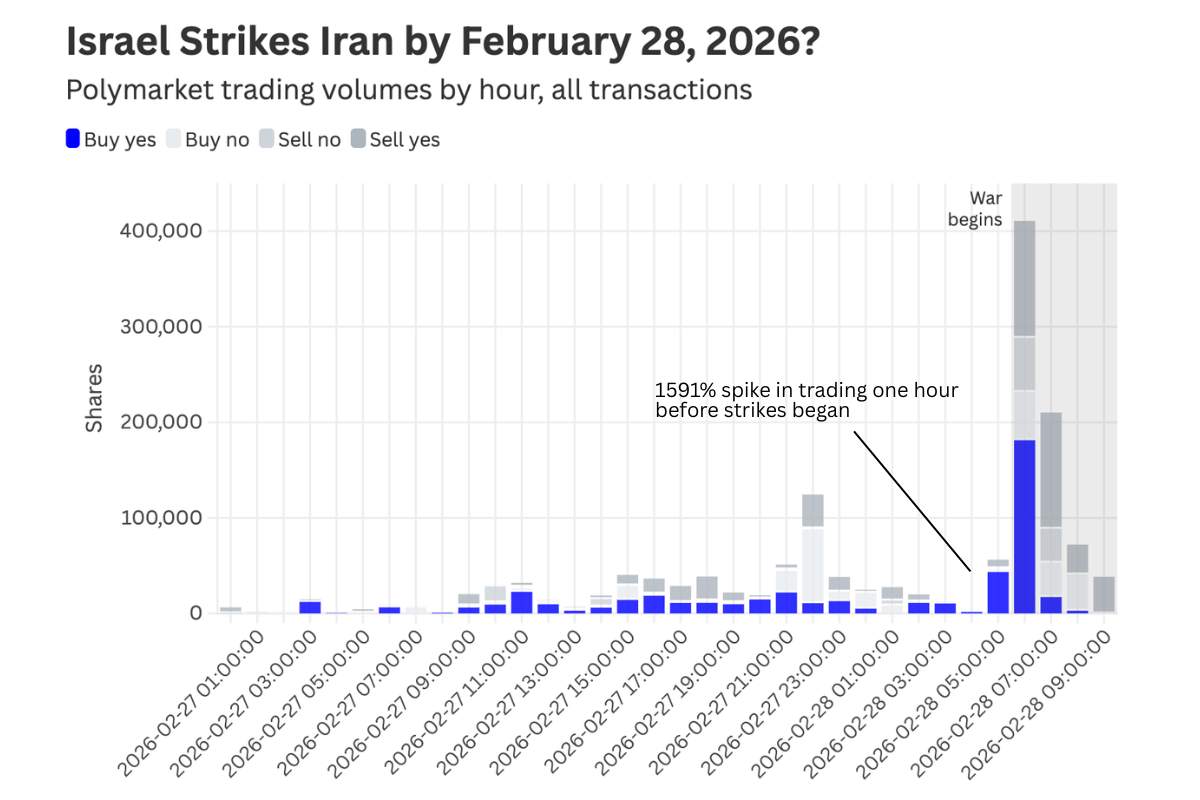
Across the two markets, the average price of ‘yes’ shares during the surge was between $0.19 and $0.21. Each winning share was subsequently redeemed for $1.
The shares bought during that pre-strike period would ultimately be worth about $799,420.
At prevailing prices, some positions taken during the surge stood to return as much as 500% of the bet if the bet was held until the markets resolved, which was when Polymarket deemed the US and Israel had launched an attack on Iran at UTC 9:30:47 and UTC 9:14:55 UTC respectively.
For individual traders, the profits were substantial.
One account, known by part of its blockchain address as ‘0x4564’, bought 109,512 ‘yes’ shares in ‘US Strikes Iran by February 28, 2026’ between 03:11 and 05:20 UTC. They earned some $90,771. It was no small risk – they would have lost $18,737 had an attack not happened.
At 19:22 UTC that evening, the trader cashed out the winnings. The Polymarket account was subsequently deleted, leaving only the placeholder username ‘Anon’.
The account’s previous betting history was limited. Their only earlier wager was a $952 bet that Kamala Harris would win the US presidential election. They lost that one.

Trump Went to War In Order to Break Iran and Left It More Powerful Than Before – US Defence Analyst
Brynn Tannehill explains how Trump’s war has resurrected an Iranian regime that sanctions and drought had been on course to topple
Two Accounts, One Prediction?
Betting by other accounts suggests a co-ordination.
Two Polymarket accounts, Aaamsaasa and SemiconductorIT, both bought large numbers of ‘yes’ shares between 05:18 and 05:30 UTC.
After making a combined $59,567, the accounts cashed out within minutes of one another, between 16:17 and 16:20 UTC later that day.
Their proceeds went to the same destination: a Solana wallet with the address 4dLZQynk9SZJf6PC. That wallet had been created at 14:37 UTC that same day.
Research by the Anti-Corruption Data Collective in Washington suggests that ‘long bets’ in geopolitical prediction markets, wagers on outcomes considered comparatively unlikely, have an unusually high success rate compared with equivalent bets on sport or celebrities.
Between 05:00 and 06:00 UTC on February 28th, the proportion of long bets was more than twice the average. In other words, traders were not simply betting more heavily on an attack. An unusually large proportion were backing outcomes that the wider market considered less likely.
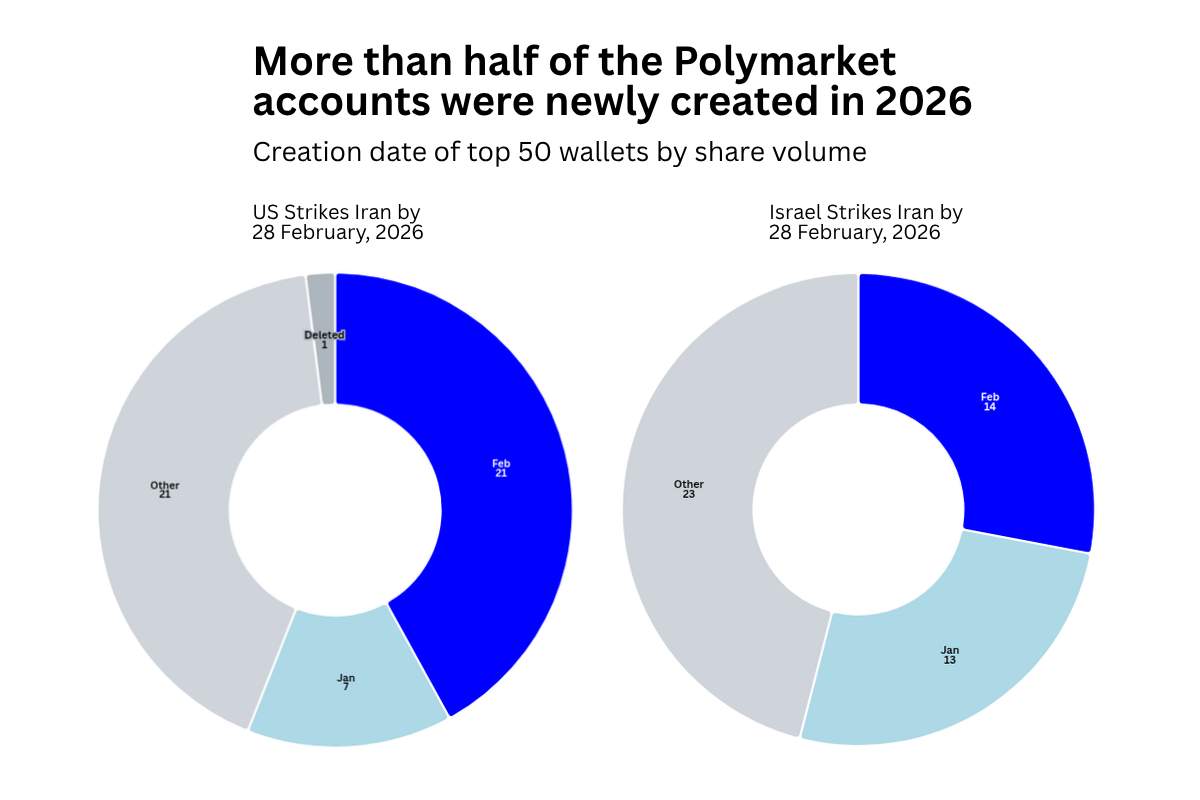
Some of the largest holders were also newcomers. According to data from Polymarket’s API, nearly 50% of the biggest holders of ‘yes’ shares in ‘US Strikes Iran by 28 February’ had joined the platform during February.
None of this proves insider trading. Prediction markets exist because participants disagree about the likelihood of future events, and traders can make large profits simply by analysing public information more accurately than everybody else.
But there is reason to scrutinise trading around secret military operations. Recent criminal cases suggest that people with access to sensitive information have already tried to turn that knowledge into prediction-market profits.
In February, Israeli authorities charged an IDF reservist and a civilian with serious security offences after alleging that classified information about forthcoming military operations had been used to place bets on Polymarket.
In May, an Israeli Air Force officer was charged over allegations that he used sensitive information to bet on military operations. During proceedings, the officer claimed that ‘the entire Israel Air Force is involved in gambling’. Prosecutors accused him of being willing to provide information for financial gain.
In August, another Israeli Air Force officer was arrested on suspicion of breach of trust after allegedly placing Polymarket bets on attacks in Iran and Yemen.
The problem is not confined to Israel.
In April, US prosecutors charged Special Forces soldier Gannon Ken Van Dyke with allegedly using classified information about an operation to capture Venezuelan president Nicolás Maduro to place prediction-market bets. Prosecutors allege that he made roughly $400,000 from wagers placed before the operation became public. Van Dyke has pleaded not guilty.
ENJOYING THIS ARTICLE? HELP US TO PRODUCE MORE
Receive the monthly Byline Times newspaper and help to support fearless, independent journalism that breaks stories, shapes the agenda and holds power to account.
We’re not funded by a billionaire oligarch or an offshore hedge-fund. We rely on our readers to fund our journalism. If you like what we do, please subscribe.
A Bet or a Financial Instrument?
In the US, prediction markets can be regulated as financial derivatives. Polymarket has previously faced enforcement by the Commodity Futures Trading Commission. That debate is moving to Europe. The Financial Times reports that Polymarket is lobbying regulators to treat its contracts as financial products rather than gambling. Gambling regulators in Britain, France, Germany and Italy disagree.
There is growing concern. Around 52% of prediction-market trading volume comes from sport, yet ESMA has warned that prediction markets are ‘rife with insider trading’.
Professor John Cheney-Lippold, who researches sports betting and digital futurity at the University of Michigan, is sceptical that markets covering such a vast range of events can effectively be regulated at scale.
‘The regulations that enable you to go after it are impossible. If you financialize everything, then you have to regulate everything, and it’s really hard to regulate everything,’ he said.
Prediction markets are often promoted as machines for aggregating information. By forcing people to put money behind their forecasts, the argument goes, they can reveal what a crowd collectively knows more effectively than opinion polls or pundits. But that premise becomes more troubling when the event being predicted is a war.
If a market suddenly becomes much more confident that an attack is imminent, it may be because traders have interpreted public evidence better than everyone else. It may be a coincidence. Or it may be because somebody knows something the public does not.
Polymarket was contacted for comment but had received no response at the time of publication.