
 Subscriptions

Read our Monthly Magazine
And support our mission to provide fearless stories about and outside the media system
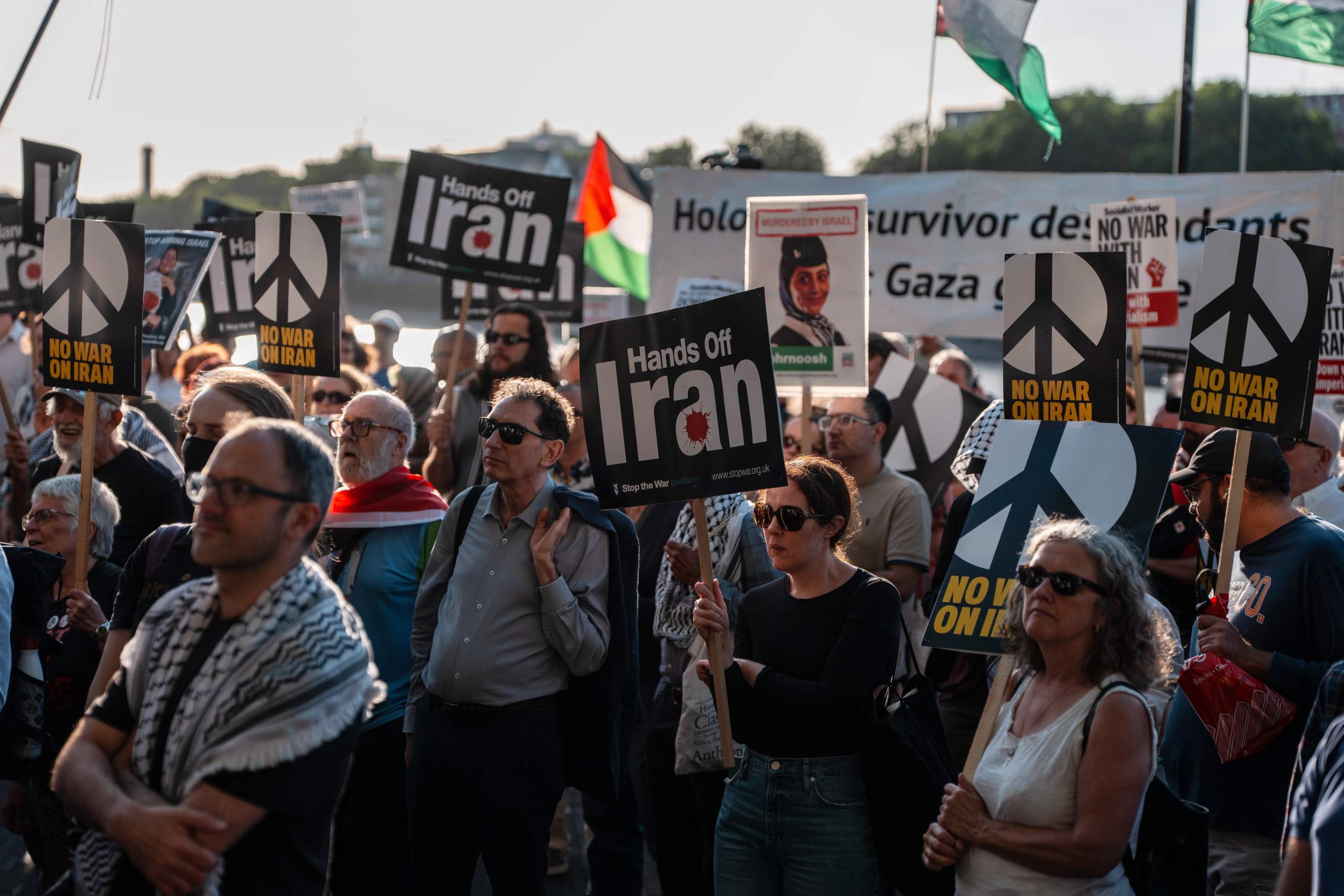
The Green Party of England and Wales is at loggerheads over how to respond to the war in Iran, with a well-organised campaign calling for an end to economic sanctions on the regime and opposition to the designation of Iran’s Islamic Revolutionary Guard Corps as a foreign state-backed threat.
Two competing motions on Iran are being debated ahead of the party’s autumn conference.
One, A93, has 106 named backers on the Green Party members’ portal and is supported by Greens for Palestine.
It calls on the British Government to “pursue diplomatic normalisation with Iran”, to “campaign for the lifting of broad-based economic sanctions” and to “oppose the proscription or designation of Iranian state institutions, including the Islamic Revolutionary Guard Corps (IRGC)” on the grounds that “such measures are counterproductive, undermine diplomacy, close channels for engagement, and reduce opportunities for mediation and peacebuilding”.
Since the Green Party’s conference is sovereign and binding, passing it would bring party policy into conflict with the position of most of its MPs. Four Green MPs recently backed a Liberal Democrat amendment calling for the IRGC to be banned more quickly than under the Government’s own plans.
ENJOYING THIS ARTICLE? HELP US TO PRODUCE MORE
Receive the monthly Byline Times newspaper and help to support fearless, independent journalism that breaks stories, shapes the agenda and holds power to account.
We’re not funded by a billionaire oligarch or an offshore hedge-fund. We rely on our readers to fund our journalism. If you like what we do, please subscribe.
The amendment, which fell, would have required the Home Secretary to bring forward regulations designating the IRGC as a state threat within one month of the Act passing, but it was defeated. Siân Berry (Brighton Pavilion), Carla Denyer (Bristol Central, by proxy), Adrian Ramsay (Waveney Valley) and Hannah Spencer (Gorton and Denton) backed the push. Ellie Chowns (North Herefordshire) has no vote recorded.
The anti-proscription motion was tightened on 7 July to oppose the designation mechanism specifically. Six days later, on 13 July, the Government designated the IRGC as a state threat and banned support for the group. The motion contains no reference to IRGC activity in the UK. Several British-Iranians appear to back the motion, with one writing on the members’ forum that relatives cannot obtain important medicines under Western sanctions.
The Government accuses IRGC proxies of targeting dissident journalists on British soil and supporting attacks on Jewish communities, including the arson attack on Jewish community ambulances in Golders Green on 23 March.
Against that motion sits A99, “Justice, Not War, For Iran”, written by British-Iranian members. It opposes US and Israeli military action while calling for Magnitsky-style sanctions on named individuals and to “financially proscribe” the IRGC.
Incorporating concerns from some members about free speech, it also backs repealing “s11-13 of the Terrorism Act and the National Security Act” to “protect freedom of speech and Association in the UK”, in a nod to members in prison or facing court for allegedly supporting the banned group Palestine Action. It has, at the time of writing, 55 supporters against A93’s 106.
Backers of A99 cite a figure from the Human Rights Activists News Agency (HRANA) of more than 53,000 arrests made by the Iranian state in January alone, including hundreds of children. On 21 January 2026, Iran’s own Supreme Council of National Security issued a statement saying 3,117 people were killed during protests against the regime.
Don’t miss a story
‘Proscription as a Political Weapon’
A93’s proposer, Dr Ashok Kumar, did not answer specific questions from this outlet, including whether he believes the IRGC has directed or supported attacks on UK soil. But he said in a statement: “Britain has no business lecturing anyone about violence in the Middle East while our Government continues to enable it. The war on Iran is illegal.”
He continued: “My motion is based on a simple principle: proscription is being used as a political weapon to restrict free speech, criminalise solidarity and shut down opposition to Western foreign policy.”
He added: “We do not need to romanticise any anti-imperialist state or movement to oppose imperialism. Western governments do not get a free pass to wage illegal wars because their opponents are imperfect.”
Dr Kumar said it was “ridiculous” to “talk about what ‘Iranians’ supposedly want as though Iran were politically homogeneous. There are Iranian members of the Green Party who support this motion, just as there are Iranians who oppose it.”
The free-speech framing appears to be a shift from what Dr Kumar told the Substack publication HR News in June, when he said: “The only reason [the IRGC are] being proscribed is because they are the only counterweight to Israel.”
Of the backers of the anti-proscription motion, Paul Ingram was the most forthright in his criticism of the Iranian Government. A nuclear disarmament specialist, a member of the party’s governing council and a former presenter on Iranian state television, he told this outlet: “I oppose the designation of the IRGC. That should not be confused with approval of the IRGC or denial of its record…
“I am appalled by serious human-rights abuses associated with organs of the Iranian state, including repression of protesters, women, dissidents and journalists. Where individuals are responsible for crimes, including crimes committed or commissioned in the UK, they should be investigated and held accountable.”
Ingram, who is currently a research affiliate at the Centre for the Study of Existential Risk at the University of Cambridge, also condemned the Golders Green arson attack and noted that four men have pleaded guilty.
On whether the IRGC directed it, he said: “An intelligence assessment, a criminal allegation in an indictment, and a judicially established command chain for a particular attack are not the same thing. I do not have independent evidence that enables me responsibly to state who ordered the Golders Green attack, and I do not think it is helpful to pretend to a certainty I do not possess.”
UK Sent Top Security Chief to Trump’s Left-Wing Crackdown Summit
The US is turning domestic and global counter-terror systems against political opponents – how is Britain responding?
Ingram appears sceptical of claims of IRGC-backed attacks on UK soil, suggesting there is no strategic benefit to Iran from antisemitic attacks and asking whether the IRGC would not more likely conduct “targeted assassinations”. He invoked misleading intelligence ahead of the Iraq war as a warning against intelligence claims being taken as certainties.
The nuclear disarmament expert was clear that if conference adopts the motion, “it would establish party policy that differs from the position taken by four Green MPs in their June vote”.
“That is a real disagreement.” But he added: “We do not wh