
 Subscriptions
Read our Monthly Magazine
And support our mission to provide fearless stories about and outside the media system
Restore Britain’s pitch to would-be members is clear. If you believe in “free speech, and direct democracy — you’re in the right place.”
Unfortunately, that does not seem to apply to the running of the party itself.
Former Reform UK MP Rupert Lowe’s party is now consistently hovering around 3% in the polls. That is substantial for a party that was only formally registered this March. In the Greater Manchester mayoral race it was biting at the heels of the Greens, securing nearly 9% of the vote.
The far-right upstart — which pushes for mass deportations, the return of the death penalty, burqa bans, and to “restore Christian values” — can no longer be dismissed as a mere social media trend. Even if X owner Elon Musk has played a major role in amplifying it.
But few have looked under the bonnet. How does Restore actually operate? Who is in control?
Byline Times has got hold of Restore Britain’s constitution and other founding documents filed with the Electoral Commission, until recently unpublished and unseen. Set alongside legal filings at Companies House, they show what kind of operation this is.
ENJOYING THIS ARTICLE? HELP US TO PRODUCE MORE
Receive the monthly Byline Times newspaper and help to support fearless, independent journalism that breaks stories, shapes the agenda and holds power to account.
We’re not funded by a billionaire oligarch or an offshore hedge-fund. We rely on our readers to fund our journalism. If you like what we do, please subscribe.
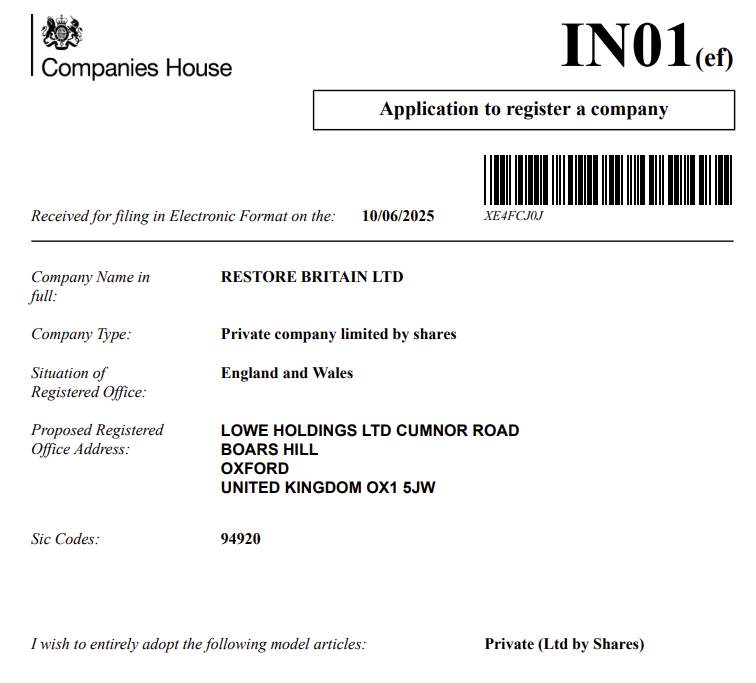
Let’s start with the company itself. Restore Britain Ltd’s certificate of incorporation, dated 12 June 2025, records it as a private company limited by shares. That is an unusual arrangement for a party, and the kind of set-up Reform UK had before it was “democratised” in 2025, as Nigel Farage would have it.
It is also the kind of arrangement Lowe himself appeared to criticise in Reform, branding it a party “led by the Messiah”.
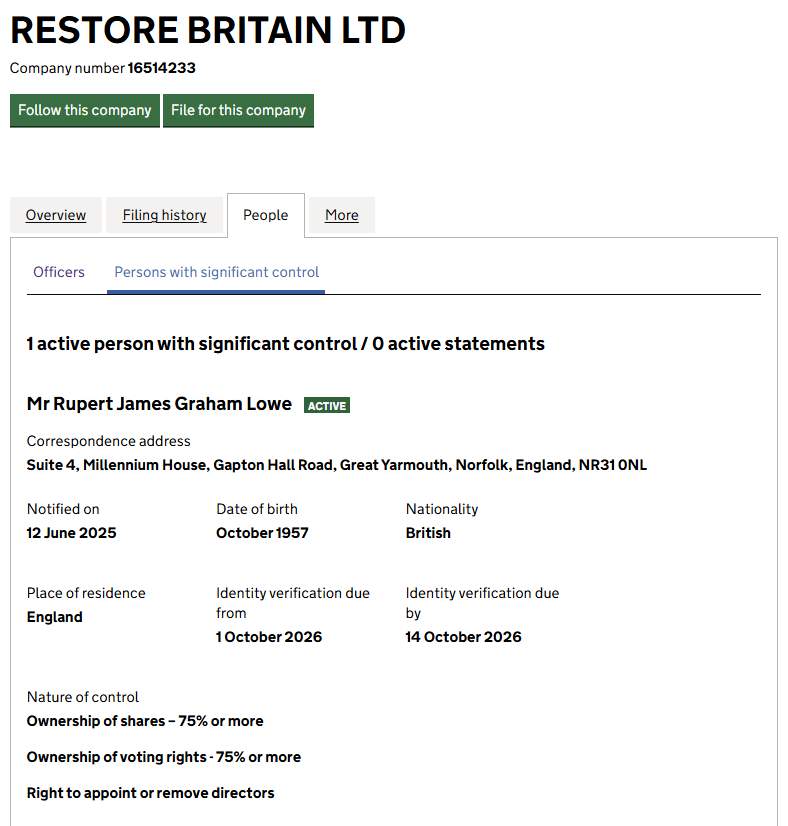
The company has issued one ordinary share (‘£1 nominal’), carrying “full rights regarding voting, payment of dividends and distributions”. It is held by the leader, founder and sole MP: Rupert Lowe.
Lowe was registered as a Person with Significant Control from the start, on all three grounds available: he controls 75% or more of the shares, 75% or more of the voting rights, and the right to appoint or remove a majority of directors. That position remains live and unchanged today.
The Companies House filings show Restore Britain Ltd is a company that Lowe owns outright.
Which Rulebook Rules?
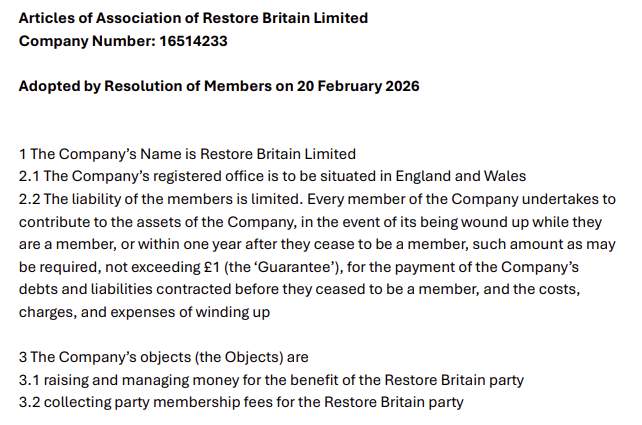
Which makes what happened next hard to explain. The Articles of Association — the rulebook governing how a company is run — are headed “Private Company Limited by Guarantee”, as are the versions handed to the Electoral Commission. A special resolution signed on 28 March (and filed with CH on 16 May 2026), adopts them on that basis.
A company cannot be both. There is no share capital in a guarantee company, and section 5 of the Companies Act 2006 bars a company limited by shares from converting into one limited by guarantee. So which is Restore? We asked. The party did not answer.
The resolution is signed by one person: “Member Name: Liam Mark Porter”. But the register shows only Rupert Lowe as the sole member — the legal term for the owner of the shares.
He holds the single share, with no transfer or fresh allotment recorded since. Porter is a director, but not a corporate ‘member’. On the face of it, the resolution adopting the current Articles was signed by someone who does not appear entitled to pass it.
Don’t miss a story
There are also two versions of the Articles in circulation. The set given to the Electoral Commission is headed “Adopted by Resolution of Members on 20 February 2026” — a date on which the company’s only director was neither Lowe nor Porter.
The set at Companies House is dated 28 March, and is more detailed: it adds a clause barring the company from distributing income to its members, and an express prohibition on accepting impermissible donations under the Political Parties, Elections and Referendums Act.
Now, the law on foreign donations applies either way. But two regulators hold different founding documents, each purporting to be the real one.
When Restore was first registered, its office was Lowe Holdings Ltd in Oxford. It has since moved to a Great Yarmouth address in Lowe’s constituency.
But the fundamentals remain the same. Lowe’s control of the company has been continuous since June 2025.
Where Power Lies
It is the constitution, though, where the full picture starts to emerge — because it sets out what members can and cannot do, and what the leader can.
Clause 5.7 makes everyone who sits on the National Board a director of the company Lowe owns. The party’s governing body and the company’s board are, by design, the same people.
From there, Lowe’s power only intensifies. The Leader appoints the National Board (5.8). The Leader chairs it (5.2). The Board is the governing body responsible for the party’s affairs (5.3). Amendments to the constitution require only Board approval (11.1). And Lowe personally holds the role of Nominating Officer, the legally-defined role which signs off candidate nominations and authorises use of the party’s name on ballot papers.
One thing that makes Restore less democratic than Reform is that there is no mechanism for removing the Leader at all. Not by the members, not by the Board, not by anyone.
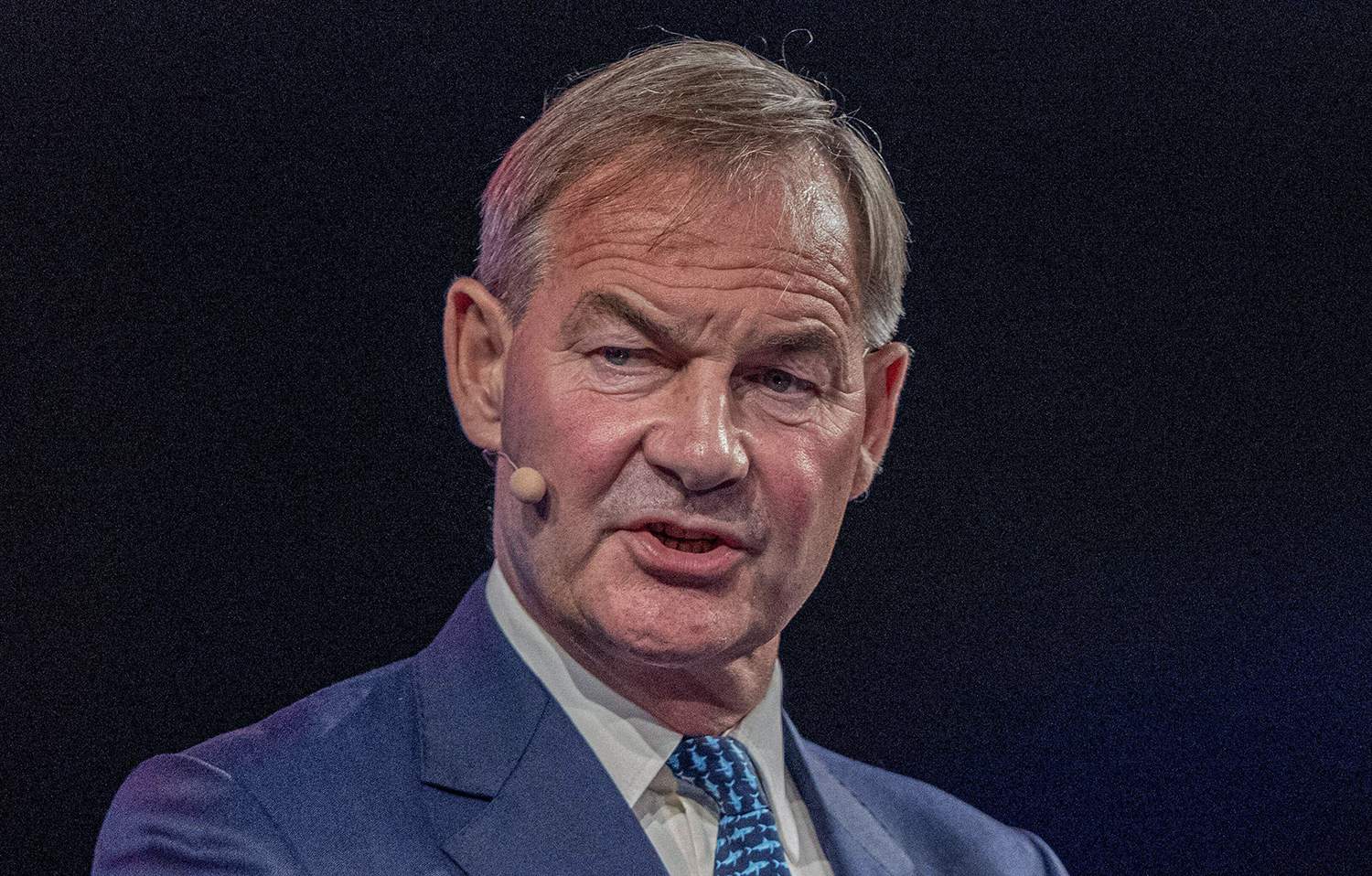
Who Is Really Bankrolling Rupert Lowe’s Restore Britain
Byline Times investigates the figures behind the Elon Musk-backed far-right rival to Nigel Farage’s Reform UK
The Articles do let the company remove a director by ordinary resolution — but Lowe holds the votes. Board members serve three years to the Leader’s five (4.1), so he outlasts every colleague he appoints, and reappoints or replaces them mid-term.
And members have no route to amend the document that governs them, beyond lobbying a Board that Lowe controls.
The Board has considerable power over them, however. It can revoke membership “following a process determined by the National Board from time to time” (7.2). There’s a separate internal dispute procedure which is fairly conventional (an impartial investigator, a written report within 28 days, an oral hearing and so on). But the Appeals Panel is appointed by the National Board, there is no external or member-elected element anywhere in it. Expulsion is “subject to confirmation by the National Board”.
Members have one theoretical power: the Leader is elected by them. But the options are limited, to say the least.
Candidates must be members “elected to the House of Commons and subject to the Party’s whip” (4.2) — that is, sitting Restore Britain MPs. There is, of course, just one.
Any leadership election is therefore uncontested by design. In practice, Lowe is actually incentivised not to get more Restore MPs elected, because they would be his only competitors for the leadership. Though he could simply strip them of the whip should they decide to mount a challenge.
The ‘financial scheme’ submitted to the Electoral Commission at the same time as the constitution is a bit looser, saying the Leader is elected by the members for a five-year term, with no restriction on who can run.
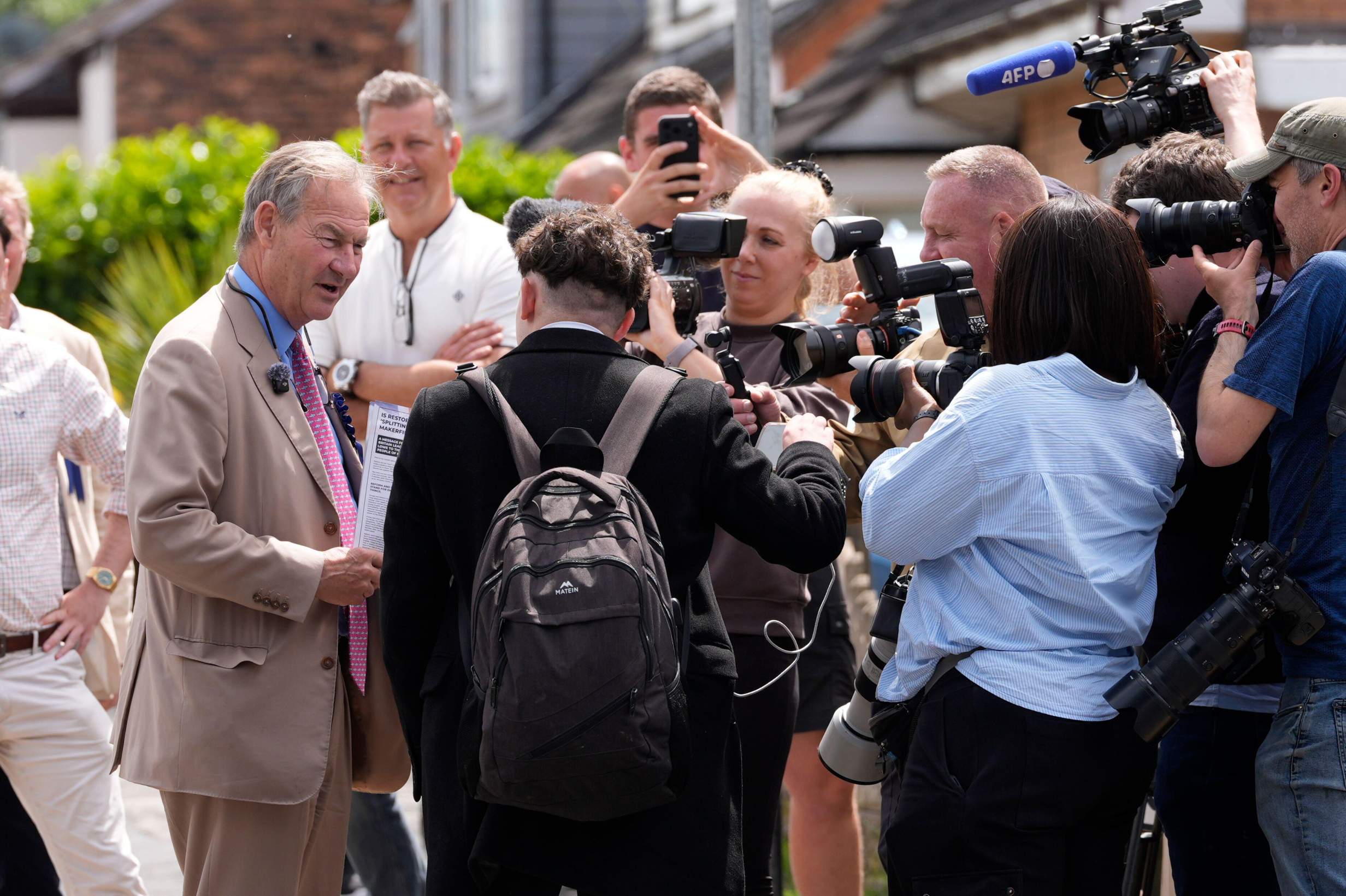
Inside Rupert Lowe’s Restore Britain With Neo-Nazis, Reform Defectors and Associated Rogues
From white supremacist donors to Hitler sympathisers, Restore Britain’s council-level operations reveal a party struggling to conceal its extremes
Toothless AGMs and Branches
The constitution requires an Annual General Meeting each year, with an incredibly high quorum of 25% of eligible voting members (6.3). Under clause 7.3, only UK residents qualify. But the AGM’s existence is largely academic, anyway.
The constitution gives the AGM no functions whatsoever. It receives no accounts, passes no motions, holds no elections and takes no confidence votes.
Nor is there any power at a local level. Candidates for every election are appointed by the National Board, following a process the Board itself determines (3.2).
Branches are explicitly provisional: “pilot branches” run by volunteer coordinators whose responsibilities the Board defines (8.3). All assets are held centrally (8.4). Promotion to formal branch status is contingent on Board approval (8.5).
So no independent local power base can form and no branch can accumulate money. It’s an unorthodox way to go about electing councillors.
The drafting is sloppy too. Clause 6.4 gives a casting vote to “the Chairman”, an office the constitution never creates. The dispute procedure sends complaints to a “Chief Operating Officer”, a post that does not exist either (the constitution lists a ‘Chief Executive Officer’). Two parts are numbered “Part IX”, and two clauses are numbered 12.1.
So what does membership of Restore Britain buy? The right to give money. A leadership ‘choice’ of just one eligible candidate. The chance to stand for office if a leader-appointed Board approves, with few – or no – real branches to preside over. Members are accountable to HQ, or perhaps more accurately, to one man.
Companies House does not comment on individual cases. But the position in law is that a company’s status is fixed by its incorporation and registration, as recorded on its certificate — which for Restore Britain Ltd, says is limited by shares. Filing a special resolution and articles describing a guarantee company does not by itself change that.
So Restore Britain remains a company limited by shares, shares which are owned and controlled by Rupert Lowe.
Is this what ‘direct democracy’ looks like?
Restore Britain and Rupert Lowe MP were approached for comment and did not respond. The Electoral Commission was also approached for comment.
Got a story? Get in touch in confidence on josiah@bylinetimes.com
holding farage to account #reformUNCOVERED
While most the rest of the media seems to happy to give the handful of Reform MPs undue prominence, Byline Times is committed to tracking the activities of Nigel Farage’s party when actually in power




 Contribute to our #ReformUncovered crowdfunder
 Subscribers Get More from JOSIAH
 Subscribers Get More from JOSIAH
Josiah Mortimer also writes the On the Ground column, exclusive to the print edition of Byline Times.
So for more from him…
