

Read Our Monthly Magazine
And support our mission to provide fearless stories about and outside the media system
A construction firm donated £100,000 to Reform UK just nine months before going into liquidation – with the collapsed company now owing more than £400,000 to HMRC.
The insolvency process could see Nigel Farage’s party, or the firm’s directors, asked to hand back the cash to pay creditors who have lost out.
In June, Byline Times revealed that at least seven firms have collectively donated £485,000 to Reform UK while on the brink of being dissolved, struck off, or otherwise in apparent distress.
Now this outlet can reveal that one of those firms has now fallen into insolvency.
FK Building Ltd gave Reform UK £100,000 on 8 October 2025. Ten weeks earlier, on 31 July 2025, its directors had signed off accounts showing its liabilities exceeding its assets, suggesting it was technically insolvent.
The accounts, for the year to 30 September 2024, showed net liabilities of £290,543. The donation was equivalent to more than a third of that shortfall.
Companies House had begun proceedings to strike the firm off the register in August 2025, and called them off on 7 October once the accounts arrived. Just a day later, £100,000 from the firm’s coffers went to Reform.
ENJOYING THIS ARTICLE? HELP US TO PRODUCE MORE
Receive the monthly Byline Times newspaper and help to support fearless, independent journalism that breaks stories, shapes the agenda and holds power to account.
We’re not funded by a billionaire oligarch or an offshore hedge-fund. We rely on our readers to fund our journalism. If you like what we do, please subscribe.
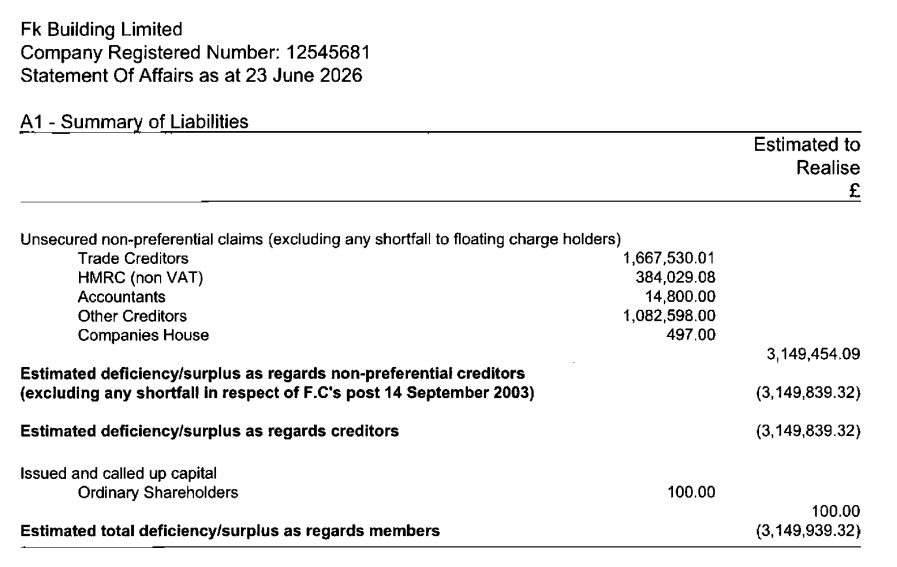
FK Building’s shareholders voted to wind the company up on 6 July this year, and liquidators were appointed. In a statement signed this June, the directors said the company had just £25,233 in the bank against liabilities of £3,175,072.
In September 2024, FK Building owed £290,543 more than it owned. By June this year, its directors put that gap at more than £3.1 million – a rise of £2,859,396 in 21 months, with the donation falling in between.
Much of that increase reflects the directors putting no value on £2 million owed to the company. The company’s accounts for the year to October 2025, due by the end of June this year, have not been filed.
Who Loses Out
Most of the company’s debts – 87%, or £2.75 million – are owed to other FK group companies. HMRC is by far the largest creditor outside the group, owed about 96% of what is due to outsiders.
The taxman is owed £409,647 in total. Of that, £25,618 relates to taxes a company collects on others’ behalf, such as VAT, PAYE, employee National Insurance and construction industry scheme deductions, which rank ahead of ordinary creditors.
On the directors’ figures the company’s cash would almost cover this, though the liquidators’ costs are paid first.
The vast majority – the remaining £384,029 – is so-called unsecured tax debt, which could include corporation tax or employer National Insurance. HMRC is unlikely to get most of this back and the taxpayer is set to lose out.
Other creditors set to miss out include Companies House itself, owed £497, potentially for filing charges or fines.
Don’t miss a story
Mike Lewis, director of TaxWatch, an investigative thinktank, told Byline Times: “Too often we see companies paying out profits and entirely discretionary expenses before folding with major tax debts. It’s the public purse – all of us – that lose out. Companies and individuals currently owe nearly £43 billion of unpaid tax to HMRC, double the level six years ago. Except for payroll taxes and VAT, most tax debt still comes fairly far down the insolvency ladder.
“In this case, from the very limited information that UK small businesses have to put into the public domain, we can’t see what this company’s finances looked like when the political donation was made. Its creditors and the public deserve to know whether it was solvent, and what its debts were, when it made this political donation.”
FK Building is owned in equal shares by Francis Anthony Keenan and his father, Francis Keenan. Both are also directors, alongside two others.
It is the latest company in the FK group to collapse. FK Group, FK Construction and FK Facades went into administration in February this year. Trade press have attributed the group’s collapse to a long-running dispute with ISG, the contractor whose own collapse rocked the industry, as well as delays in securing approvals under the Building Safety Act and rejected insurance claims.
Payback Time
The liquidators could seek to claw back the donation from Reform under the Insolvency Act 1986.
Insolvency experts this outlet has spoken to note that a gift made within two years before a company goes into liquidation can be challenged as a “transaction at an undervalue”.
If the company was unable to pay its debts at the time, or became unable to as a result, the court can order the position to be restored – which could mean Reform repaying the money. The liquidators would have to prove FK Building was insolvent when it gave.
Insolvency lawyer Jamie Leader told Byline Times: “On its face, the donation to Reform on 8 October 2025 is vulnerable to challenge as a transaction at an undervalue under s.238 Insolvency Act 1986. A political donation is a gift and thus plainly a transaction at an undervalue, and the gift was made only nine months before the start of the liquidation; well within the two year ‘look back’ period.

The Troubled Firms That Gave Reform UK Tens of Thousands of Pounds Whilst on the Brink of Collapse
Anti-corruption campaigners question why firms are choosing to donate tens of thousands of pounds they apparently don’t have to Nigel Farage’s party
“A transaction at an undervalue may be defensible where the directors of the company made the donation in good faith for the purpose of carrying on its business, and where (on an objective view) there were reasonable grounds for believing that the donation would benefit the company…It seems highly unlikely that that defence could be made out on these facts.”
He added: “In fact, it is hard to think of any circumstances where it would be reasonable for the directors of an insolvent company to consider in good faith that it would be in the interests of the company to use scarce cash resources to make a political donation.
“In those circumstances, the only realistic possible area for dispute appears to be whether FK Building Ltd was insolvent at the date of the donation. On the basis of the filed accounts and the statement of affairs, it would seem very hard for the directors and/or Reform to argue that it was not.”
Malcolm Niekirk, an insolvency solicitor and partner at Frettens LLP, agreed: “It seems very likely that the company was balance sheet insolvent at the time, based on its own accounts filed at Companies House before and after the transaction.”
“It looks to me as if the liquidators are likely to be thinking about making a claim for repayment from the recipient [Reform UK],” he said.
Niekirk added that it would be difficult for a party to argue its donors received something of value in return, which would change the calculation as to whether the money should be repaid. This scenario, he said, “would look a little too much like corruption.”

Criminal Checks for MPs, Donations Caps and Electoral Reform: Labour Rebels Push for Tougher Elections Bill
From banning crypto and oil company cash to radical reform of our voting system, Labour backbenchers are testing how far their own Government is willing to go to protect British democracy, reports Josiah Mortimer
The 2024 accounts, approved ten weeks before the gift, would be strong evidence of the state of the firm at the time of the gift, though the liquidators would need to establish the company’s position on the day of the donation itself.
The directors could also face claims from those, like HMRC, seeking to claw back what’s owed.
Political donations of more than £5,000 in a year need a shareholders’ resolution passed before the payment. Without one, the directors responsible must repay the company with interest and cover any loss, and the liquidators can enforce this. Such resolutions do not have to be filed at Companies House.
Niekirk said: “The liquidators are likely to be considering whether the directors got a valid approval from the company’s shareholders before donating. Without that – which may be held by the recipient – the directors might be obliged to reimburse the company the amount donated.”
He said there was also some evidence the company was in the “twilight zone” of insolvency, when directors must give weight to the interests of those the company owes money. “That would have changed the focus of the directors’ duties to make it highly unlikely that they were complying with their statutory duties in donating the money,” he said.
Setting out the case liquidators might put to the directors, he said: “How in the name of all that is holy would it have been in the interests of the creditors for you – the directors – to give away their money like that?”
The directors did not respond when asked whether such a resolution was passed.
Julian Pitts, managing partner in restructuring at BTG, the financial and real estate advisory group and one of FK Building’s joint liquidators, said: “Our investigations, as part of our statutory obligations as Joint Liquidator, are ongoing and we will report to creditors in due course. We cannot give more detail at this time.”
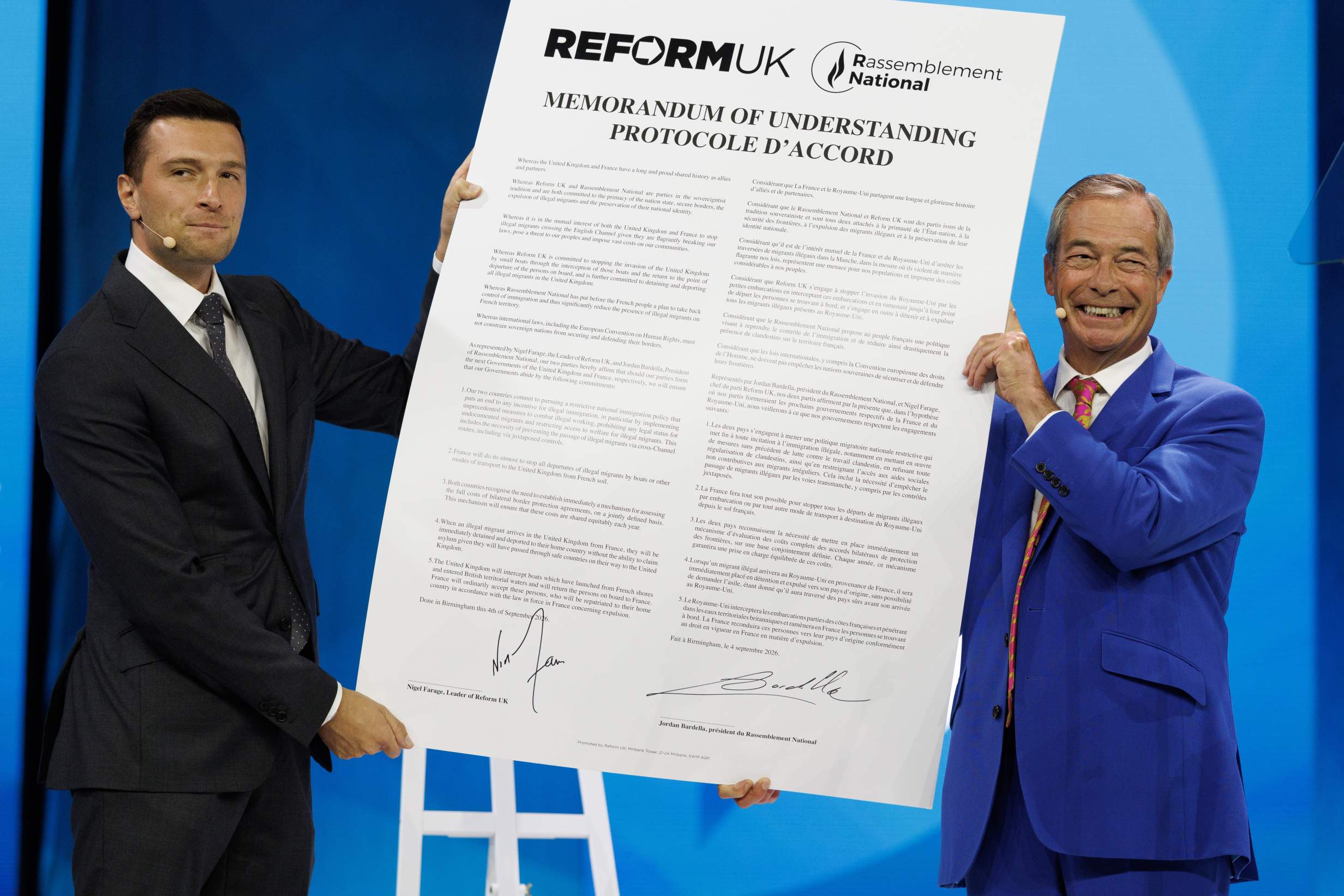
Reform UK Named ‘Authoritarian-Leaning’ Party in Index of Far-Right Cooperation Across Europe
Experts say Farage’s pact with Marine Le Pen’s National Rally is part of a pattern of far-right parties lending each other legitimacy before taking power
Rule Change
To donate to a party currently, a company must be registered in the UK and carrying on business here. Electoral law does not define “carrying on business”, so the Electoral Commission recommends that parties, where in doubt, get direct confirmation from the firm’s directors.
In July, the Commission told Byline Times that late-filing and even insolvent companies can still be permissible donors, but that parties should carry out extra checks. FK Building was under a strike-off notice for failing to file accounts until 7 October 2025, the day before the donation.
There is no suggestion the donation was impermissible under current electoral law.
The Government has since amended the Representation of the People Bill, which is going through the House of Lords this week, to introduce a profit test for company donations.
The test would limit company donations to post-tax profits made over the previous five years. It largely incorporates a recommendation of the Rycroft Review into foreign influence in UK politics.
Campaigners have, however, called for the government to go further. The bill, as it stands, would not appear to rule out FK Building’s £100,000 donation, despite it being balance-sheet insolvent on its latest accounts, and nine months from liquidation.
The test counts profitable financial years within the five calendar years before the year of the donation. For FK Building, the firm would be able to donate up to £199,061 under the new rules, roughly twice its actual donation.
Reform UK and FK Building’s directors did not respond to requests for comment.
Got a story? Get in touch in confidence on josiah@bylinetimes.com
holding farage to account #reformUNCOVERED
While most the rest of the media seems to happy to give the handful of Reform MPs undue prominence, Byline Times is committed to tracking the activities of Nigel Farage’s party when actually in power



 Contribute to our #ReformUncovered crowdfunder
 Subscribers Get More from JOSIAH
 Subscribers Get More from JOSIAH
Josiah Mortimer also writes the On the Ground column, exclusive to the print edition of Byline Times.
So for more from him…
