
 Subscriptions
Read our Monthly Magazine
And support our mission to provide fearless stories about and outside the media system
British television gave the Edinburgh terror attack on five Muslim men just 160 minutes of coverage. A comparable antisemitic attack in London two months earlier received 1,107 minutes, according to new data from the Centre for Media Monitoring (CfMM), an independent media monitoring project based in London.
The disparity emerges against a backdrop of rising tension this year. Riots broke out in Southampton, triggered by the sentencing of Henry Nowak’s killer, and in Belfast, following the stabbing of Stephen Ogilvie. Both cases drew inflammatory comment from senior political figures, including Reform UK leader Nigel Farage and US Vice-President JD Vance.
However the Edinburgh attack on 19 June, in which five men were injured, with three requiring hospital treatment, received much less of a political and media response.
The assailant, Lewis Hawkes, 36, has been charged with five counts of attempted murder linked to terrorism. Police have withheld the names of the victims.
In video footage showing Hawkes being arrested by police officers, he is recorded saying, “I’m protecting the country from these f*cking Muslim b*stards raping our young daughters.”
The Coverage Gap
The comparison covers the Edinburgh attacks and the antisemitic attack in Golders Green in April.
Both datasets compare broadcast minutes across UK television channels and cover a four-day monitoring window for each event – Golders Green (29 April – 2 May 2026) and Edinburgh (20–23 June 2026).
The Golders Green attack was formally declared a terrorist incident by the Metropolitan Police, the same categorisation attached to Hawkes’s charges in Edinburgh. Two men, Shloime Rand, 34, and Moshe Shine, 76, were hospitalised after being attacked on account of being Jewish.
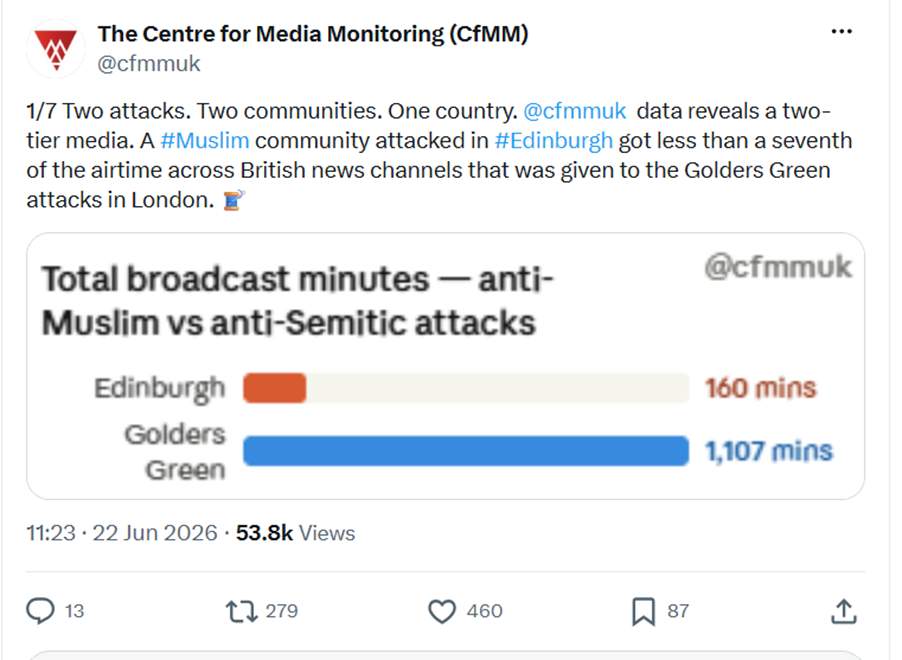
The director of CfMM, Rizwana Hamid, told Byline Times:
“The Centre for Media Monitoring’s analysis of British broadcast and online news coverage found a striking disparity in how two attacks targeting faith communities were reported.
“While the attack in Golders Green rightly received extensive and sustained media attention, the attacks on Muslims in Edinburgh generated significantly less coverage across both broadcast and online news outlets during the same initial reporting period.
“When audiences repeatedly see violence against one community treated as front-page news while similar attacks against another receive comparatively limited attention, it inevitably raises questions about whose experiences are considered newsworthy.”
ENJOYING THIS ARTICLE? HELP US TO PRODUCE MORE
Receive the monthly Byline Times newspaper and help to support fearless, independent journalism that breaks stories, shapes the agenda and holds power to account.
We’re not funded by a billionaire oligarch or an offshore hedge-fund. We rely on our readers to fund our journalism. If you like what we do, please subscribe.
The Southampton Riots
On 2 June in Southampton, violent skirmishes erupted following the sentencing of British Sikh Vikrum Digwa for the murder of 18-year-old white student Henry Nowak in December 2025.
Preceding the riots, Reform UK’s Nigel Farage said the case in Southampton showed evidence of “two-tier policing” and “anti-white prejudice”, and called on the public to respond with “pure, cold rage”.
Across the Atlantic, JD Vance followed by blaming the death on the “mass invasion of migrants” and saying the “only response” was “righteous anger”.
The violence left 11 police officers injured. More than 20 people have since been charged in connection with the disorder, of whom 13 have so far been jailed.
Mustafa Al-Dabbagh, the assistant secretary general of the Muslim Council of Britian (MCB), told Byline Times this rhetoric had fuelled the anger and violence seen in Southampton, Belfast and Edinburgh.
“The proliferation and promotion of this kind of disgusting rhetoric online have legitimised Islamophobia in the media”, he said. “Across the media ecosystem, discussions about the Muslim community are taking place in ways that, if you simply replaced the word ‘Muslim’ with ‘Jew’, ‘Hindu’, ‘Christian’ or ‘Sikh’, would clearly be recognised as racism and hate speech.
“We see passive language used when it comes to Muslims, both here in the UK and internationally. Whether it’s reporting on the genocide or other horrific events happening around the world, that kind of language trickles down into society and shapes the way people think,” he added, characterising the problem as one of equality more broadly, rather than something specific to Muslim or Jewish communities.
The Belfast Riots
On 9 June, organised riots broke out following the attack on Belfast resident Stephen Ogilvie. The man charged for the attack was Hadi Alodid, a Sudanese man granted refugee status in the UK in 2023.
In response to the attack, rioters targeted migrant, asylum seeker and Muslim communities in northern Belfast, attacking their houses and burning their properties.
Police have treated the Belfast attack as a criminal rather than a terrorist matter, despite the fear it caused among minority communities.
Al-Dabbagh pointed to the events in Belfast as another example of discriminatory media treatment.
“What happened in Belfast is actually worse than what happened in Edinburgh because at least in Edinburgh they called it terrorism. In Belfast, absolutely nothing has been done. No emergency COBRA [Cabinet Office Briefing Room] meetings or special police task forces were deployed to protect the communities under attack,” Al-Dabbagh said.
CfMM’s comparison is limited to Edinburgh and Golders Green, the two attacks for which broadcasters’ output can be directly measured. Whether the same gap holds for Southampton and Belfast, where the story has been about political reaction rather than the original crimes, is a question the organisation has not yet quantified.
“The media has a responsibility to apply the same editorial standards to all victims of hate crime, because unequal reporting risks creating the perception that some lives and communities matter less than others”, said CfMM’s Hamid.
“This is not about suggesting that one community deserves less coverage than another. Every targeted attack motivated by hatred should be reported with the same urgency, prominence and seriousness, regardless of who the victims are. Consistent journalism is fundamental to maintaining public trust.”