 Subscriptions
Read our Monthly Magazine
And support our mission to provide fearless stories about and outside the media system
Upon taking office in 2025, US President Donald Trump set out to dismantle America’s counter-disinformation capabilities, claiming that trying to mitigate disinformation is a threat to free speech. However, newly leaked documents suggest that at the same time, Trump and his allies were shutting down initiatives aimed at combatting malign foreign influence, defunding research on disinformation and hate, and using the full force of the Government to go after individual researchers, the White House was quietly working with one or more private organisations to build parallel capabilities, except this time they would be designed to be used offensively and turned inward at American citizens.
Information Laundering
The leaked documents, some of which were shared on X by Gabrielle Cuccia — a former pro-Trump influencer who claims she was fired from her job at One America News Network (OANN) last year for criticising US Secretary of Defense Pete Hegseth — reveal what looks like an expansive covert domestic influence campaign orchestrated by the White House and laundered through an organisation called Vine and Fig Tree (VFT). According to information contained in the documents, VFT has been working on behalf of the White House to monitor certain right-wing influencers, study their online networks, and identify vulnerabilities that could later be used to “go after” them with smear campaigns. The documents also reveal discussions about using burner accounts and AI-generated media, testing different types of messaging and engagement tactics, and laundering the administration’s talking points through influencers to obscure the Government’s role.
According to Cuccia, she got access to the documents when VFT reached out to her to ask for her help writing a script that would be used to produce an “AI-generated video on behalf of the White House…” She says VFT told her that they had been brought in to work on this project because White House officials “don’t want it to look like it’s actually coming from the WH [White House].”
This strategy appears to have already been deployed successfully at least once in recent months. According to Cuccia, VFT told her that “it worked out for them and Nick Shirley,” implying that the White House may have been involved in coordinating with right-wing content creator Nick Shirley, whose selectively-edited viral video claiming to show fraud in Minnesota’s Somali community attracted the attention of the White House and allowed Trump to justify ordering a surge of federal resources into the state, ultimately resulting in protests and the shooting deaths of two Americans exercising their First Amendment rights.
The allegations stemming from the leaked documents have not yet been independently verified, but the tactics described in the files align closely with the administration’s approach to information competition and confrontation. For example, the State Department’s new counter-disinformation framework includes directives to partner with local influencers and media personalities to spread pro-administration messaging in a way that looks authentic. The framework further emphasises X as the major platform on which to deploy influence operations, with instructions to use the Community Notes feature to challenge unfavourable messaging. Additionally, according to court documents, the administration has also quietly used publicly-funded news outlets like Voice of America to launder its talking points.
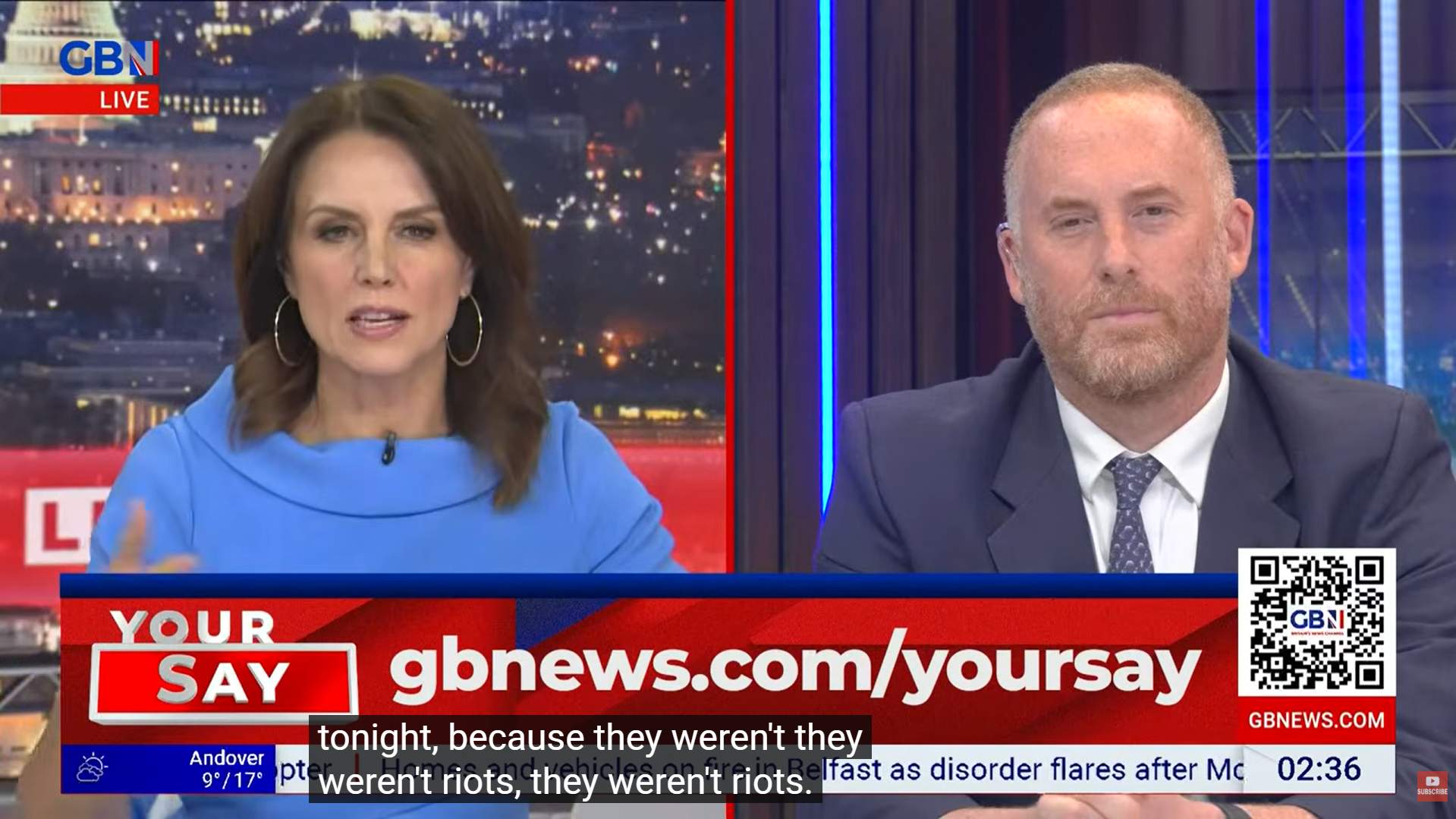
GB News Presenter Denied Racist Violence in Belfast Was a ‘Riot’ and Claimed ‘Not a House Has Been Burnt Down’
Bev Turner told her viewers that the Belfast violence amounted to mere ‘skirmishes’ despite hundreds of masked men terrorising migrants and ethnic minority people in the city
Trump’s Grievance-Fuelled War On US Counter-Disinformation Capabilities
For years, Trump and his allies have argued that Government involvement in counter-disinformation work posed an existential threat to free speech. After his 2020 election loss, Trump was quick to blame the people in this line of work, which was reportedly part of what drove him to take a wrecking ball to US counter-disinformation capabilities when he took office in 2025.
On the day he was sworn in as the 47th president, Trump signed an Executive Order (EO) focused on “restoring freedom of speech” and “ending federal censorship.” The text of the EO condemns the Biden administration for using the “guise of combatting ‘misinformation,’ ‘disinformation,’ and ‘malinformation,’” to infringe on Americans’ free speech rights “in a manner that advanced the Government’s preferred narrative about significant matters of public debate.” Similar wording was used in a White House fact sheet that personally targeted Chris Krebs, the former head of CISA, accusing him of having “recruited…major social media platforms to further [his] partisan mission” and working “covertly” to promote censorship and partisan political narratives. In the same document, the White House alleged that Krebs had “suppressed conservative viewpoints under the guise of combatting purported misinformation.”
Since then, Trump has overseen the shuttering of the Federal Bureau of Investigation’s (FBI’s) foreign influence task force, the Cybersecurity and Infrastructure Security Agency’s (CISA) election security initiatives, and the Global Engagement Center’s (GEC) Counter Foreign Information Manipulation and Interference office. The Department of Justice (DOJ) similarly disbanded teams focused on investigating foreign influence campaigns. In another extraordinary move, the Trump administration levied sanctions against five Europeans involved in anti-hate and anti-disinformation work, claiming they violated Americans’ free speech rights.
Within eight months of the start of Trump’s second term as President, the US had “ceased all Frameworks to Counter Foreign State Information Manipulation and any associated instruments implemented by the former administration,” according to a Government press release.
At the same time, the White House started posting content attacking US news outlets and journalists as part of a new section of the official White House website called the “Media Bias Portal.” The portal includes things like an “Offender Hall of Shame,” an archive of media “lies” and even a tipline that encourages people to submit information about media outlets “misrepresenting the Trump administration.”
ENJOYING THIS ARTICLE? HELP US TO PRODUCE MORE
Receive the monthly Byline Times newspaper and help to support fearless, independent journalism that breaks stories, shapes the agenda and holds power to account.
We’re not funded by a billionaire oligarch or an offshore hedge-fund. We rely on our readers to fund our journalism. If you like what we do, please subscribe.
Blurred Lines
If the White House is, indeed, engaging in any of the activities described in the leaked documents, that alone would be an extraordinary abuse of power. But the even bigger scandal here is the direct contradiction between the Trump administration’s alleged involvement in offensive covert influence campaigns and the public rationale they gave for dismantling America’s counter-disinformation infrastructure.
For the past year, the administration has argued not only that Government should avoid being involved in influence operations and other interventions in the information environment, but that it should lack the capacity to monitor, attribute, and expose them. Yet as Trump and his allies systematically dismantled the country’s counter-disinformation capabilities, they appear to have been simultaneously building the scaffolding for an even more insidious, opaque, and politically-charged form of information control.
Defensive counter-disinformation initiatives are, at least in theory, observable and contestable. Government agencies publish reports, researchers describe the methods they use, journalists scrutinise the findings, and Congress can intervene if/when it becomes necessary. But the allegations stemming from the leaked documents point toward something far less visible by design.
In a democracy, Government officials and political actors are expected to advocate for their policies and candidates transparently, allowing citizens to evaluate the source and credibility of information for themselves. Covertly shaping narratives through unattributed third parties or deceptive amplification tactics (eg: bots) undermines that transparency. Citizens cannot meaningfully exercise free speech rights when they are unaware of who is attempting to influence them or whether seemingly authentic political conversations are actually being artificially engineered behind closed doors.
Ultimately, what we are left with is a troubling picture of an administration that destroyed our defences against covert influence while allegedly engaging in influence activities that became harder to detect because those defences were removed. Far from a principled defence of the First Amendment, the Trump administration’s actions seem to imply that malign influence, information manipulation, and deception only become problems when we become aware of them.