Read Our Monthly Magazine
And support our mission to provide fearless stories about and outside the media system
More than 30 women and girls have died violently at the hands of men in Northern Ireland since 2020. There were no “protests” for Natalie McNally, Sarah Montgomery, or Ellie Flanagan; no “rage” at the brutality of their murders.
Northern Ireland does not have an immigration problem, it has a problem with violence.
The Shankill Butchers, the Kingsmill Massacre, Bloody Sunday – violence did not arrive in Northern Ireland on a boat of migrants from Europe or Africa or the Middle East, but through British colonialism that incited civil war and the partitioning of Ireland, leaving behind a legacy of sectarianism and a society scarred by conflict.
At the centre of the latest disorder is Stephen Ogilie, a man in his 40s who was violently assaulted by Hadi Alodid, losing an eye and sustaining serious knife wounds. Three people intervened including Maitiu Mag Tighearnan, who was seen beating the assailant with a hurling bat, most likely saving his life.
Northern Ireland has been home to many barbaric attacks; in 2017, Lurgan man David Lyness murdered Anita Downey, a mother of three – she suffered a wound to her neck so severe that it extended to the back of her spine. The difference? This week’s assault in North Belfast was perpetrated by a Sudanese migrant. Men did not take to the streets for Anita, because this isn’t about any victim or community – it is bold-faced racism.
Hate Amplified
A video of the attack against Ogilie quickly circulated on social media and was instantly exploited by far-right agitators in England and the United States who probably couldn’t point Belfast out on a map. They know absolutely nothing about Northern Ireland’s history of violence, care not for the lives and futures of the volatile young people they goad onto the streets to commit acts of hate for which they are arrested, or the innocent people whose homes and businesses have since been destroyed. Their objective is chaos. They want more clicks, more views, more money, more influence. Musk’s X feeds on negative content.
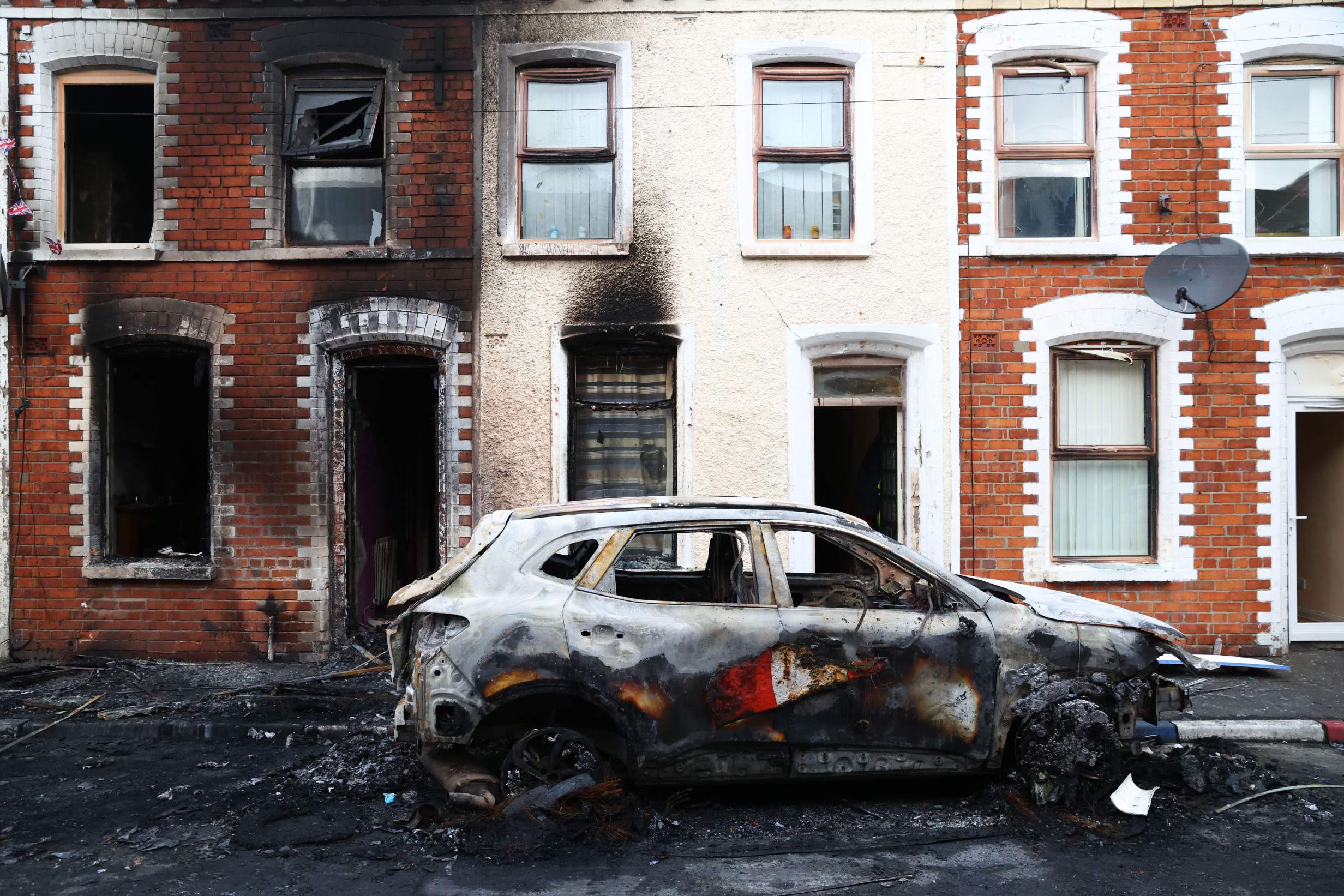
Seizing on any opportunity to further their own aims, Elon Musk, Tommy Robinson and Reform representatives amplified hateful discourse and spread disinformation in an attempt to cause civil unrest. “Prepare for War”, said messages circulating on social media and WhatsApp. Because nothing says solidarity like burning a bus or setting a family’s home on fire because of the colour of their skin.
The outside interference of bad faith actors led to the proliferation of AI-generated images of the victim, and escalated targeted attacks against minority communities by circulating lists of home addresses that racist thugs suspected were occupied by migrants. What unfolded was not a protest, it was a racist pogrom with men dressed in dark clothes, their faces covered going door-to-door to set alight family homes.
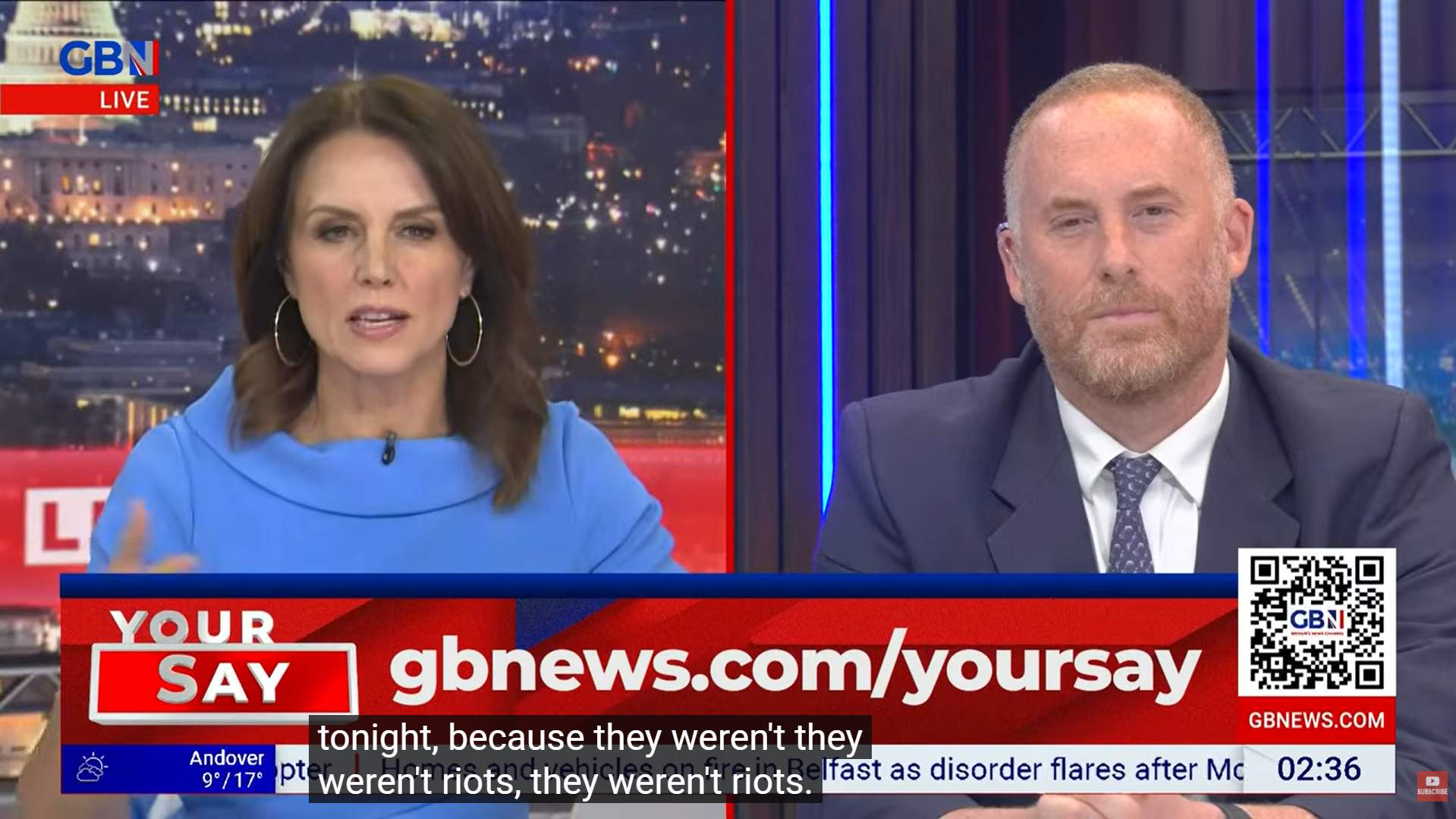
GB News Presenter Denied Racist Violence in Belfast Was a ‘Riot’ and Claimed ‘Not a House Has Been Burnt Down’
Bev Turner told her viewers that the Belfast violence amounted to mere ‘skirmishes’ despite hundreds of masked men terrorising migrants and ethnic minority people in the city
‘Recreational Rioting’
The displays of bigotry fuelling the riots that erupted on the streets of largely loyalist parts of Belfast are not novel – they are annual. Colloquially known as “recreational rioting” due to the large presence of youths who participate, throwing rocks and burning wheelie bins – not in protest to Government policy, but because they are egged-on and encouraged by self-appointed “community leaders”; paramilitaries and criminal gangs who exploit and control some of the Northern Ireland’s most deprived areas.
Referred to as sinkhole estates, defined by poverty, unemployment and lack of aspiration, these neighbourhoods have been a powder-keg for violent disorder for decades. While violence has historically been directed predominantly toward Catholics, during the intense sectarian violence of August 1969 over 1500 catholic families were forced out of their homes in Belfast, the equivalent of 1 in 20. Now, with the influence of bad faith actors, far-right agitators and paramilitaries, the criteria has broadened to include migrants.
Rather than free society from the scourge of paramilitaries, political representatives legitimise their existence. Last weekend, DUP MP Carla Lockhart was pictured standing side-by-side with masked men who sought to intimidate a peaceful pro-Gaza march outside Scarva. In 2024, DUP Education Minister Paul Givan defended meeting with loyalist paramilitaries in his official capacity. Like safe driving ads, we watch TV commercials warning of the coercive control of paramilitaries. None of this should be accepted as normal.
Young and impressionable boys are encouraged out onto the streets as fodder for narrow political agendas and community control with little understanding of the long-term consequences of a criminal record, let alone the severe impact their actions have on already-vulnerable communities.
This cycle has been in play since the collapse of key Northern Ireland industries like ship building since the 1960s. During the Troubles, bad faith actors weaponised economic deprivation and job losses to stoke division between working class Protestants and working-class Catholics. In the decades following the Good Friday Agreement, their influence has waned but for small pockets in some of the most disadvantaged areas where they maintain their position of control by perpetuating a fear of the “other”.