
 Subscriptions
Read our Monthly Magazine
And support our mission to provide fearless stories about and outside the media system
Conservative leader Kemi Badenoch last week cited a new University of Aberdeen geology paper as being supposed proof that the Government’s ban on new North Sea oil and gas licences was “utter madness”.
The Daily Mail, Scotsman, GB News, Energy Voice and Aberdeen University’s press office all ran with the central claim: that the West of Shetland basin holds 4.7 billion barrels of oil equivalent (boe), and developing it requires what the authors call a “bespoke fiscal regime” – a tax break.
“Untapped North Sea oil could keep Britain going for four years” blared one Telegraph headline.
These numbers, unfortunately, do not survive the paper’s own data.
The 4.7 Billion Barrel Figure
The 4.7 billion barrel figure mentioned in the paper represents the North Sea Transition Authority (NSTA) 2023 estimate of prospective ‘yet-to-find’ resources. These are not confirmed volumes that Britain can produce. This figure represents speculative geological potential that remains undiscovered, unevaluated and commercially unproven. And the total that is recoverable will in reality be a fraction of that number.
The Conservative leader, followed by the right-wing press, either misunderstood this very basic fact, or chose to misrepresent it.
The paper’s own data shows that across 50 years of West of Shetland exploration, 171 wells produced 47 discoveries, of which 13 are producing or imminently producing. The cumulative conversion rate from exploration well to producing field is around eight per cent.
Applying that rate to 4.7 billion barrels of oil equivalent (boe) produces a realistic geological-to-commercial production figure of around 350 to 380 million boe across several decades. For context, 380 million boe is roughly 325 days of UK gas demand. Not only is this less than a year (not The Telegraph’s “four years”), it wouldn’t all come out in a year as it is spread across decades of production decline.
The political case for reopening the basin rests on a figure that the paper’s own historical record deflates by more than 90%.
ENJOYING THIS ARTICLE? HELP US TO PRODUCE MORE
Receive the monthly Byline Times newspaper and help to support fearless, independent journalism that breaks stories, shapes the agenda and holds power to account.
We’re not funded by a billionaire oligarch or an offshore hedge-fund. We rely on our readers to fund our journalism. If you like what we do, please subscribe.
Industry Co-Authorship
The press coverage also missed three important things about the paper itself. The first concerns its authorship. The paper has 10 named authors. Lead author Professor Nick Schofield is Professor of Igneous and Petroleum Geology at the University of Aberdeen.
However, five of his co-authors work for companies with a direct commercial stake in the policy change being recommended: Ben Kilhams is employed by Shell, Lucinda Layfield by Equinor, and Douglas Watson by BP; Eric Mueller and Jens Beenfeldt work for TGS, a seismic data company whose business model depends on continued exploration activity.
All five disclosed their affiliations in the paper’s acknowledgements, noting they had contributed “in their own time” via honorary research positions at Aberdeen. This disclosure is proper, satisfies the paper’s formal requirements, and there is no suggestion of wrongdoing. But the disclosure does not change the fact that half the authorial team is employed by oil and gas firms that would be the direct beneficiaries of the fiscal regime the paper recommends.
Shell and Equinor are partners in Adura, the joint venture formed in December 2025 to consolidate their UK upstream operations, including the Rosebank field at the centre of the West of Shetland debate. BP operates Clair, Foinaven and Schiehallion in the same basin; TGS sells seismic data to all three. The paper recommends that British taxpayers underwrite an enhanced fiscal regime for the basin where these companies hold their UK assets. These affiliations went unreported in the press coverage that circulated the paper’s findings.
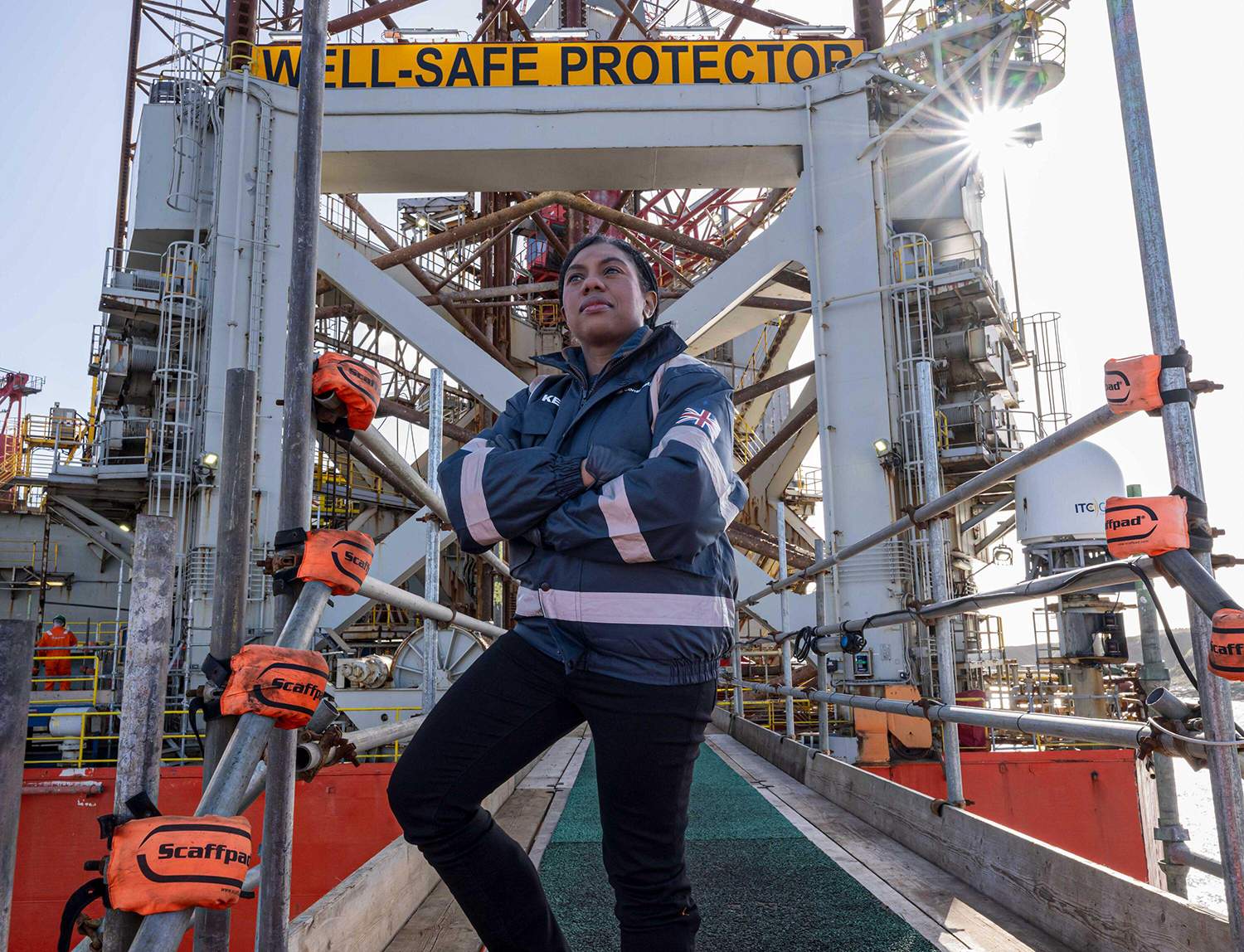
Kemi Badenoch Campaigns For North Sea Drilling at Company Owned by Oil and Gas Executive Who Donated £250,000 to the Conservatives
The Conservative party, which calls the Government’s plans for replacing fossil fuels with renewable energy “crazy” has also taken millions of pounds from funders and directors of anti-Net Zero lobby groups
The Fiscal Gap
The second omission is a single sentence buried two-thirds of the way through the paper’s discussion section: “an in-depth economic benefit analysis of such a move is beyond the scope of this paper.” The paper advances a fiscal policy recommendation while explicitly forgoing the analysis that would tell taxpayers what it would cost.
An Age of Transformation report by this reporter and Divyesh Desai, formerly of Shell Asia’s liquid natural gas division, built a conservative 30-year discounted cash-flow model of what a reopened North Sea licensing programme would mean for the British Treasury under existing tax rules – precisely the fiscal calculation the Aberdeen paper deferred. The model is open for replication, with full Python code published alongside the report.
At the prices any new licence would actually face by the time it began producing in the 2030s, a decade-long programme of 500 licences converting to 20 producing fields would cost the Treasury around £298 million in today’s money — plus £2.85 billion in decommissioning refunds the state is contractually committed to pay.
West of Shetland fields cost significantly more to develop than the North Sea average. Rosebank Phase 1 alone required a $3.8 billion (around £3 billion) investment decision, and fields in the basin typically take 14 to 17 years from discovery to first production. Both factors mean the tax reliefs any new regime would trigger are substantially larger than elsewhere in the North Sea.
The paper proposes cutting the headline tax rate from 78% to between 30% and 40%. Applied to a field the size of Rosebank, that would widen the per-field Treasury loss to between £500 million and £900 million. Across the five to 10 new fields a bespoke fiscal regime might unlock over a decade, the total additional cost to the public purse runs to between £3 billion and £8 billion, plus a further £500 million to £1 billion in decommissioning refunds the state is legally committed to pay. Conveniently, no figure of any kind appears in the paper.
Don’t miss a story
The Norway Comparison
The Norway comparison the paper deploys is also selectively framed. Norway refunds up to 78% of exploration costs, yes.
But here’s the third thing the paper carefully fails to mention: the Norwegian state also retains 67% ownership of Equinor and holds direct equity stakes in fields through its State’s Direct Financial Interest, managed by Petoro, ensuring the upside of production flows substantially to the state.
The proposed UK regime would replicate Norway’s exploration cost refunds. But it would jettison the equity structure that directs Norway’s production profits to the state. Under the proposed UK terms, taxpayers carry the cost while operators retain the upside. The paper Badenoch is rallying behind is advocating state socialism for Big Oil.
The Production Timeline
The fourth omission concerns timing. As the paper itself concedes: “if a field like Rosebank were discovered today, it might not come online until at least 2040.” A licence awarded in 2026 cannot produce oil and gas in any timeframe that affects the current price environment, the present energy security situation or household energy bills before the early 2040s.
By then, the energy market conditions that underpin the political case for reopening will have shifted considerably. The behaviour of the industry itself supports this reading: Shell and Equinor merged their UK upstream operations into Adura five months before the paper’s publication, explicitly to extract value from existing fields in a more difficult geological context.

The Oil Lobby Is Using the Iran War to Revive North Sea Drilling but Official Data Shows It Won’t Cut Bills
Fossil fuel funded think tanks, petrostate-linked policy institutes and oil market insiders are all being presented as impartial observers by the media, reports Nafeez Ahmed
The Fiscal Exposure
The Office for Budget Responsibility (OBR) has calculated, in its 2023 Fiscal Risks and Sustainability report, what continued exposure to global gas markets costs the British state: approximately £364 billion in absorbed price shocks out to 2050.
Every new field locks in another 22 years of British infrastructure and political commitment to the global gas market the OBR has identified as Britain’s largest fiscal vulnerability. A West of Shetland economic zone of the kind Schofield and his co-authors recommend would compound this exposure.
The Aberdeen study contains 176 pages of careful subsurface geology built on five decades of data. Undoubtedly, the geological synthesis is serious.
The policy recommendation attached to it is another matter. Its fiscal cost has never been calculated. Its production timeline cannot affect present-day energy prices. And the companies that would benefit from it have already concluded the same thing — choosing to consolidate existing fields rather than compete for new ones. Byline Times contacted its lead author, Professor Nick Schofield, for comment.
The closing line of the paper is, perhaps, the most honest:
“… it remains uncertain whether this paper will serve as an important reference to support future exploration activity West of Shetland or merely as an obituary.”
An obituary: Kemi Badenoch did not mention that part. Neither did the rest of the press.