
 Subscriptions

Read our Monthly Magazine
And support our mission to provide fearless stories about and outside the media system
The UK is heading for a ‘perfect storm’ scenario due to a lack of regulation in election advertising in the era of AI fakes, and a five-party system with increasingly marginal electoral contests, according to a new report.
The Reform Political Advertising (RPA) campaign is calling for greater regulation to ensure transparency and factual accuracy in election ads.
While the Advertising Standards Authority does regulate advertisements made by companies and third sector bodies, it does not regulate non-broadcast electoral advertising, including online ads.
While it is a crime to ‘make or publish a false statement of fact about the personal character or conduct of a candidate’, electoral law doesn’t require claims made in political campaigns to be truthful or factually accurate. The RPA campaigns for making electoral advertisements subject to regulation to ensure ‘that fact-based claims are accurate’, and regularly publishes evidence of parties having abused this loophole in and around election periods.
The report, which focuses on the May 2026 elections, highlights examples of distortions of fact and misrepresentations of data across parties. It also delves into the increasingly marginal (defined as a winning margin of five per cent or less) results of elections in recent years, using open source data compiled from local council sources by Democracy Club, and comparing it to local elections over the past four years.
ENJOYING THIS ARTICLE? HELP US TO PRODUCE MORE
Receive the monthly Byline Times newspaper and help to support fearless, independent journalism that breaks stories, shapes the agenda and holds power to account.
We’re not funded by a billionaire oligarch or an offshore hedge-fund. We rely on our readers to fund our journalism. If you like what we do, please subscribe.
The analysis shows that 2026 saw the highest rate of contests won on low margins in recent years, with 41% of wards having a winning margin of less than 5%, and 398 wards decided on a knife-edge margin of less than 1%.
Nine wards were decided on a winning margin of just one vote, in an overall picture which leaves democracy at local level ‘vulnerable’ to abuse, meaning that ‘disinformation and misleading election advertising do not need to shift thousands of votes to have a decisive impact’.
Losing Here
A Reform UK leaflet, distributed in Chelmsford, gave no source for a bar chart that had the party polling at 34% and the Conservatives and Labour tied at 16%, and didn’t even mention the Liberal Democrats. Full Fact noted that the bar chart was “completely out of proportion”, and polling from JL Partners’ 15th April 2026 Local Elections MRP, while putting Reform at 39% in Essex, also showed the Conservatives on 21% and the Lib Dems at 19%.
Of the eight Chelmsford wards, Reform won four of them, three went to the Lib Dems, and the Conservatives took one. One of the wards that Reform beat the Lib Dems in was decided by just 34 votes, with others in the low hundreds.
In the West Midlands, the Conservatives ran an ad template across multiple wards explicitly telling voters that “only the local Conservatives can beat Labour”, downplaying the strength of the Green vote in some areas. The results showed that the Greens ended up ahead of the Conservative candidate in Harborne by 52 votes, and Labour beat the Greens by just three votes in Bournville and Cotteridge, with the Conservatives trailing much further behind.
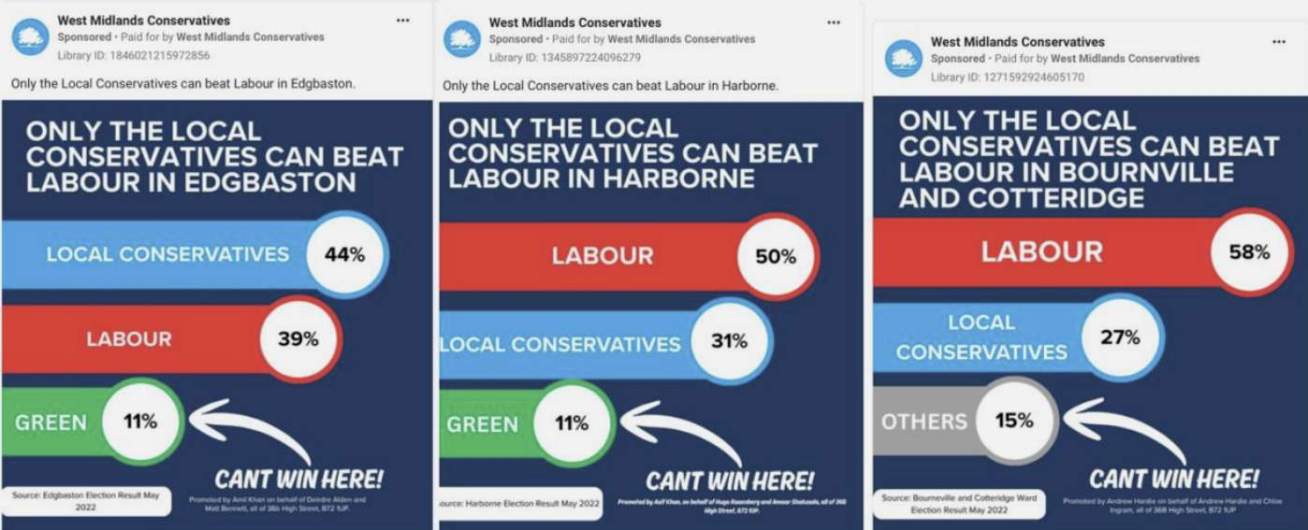
The report adds: “The issue is not that parties cannot make the case that they are best placed to win. It is that tactical voting claims should reflect the local contest voters are actually facing. In these cases, the claim that only the Conservatives could beat Labour presented a simplified and misleading picture of local competitiveness.” The data used was also from the 2022 election results.
One leaflet, delivered by the Labour Party in the Northfields Ward, Ealing, is described as containing a ‘cynical manipulation of data’ which was ‘specifically designed to falsely imply that Reform UK might win’. The goal being to scare voters away from voting for Green Party, Ealing Community Independent, or Liberal Democrat candidates.
And a leaflet distributed by the Liberal Democrats in Blackheath stated that “only the Liberal Democrats can beat Labour here”, and that “the Green Party can’t win in Blackheath”.
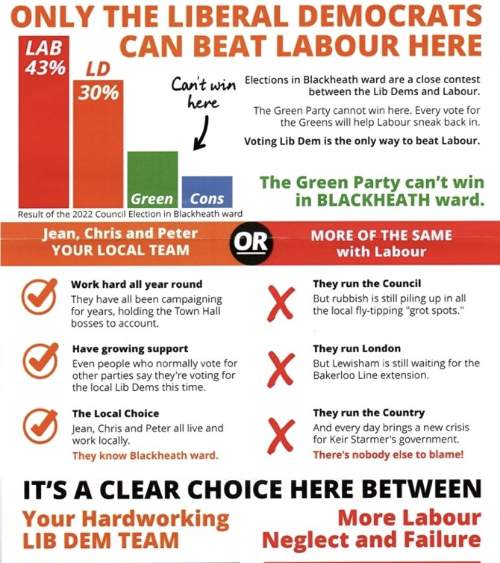
The data used to inform this messaging, however, was not from current polling but the 2022 council election results. The results of the election also proved that the claim was wrong, as two of the three seats in the ward were in fact won by the Greens, with the other being won by Labour.
Speaking to Byline Times, Lord David Puttnam, Chair of Reform Political Advertising, said: “This analysis shows that Britain’s elections are entering a dangerous moment. As campaigning moves into the AI age, more and more contests are being decided by tiny margins – sometimes just a handful of votes.
“In that environment, misleading election advertising only needs to influence a very few people to distort the outcome. Voters deserve basic safeguards so that all election advertising is transparent and factually accurate.”
Local elections held in 2026 have been no different than previous years in terms of parties putting out misleading information in campaign literature, with Labour, Reform UK, the Conservatives, Lib Dems, and Green Party – which supports the tightening of regulation in this area – all having released misleading materials at various points during the year.
Don’t miss a story
A separate Guardian and Full Fact investigation also found a number of other instances of ‘dodgy’ data being shared by major parties in the locals. These included Conservative leaflets which confused some into thinking they were for the Green Party, as they were printed in Green and only included a small Conservative logo. Another Conservative campaign in Haslemere stated that “Reform can’t win here”, but used data for the whole of Surrey from the 2024 general election, which Full Fact described as “very unreliable evidence”.
A leaflet put out by the Greens in Gateshead showed Reform in the lead beneath a headline which read “Greens are now the only alternative to Reform”. The chart referenced YouGov opinion polling from March, but more recent polling from the same pollster put the party in third.
Meanwhile, in Eastgate and Moreton Hall, in Suffolk, the Lib Dems stated that the contest was between “Lib Dem or Reform here”, despite using a bar chart showing the Conservatives in second and their party in third place.
A Chance to Act
The findings come with the possibility of meaningful change to ‘actually do something’ about lack of regulation in the electoral advertising space, with several amendments to the Representation of the People Bill being put forward by MPs at the report stage, following consultation with the RPA campaign.
These include the introduction of election advertising regulation to combat misleading factual claims, establishing an independent database of election advertising to counter “dark” election advertisements (those only visible to the recipient), making it illegal to create or distribute digital content that falsely claims to be speaking for a political candidate, and plans to strengthen ‘imprint’ rules to require all relevant media to display, prominently, the name of the party promoting or creating the ad.
Alex Tait, Co-Founder, Reform Political Advertising, told Byline Times: “Free and fair elections depend on voters being able to trust the information they receive during a campaign. The amendments we’re putting forward are a proportionate and necessary step to protect voters from misleading claims and disinformation. No party should be able to win votes by knowingly misleading the electorate.”
Green MP, Ellie Chowns said: “Political misinformation and disinformation are among the gravest threats to our democracy and to public confidence in politics. As elections become more contested and the use of AI in political materials grows, our current rules are simply not strong enough to protect voters or ensure fair competition.
“The Government must bring forward serious reforms to make our democracy more resilient, including a proper regulatory framework to prevent misinformation and disinformation in political advertising, stronger controls on political deepfakes, increased powers for the Electoral Commission, and tougher action to combat the influence of dark money and foreign interference in our politics”.
The report is available here.
Got a story? Get in touch in confidence on tips@bylinetimes.com