
 Subscriptions
 Subscriptions

Read our Monthly Magazine
And support our mission to provide fearless stories about and outside the media system
Whatever the outcome of the civil trial between various claimants and Associated Newspapers Limited (ANL), the newspaper group behind the Daily Mail and The Mail on Sunday, the legal claims shed light again on what former prime minister Gordon Brown called “the criminal media nexus” — a circle of dodgy journalists and corrupt police officers circulating around the hub of the private detective agency Southern Investigations.
These horrific murders may seem like ancient history, but they are at the centre of astonishing legal claims against the UK’s largest newspaper publisher and owner of one of the world’s most-read online news websites, which is currently bidding to increase its hold on the British media by buying the Telegraph group.
The Daniel Morgan Murder
The murders of Daniel Morgan and Stephen Lawrence took place six years apart, but only a few miles away from each other in south‑east London. And they are connected by more than just geographical proximity.
Both murder investigations were stymied by the same cartel of corrupt police officers with gangland affiliations, and ready access to the British popular press.
Anyone who saw the recent TV drama The Hack, or has followed the podcast Untold: The Daniel Morgan Murder that I hosted and produced with Deeivya Meir ten years ago, will understand the centrality of Southern Investigations to the spread of the dark arts of “unlawful information gathering” (UIG) after one of its founders, Daniel Morgan, was slain with an axe in the car park of a Sydenham pub in 1987.
After Daniel’s murder, his co‑founder Jonathan Rees, and the man who took Daniel’s place, former “King of Catford” Detective Sergeant Sid Fillery, went on to turn Southern Investigations into the hub of the dark arts — bribing police officers, hacking phones and computers, blagging financial and medical records, impersonation, surveillance and intimidation.

Press and Police Corruption: Mail Hearing Reveals More Connections between Murders of Daniel Morgan and Stephen Lawrence
Witness statements on behalf of the claimants against Associated News plunge us straight back into what Gordon Brown once described as the ‘criminal media nexus’
They trained some of Britain’s most feted journalists, like the “Fake Sheikh” Mazher Mahmood, who was convicted of conspiring to pervert the course of justice in 2016.
As well as billing for hundreds of thousands of pounds a year the now‑shuttered News of the World, they worked for Piers Morgan’s Mirror Group and (as laid out in my book with Alastair Morgan, Who Killed Daniel Morgan?) claimed to work for other newspapers, including the Daily Mail.
Though Rees and Fillery were both arrested on suspicion of conspiracy in Daniel’s murder (Rees three times and Fillery twice), the multiple investigations finally came to a close at the Old Bailey in 2011 when the prosecution collapsed due to multiple flaws in disclosure. No further investigation was possible due to a quarter of a century of police corruption that made the evidence totally unreliable.
Technically, Daniel’s murder remains “unsolved”, but the details amassed by the Daniel Morgan Independent Panel, which reported in 2021, make it clear that the police are not looking for any further suspects.
Included in the panel report is a detailed account of how the original murder inquiry was stymied by the presence in the incident room, on the night before Rees and Fillery were arrested, of a former disgraced police officer, Jonathan Ross.
According to another police officer, Derek Haslam, who worked undercover for the Metropolitan Police Service (MPS) for nine years gathering information on Southern Investigations and its network of connections with corrupt police officers, journalists and the underworld, Ross was a “corrupt policeman” who specialised in “selling information to the Mail and other newspapers from corrupt, serving officers”.
Ross sold hundreds of these stories to the press, often working with Jonathan Rees and News of the World after he had helped stymie the first Morgan murder squad investigation.
The Stephen Lawrence Murder
According to Derek Haslam, John Ross targeted Doreen Lawrence during the turbulent first years of the botched investigation into her son’s brutal murder in 1993 at a bus stop in Eltham. The suspects were a gang of young men with family connections to the criminal underworld, which in turn was close to senior police officers in south east London.
Rees — who had a “lucrative obsession” with Doreen Lawrence — also worked with Ross providing stories for the Mail, Haslam has testified to the court, and “boasted about doing illegal stuff for [them] including computer and phone hacking, bribing police officers and a whole range of other unlawful activities”.

10 Reasons Why Paul Dacre is Unfit to Be the New Ofcom Chair
Brian Cathcart gives a personal view of why the former Daily Mail editor would be the worst thing to happen to the broadcasting regulator entrusted with upholding journalistic standards
All of the five articles from 1997 to 2007 cited as “unlawful” by Doreen Lawrence’s legal team — because they were allegedly sourced through “phone tapping, obtaining phone bills, accessing bank accounts, car registration details, corrupt payments to cops and other confidential data unlawfully gathered” — were bylined by the Mail’s then crime correspondent, Stephen Wright.
Wright was a habitual user of private investigators whose work has been proven to employ these dark arts in other civil cases against Murdoch’s News Group Newspapers (NGN) and the Mirror Group, the court documents claim.
They adduce alleged payments to police sources which, according to Baroness Lawrence, explain stories that “had to have come from leaks within the police as the information published was known only to a very closed circle and there were protections in place to keep it confidential for the effectiveness of the investigation”.
They also note that Wright was in regular contact with Jonathan Ross, with call data recording 97 calls and 55 text messages between 2011 and 2014. Wright claims he cannot recall anything about what any of the calls or texts might relate to. Ross died two years ago.
The Mail’s editor‑in‑chief, Paul Dacre, made much of his newspaper’s campaign for justice for the Lawrence family, and published a memorable front page calling Stephen Lawrence’s alleged assailants “Murderers”.
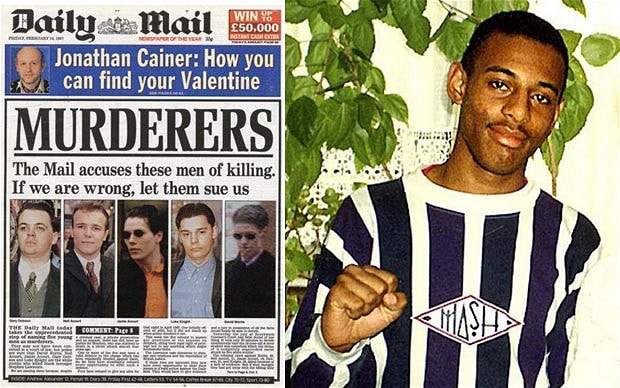
But the resistance of ANL to explain the alleged dark arts pursued under the surface has left Baroness Lawrence feeling “violated” and “profoundly betrayed”. The company’s failure to apologise for the intrusions has resurrected the trauma of the murder itself and the botched police investigation — it feels like “history repeating itself”, she has told the court.
“I am a victim all over again, but by people who I thought were my allies and friends. I am being made to fight when all I have ever wanted is to be told the plain truth and for justice to be done, and an apology. I am angry that I have been made to fight in the courts for over three years for things that could be so easy and simple.”
There are five other litigants in the case against ANL, including Prince Harry, actors Elizabeth Hurley and Sadie Frost, Sir Elton John and the former Liberal Democrat MP Simon Hughes, with much more recent allegations of various forms of unlawful access to personal information stretching all the way forward to 2018.
ANL disputes all the claims, saying it gained its information through legitimate sources and in the public interest. The trial is expected to last nine weeks, and to cost ANL almost £40 million in fees