
 Subscriptions
 Subscriptions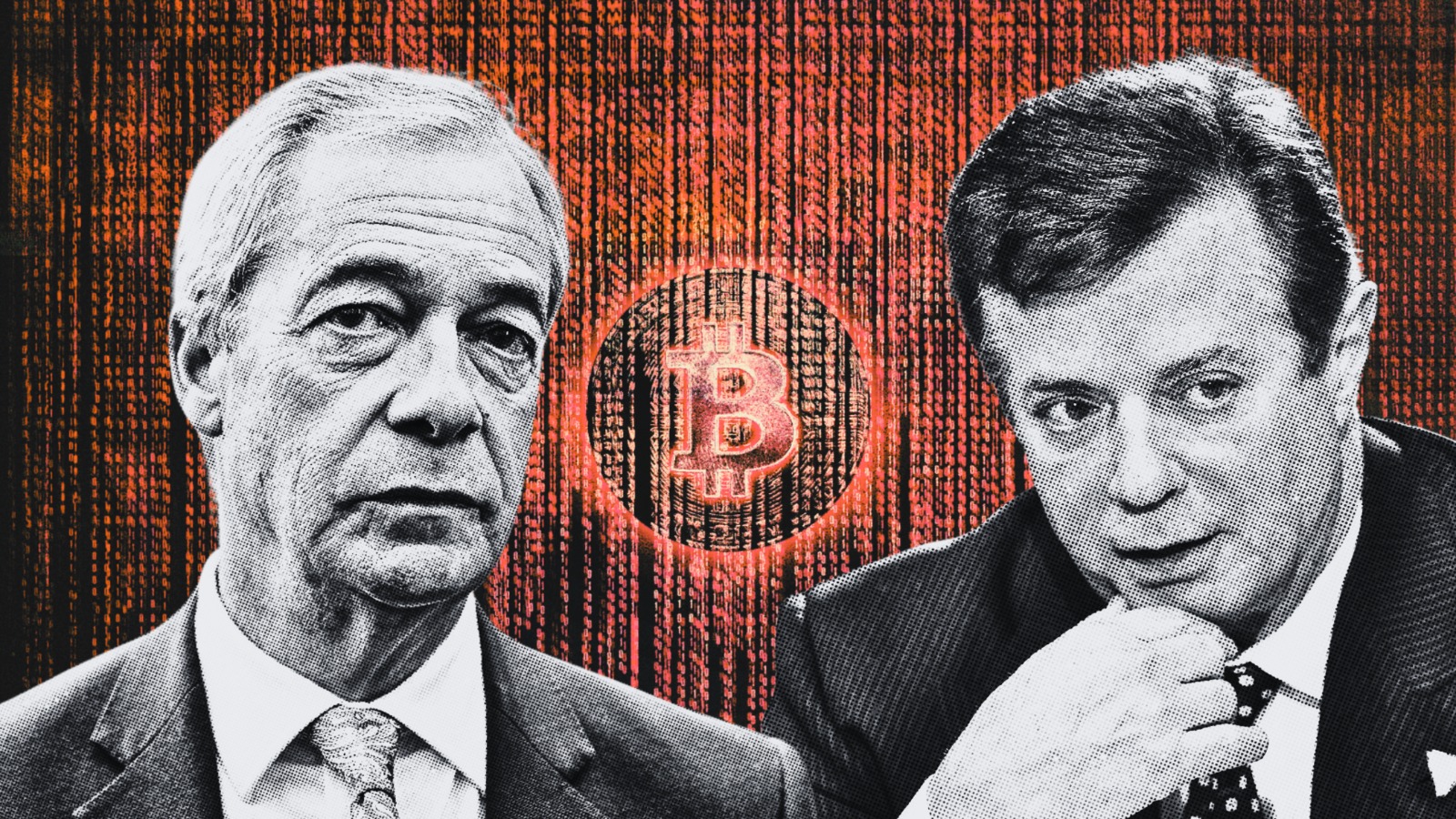
Read our Monthly Magazine
And support our mission to provide fearless stories about and outside the media system
Nigel Farage has been paid by a cryptocurrency adviser to US President Donald Trump, who worked with Paul Manafort – Trump’s former campaign chair, jailed for financial crimes after investigations into his Kremlin-aligned influence operations – to lobby the president on Bitcoin policy.
David Bailey, chief executive of BTC Inc and a senior cryptocurrency adviser to Trump, brought Manafort into his lobbying operation in early 2024. Together, Manafort and Bailey spent the rest of the year working to persuade Trump to embrace Bitcoin and establish America’s first Strategic Bitcoin Reserve.
Bailey subsequently paid Farage a speaking fee through BTC Inc, months before the Reform UK leader unveiled a pro-crypto policy platform that mirrors the Trump administration’s digital asset agenda.
Paul Manafort’s role in the development of Trump’s entire cryptocurrency strategy raises questions about Bitcoin’s role as a vehicle of Russian influence, in particular as a mechanism to weaken national fiat currencies.
It also links Farage to one of the most controversial figures in modern American politics – and raises questions about whose interests are actually being served by Reform UK’s proposed Cryptoassets and Digital Finance Bill.
Trump’s Campaign Chair
Paul Manafort’s involvement in shaping Trump’s Bitcoin policy represents a remarkable political rehabilitation. The veteran Republican operative was convicted in 2018 on charges including tax fraud and bank fraud, stemming from his work advancing Russian interests.
A bipartisan Senate Intelligence Committee investigation concluded in August 2020 that Manafort’s activities “represented a grave counterintelligence threat” to the United States. The committee found that while serving as Trump’s 2016 campaign chairman, Manafort regularly shared internal campaign polling data and strategy with Konstantin Kilimnik, whom the report identified as a Russian intelligence officer. The US Treasury Department later confirmed that Kilimnik “provided the Russian Intelligence Services with sensitive information on polling and campaign strategy.”
Manafort’s work for Russian-aligned interests stretched back decades. From 2005, he held a $10 million annual contract with Russian oligarch Oleg Deripaska – described as closely aligned with Vladimir Putin – for work that Manafort said would “greatly benefit the Putin Government.” The Senate committee concluded this influence work was “in effect, influence work for the Russian Government and its interests.”
Between 2004 and 2014, Manafort worked as chief political adviser to Viktor Yanukovych, Ukraine’s pro-Russian president, and his Party of Regions, which US diplomats described as “a haven” for “mobsters and oligarchs.” Manafort received millions in undisclosed payments to rehabilitate Yanukovych’s image in the West and advance pro-Kremlin policies, including blocking Ukraine’s NATO membership.
Trump pardoned Manafort, who has always denied representing Russian political interests, in December 2020.

Trump and Musk Welcome Russian Propaganda After Sanctioning European Disinformation Experts
If there’s any question that the US is now more aligned with Russia rather than Europe, recent State Department decisions have removed all doubt
Manafort’s Return
By early 2024, David Bailey had recruited Paul Manafort to help orchestrate what would become one of the biggest political pivots of Trump’s campaign: his transformation from crypto sceptic to Bitcoin champion.
Bailey was first connected to Manafort after a meeting of fellow Bitcoin evangelists in Puerto Rico which included Tracy Hoyos-López – Manafort is her sister’s godfather. Manafort then plugged Bailey into the heart of Donald Trump’s campaign team.
Over the next few months, Bailey and Manafort worked to educate Trump’s inner circle on Bitcoin policy, craft messaging that would appeal to crypto investors as a new MAGA constituency, and develop the policy framework for what Trump would later promise: making America the “crypto capital of the world.”
This culminated in a pivotal meeting at Trump Tower in New York, orchestrated by Manafort. Bailey attended with Hoyos-López and several other crypto advocates. By mid-June, Bailey and Manafort arranged for a group of Bitcoin mining executives to meet Trump at a 90-minute high-level crypto roundtable at his Mar-a-Lago Club in Palm Beach, Florida.
In December 2025 at a conference hosted by Bailey’s BTC Inc, Manafort took credit for Donald Trump’s new crypto agenda. On stage with Bailey associate Hoyos-López, Manafort confirmed that in February 2024, Trump told him over several conversations that he was concerned about “the lawfare that he was experiencing with the Biden administration going after him criminally [and] the problems of debanking” – to which crypto appeared to be a potential solution:
“So when we raised the issue of trying to bring the crypto industry onshore, he [Trump] was very receptive. And David Bailey was one of the critical early people we brought in to talk with him and explain to him the details of it which he immediately got. And after the first roundtable we had with him, he was all in. In fact we were putting together the framework for him announcing his commitment to Bitcoin when he was doing an event in Mar-a-Lago and while I was in Washington in a meeting I got a phone call saying President Trump just announced that he’s for bringing crypto on shore and he got ahead of us a little bit because he wanted to get the message out.”
Bailey’s collaboration with Manafort had, in other words, proved devastatingly effective. Trump, who had previously dismissed Bitcoin as a scam, began appearing at Bitcoin conferences as if they were campaign rallies. He promised to halt what he called a regulatory “witch-hunt” against crypto exchanges, pledged to fire Securities and Exchange Commission chair Gary Gensler, and – echoing Bailey and Manafort’s core pitch – floated the idea of a Strategic Bitcoin Reserve that would place Bitcoin alongside gold and dollars in America’s official holdings.
Trump’s entire crypto agenda was, in other words, largely constructed under the influence of Manafort, a man who multiple US official inquiries had found significantly advanced Russian interests, often at the expense of American interests.
By January 2025, Manafort turned up as a VIP guest at the Crypto Ball celebrating Trump’s second inauguration, which was attended by Speaker of the House Mike Johnson, as well as incoming Treasury and Commerce Secretaries Scott Bessent and Howard Lutnick. Sources familiar with the industry confirm that Manafort is now advising crypto interests how to navigate President Trump’s inner circle.
In the meantime, Bailey’s BTC Inc had positioned itself as a hub for the new Trump crypto-political complex, building out a network of conferences, podcasts and investment vehicles designed to make Bitcoin not just an asset, but a political identity. Since Trump’s election victory, Bailey has visited the White House at least six times, personally discussed Bitcoin policy with the president, and dined with the new SEC chair.
ENJOYING THIS ARTICLE? HELP US TO PRODUCE MORE
Receive the monthly Byline Times newspaper and help to support fearless, independent journalism that breaks stories, shapes the agenda and holds power to account.
We’re not funded by a billionaire oligarch or an offshore hedge-fund. We rely on our readers to fund our journalism. If you like what we do, please subscribe.
From Manafort to Farage
It was into this Bailey-Manafort construction that Farage stepped when he accepted payment from BTC Inc and took the stage at Bitcoin 2025 in Las Vegas in May. Farage’s parliamentary register of interests belatedly recorded on 3 October 2025 that he was paid £7,410.00 by Bailey’s BTC Inc for a “speaking engagement.”
The event itself was a stunning showcase of the crypto-political alliance that Bailey and Manafort had forged. Joining Farage on stage were David Sacks, Trump’s AI and crypto czar; Bo Hines, Executive Director of Trump’s Council of Advisers for Digital Assets; Eric Trump and Donald Trump Jr.; and Vice President JD Vance, who publicly thanked Bailey for “everything you’ve done for the Bitcoin community.”
In front of a hall packed with American Bitcoin maximalists, Farage delivered a speech that has since set the direction of Reform UK’s economic platform – and which reads like a British translation of the very playbook Bailey and Manafort had sold to Trump.
“When it comes to your industry, when it comes to growth in this industry, then I am your champion,” he told the crowd. He promised to “bring crypto in from the cold,” vowed to slash capital gains tax on crypto, and pledged to force the Bank of England to establish a state-owned Bitcoin reserve if he became prime minister.
Every major policy commitment echoed the positions of the Bailey-Manafort lobbying operation: the anti-regulatory rhetoric, the Strategic Reserve proposal, the framing of crypto as a populist revolt against “the regime.”
Back in Britain, Reform UK simultaneously published a seven-page Cryptoassets and Digital Finance Bill. The proposed legislation promised to cut taxes for digital asset investors, allow people to pay taxes in cryptocurrency and to halt work on a central bank digital currency, which Farage dubbed an “authoritarian nightmare.”
The policy platform reads as a direct adaptation of the agenda Bailey had crafted for Trump.
The Wider Network
The Manafort-Bailey-Farage connection is not the only thread tying Reform UK into a Trump-aligned transatlantic network of digital money.
As previously reported by Byline Times, Christopher Harborne – the intensely private billionaire who has donated £9 million to Reform UK – is an investor in the stablecoin company Tether. That stake ties his profits to Rumble, a ‘free speech’ video platform that refused to ban Russian state media after the invasion of Ukraine and later hosted a Kremlin intelligence-linked influence operation. The platform continues to host that content to this day.
On 13 October 2025, Farage also registered a payment of £30,000 for a speaking engagement from Blockworks Inc., a leading crypto data and information platform with ties to pro-Trump crypto investment. Two years earlier, Blockworks secured a $12 million investment led by digital assets equity fund 10T Holdings, founded by Dan Tapiero, who told CoinTelegraph shortly after Trump took office for his second term: “There’s no government in the world that I’m aware of that is as activist and pro-capitalist, pro-business and pro-efficiency as the United States.” He also praised Elon Musk’s Department of Government Efficiency (DOGE) as a driver of productivity and “higher corporate profitability.”
The pattern reveals how Farage has positioned himself as the British end of an American-led crypto-political network, one that sees digital money not merely as a technology, but as a key part of a new authoritarian political order.
David Bailey and Nigel Farage did not respond to requests for comment.