
 Subscriptions
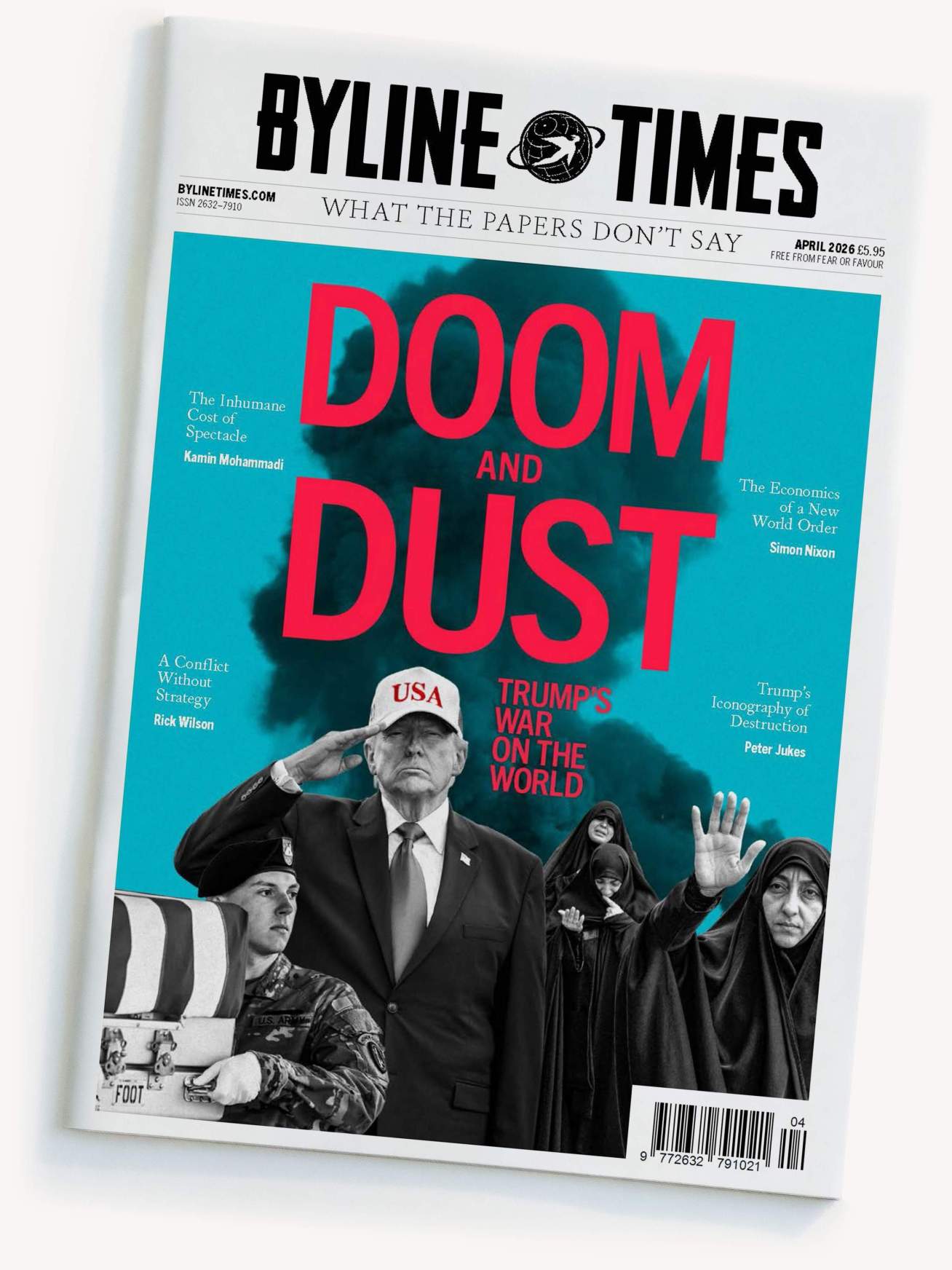
Read our Monthly Magazine
And support our mission to provide fearless stories about and outside the media system
Britain’s Army is shrinking to its smallest size since the Napoleonic wars, struggling to recruit and unable to modernise at the pace its own commanders say is required. Yet despite this contraction, new Ministry of Defence (MoD) figures obtained by Byline Times suggest that the UK is quietly extending its global reach by sending military reservists into more countries than at any point in recent history.
The FOI disclosure reveals that 612 reservists were deployed overseas last year, entering what the MoD classifies as a “deployment theatre” for more than 24 hours in 51 countries and territories. It is an unusually broad global footprint for the modern Army Reserve – particularly for a force shrinking to its smallest size in two centuries – and one the Government has offered no public explanation for.
The MoD will not say what these part-time soldiers were doing, under whose authority they were sent, or why some missions took place in states that have no publicly declared UK military interest. When asked whether reservists had also been deployed to other, undisclosed countries, the department issued a “neither confirm nor deny” response – the phrasing normally reserved for sensitive or clandestine operations.
In a previous FOI disclosure, the MoD listed Iran as a deployment location before withdrawing the claim once Byline Times asked for clarification.

How Epstein Channelled Race Science and ‘Climate Culling’ Into Silicon Valley’s AI Elite
The Epstein files expose how racial hierarchy, genetic “optimisation” and even climate-driven population culling circulated inside Big Tech circles
It leaves a striking contradiction at the heart of British defence: as the Army contracts, its overseas activity appears to be quietly expanding, pushed into opaque theatres with little democratic scrutiny and few safeguards for accountability.
These revelations come at a moment when the military is facing scrutiny over a murder-rape case in Kenya and allegations that UK Special Forces carried out unlawful killings in Afghanistan – abuses senior officers stand accused of concealing.
This month, Kenya’s parliament delivered a very clear warning of what happens when overseas deployments drift beyond scrutiny. A sweeping year-long inquiry into the British Army Training Unit Kenya (BATUK) has accused troops of decades of abuses, from sexual violence and fatal accidents to environmental damage and the negligent handling of unexploded ordnance. All of this seems to be shielded by a veil of diplomatic and military immunity that allowed grievances to fester for generations.
Kenyan lawmakers described BATUK’s refusal to give evidence as showing an entrenched culture of impunity. This echoes patterns seen elsewhere in Britain’s military footprint from Iraq to Afghanistan: allegations initially dismissed, investigations obstructed, civilian harm minimised, and accountability delayed and denied until the political cost becomes impossible to ignore.
Where They Went
The MoD’s list spans NATO allies, conflict zones and several states where the UK has no obvious strategic interest. A handful of deployments follow familiar patterns of deterrence or alliance maintenance. Others sit far less comfortably, resembling the routines of a vanished Empire that persist more through inertia than declared strategy. The Gulf features prominently — unsurprising given long-standing security partnerships and the region’s role as a major purchaser of British defence equipment. Eastern Europe also appears heavily on the list, consistent with the UK’s efforts to signal resolve against Russia following the invasion of Ukraine.
Yet interspersed among these are countries where the UK’s interests feel, at best, opaque.
Cape Verde, Djibouti, Lebanon, the Maldives: each appears on the MoD’s ledger with no accompanying explanation. It makes some trips look less like a focused military power and more like a public school boy adventurer determined to fill the final pages of a passport – deployments that happen because they can, rather than because the public has ever been told why they should.
Professor Paul Dixon of Queen Mary University of London suggests this reflects a deeper instinct: a state still performing global influence even as its capabilities contract.
Dr Louise Tumchewics of the University of Southern Denmark characterises the deployments as “everything, everywhere, all at once,” though with the distinct sense of “accomplishing something, anything, but most likely nothing.”
It’s part of a wider picture. In 2020 Britain was reported to be maintaining 145 permanent military sites in 42 countries. Defence attachés and loan service personnel often reside in states Britain itself designates as human-rights concerns, all the while supporting arms exports.

‘Keir Starmer’s Brexit Blind Spot Leaves Britain With a Major Missed Opportunity’
It was striking that the most impressive recent speech on Britain’s future in Europe came not from our current Prime Minister, but from one of his Conservative predecessors, argues Alexandra Hall Hall
The Cost of Staying Global
The compulsion to remain a global forced plays out not only in deployments but in the MoD’s travel habits. Freedom of Information data obtained by Byline Times also show military personnel flying to 170 countries in a single year.
Some visits raise obvious questions. Nearly £300,000 was spent on trips to Israel in 2023, even as ministers publicly condemned civilian casualties in Gaza. Servicemen and women were also dispatched to a range of states Britain deems human rights priority countries, and to more than a dozen that have experienced or narrowly avoided military coups in the past decade.
Why the defence of Britain required visits to Kiribati or Western Samoa remains unexplained.
The MoD insists this is business as usual. But at a time when senior commanders warn that the forces cannot afford their own modernisation – and when the Army is shrinking to historic lows – it raises the question of whether perpetual motion substitutes for strategic clarity.
Global Britain, in this telling, can look less like a coherent defence posture and more like a frequent-flyer scheme: the miles increasing, even if the purpose does not.
Dr Tumchewics argues that such activity reflects “an effort to retain great power influence whilst having all of the impact of a small defence force.”
This year’s Strategic Defence Review offers strategic cover to that ambition. It insisted on “NATO First,” but swiftly added it did “not mean ‘NATO only’,” granting the MoD a doctrinal umbrella wide enough to justify almost any overseas presence.
Not all overseas activity is increasing. The MOD has reportedly confirmed that it will “reduce the number of overseas training exercises” outside Europe from next year.
ENJOYING THIS ARTICLE? HELP US TO PRODUCE MORE
Receive the monthly Byline Times newspaper and help to support fearless, independent journalism that breaks stories, shapes the agenda and holds power to account.
We’re not funded by a billionaire oligarch or an offshore hedge-fund. We rely on our readers to fund our journalism. If you like what we do, please subscribe.
The Environmental Cost
Britain’s overseas sprawl also carries a climate footprint that the Government rarely acknowledges. The MoD is Whitehall’s largest emitter of greenhouse gases, responsible for roughly half of central government emissions. Independent assessments suggest that when supply chains and overseas operations are included, the figure may reach 11 million tonnes of CO₂ a year.
Lieutenant General Richard Wardlaw said in 2020 that the Army must “play its part” in the transition to zero carbon. Retired Lieutenant General Richard Nugee has argued that genuine security depends on integrating climate resilience into defence policy.
Yet the MoD’s global travel patterns suggest a simpler logic. Presence matters more than emissions.
As Professor Paul Rogers, Emeritus Professor of Peace Studies at the University of Bradford, told Byline Times, this is “a UK defence posture… with little sense of a global concern over climate breakdown, marginalisation or runaway wealth.”
The MoD itself defends its overseas trips: “The first duty of government is to protect the nation and keep our citizens safe. This government is delivering on the Strategic Defence Review as a deliverable and affordable plan for Defence to meet the challenges, threats, and opportunities of the twenty-first century”, a spokesperson said.
What this FOI disclosure ultimately exposes is a defence establishment still acting as if global presence is its own justification – even as its capabilities contract and its operations drift beyond public view. Reservists are now being sent into countries the Government will not name, under mandates it will not explain, and at a cost it barely measures.
Whether this is sustainable – or accountable – is a question no Government has yet chosen to confront.