
 Subscriptions

Read our Monthly Magazine
And support our mission to provide fearless stories about and outside the media system
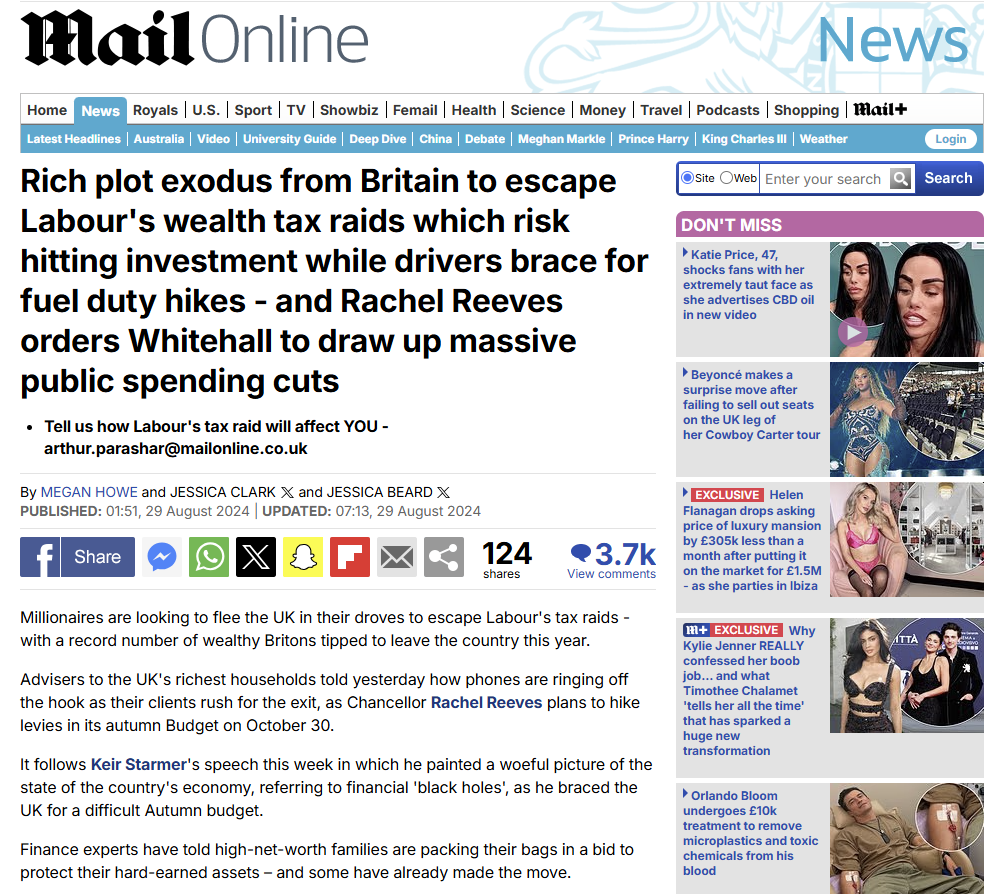
A supposed millionaire ‘exodus’ that was given blanket coverage in the British press – and which was credited to the Labour Government’s decision to weaken reforms to ‘non-dom’ tax avoiders – did not actually happen, according to a new study.
The media reporting, consisting of over 10,900 news pieces across print, broadcast and online news in 2024, was primarily based on a report published by Henley & Partners, a firm that helps arrange so-called ‘golden passports’, allowing the super-rich to secure residence rights or citizenship through investment or simply paying for it. The European Court of Justice recently ruled one such golden passport scheme, covering Malta, was unlawful.
The Tax Justice Network’s review – co-published with Patriotic Millionaires UK and Tax Justice UK – of the Henley report finds that the number of millionaires claimed by Henley & Partners to be leaving countries in “exodus” in 2024 represented almost zero percent of those countries’ millionaire populations.
For example, the 9,500 millionaires widely reported to be leaving the UK in 2024 represented 0.3% of the UK’s 3.06 million millionaires. It would take over 300 years for the ‘exodus’ to result in 100% of current millionaires to leave at this rate, even if no new ones emerged or moved here.
ENJOYING THIS ARTICLE? HELP US TO PRODUCE MORE
Receive the monthly Byline Times newspaper and help to support fearless, independent journalism that breaks stories, shapes the agenda and holds power to account.
We’re not funded by a billionaire oligarch or an offshore hedge-fund. We rely on our readers to fund our journalism. If you like what we do, please subscribe.
Media reporting widely blamed the alleged millionaire exodus on tax policies in the same year that calls for a wealth tax on the super-rich gained unprecedented momentum globally.
The media reporting was equivalent to 30 news pieces a day on the “non-existent” millionaire exodus across 2024.
Reviewing the full period from 2013 to 2024 for which the Henley report presents estimates on millionaire migration, the Tax Justice Network found that millionaire migration rates consistently stood at near-0% for every year.
Academic studies consistently show that it is very rare for wealthy people to relocate countries – uprooting their families – simply due to tax policy.
Henley’s estimates reveal a picture that is “at complete odds with the report’s narrative and media coverage: millionaires are highly immobile, and nearly 100% of millionaires have not relocated to a new country since 2013, if Henley’s estimates are to be taken at face value,” the TJN report’s authors say.
The UK Labour Government’s decision in January 2025 to weaken non-dom tax reform was widely reported to be a result of concerns about the Henley report’s findings (though a Treasury official gently denied this to Politico in January: “It’s not necessarily a response to reports we’re worried about the exodus of millionaires.”)
The Tax Justice Network’s review of the Henley ‘Exodus’ report flags several alleged methodological problems, as well as contradictions in Henley & Partner’s reporting.

Spring Statement: ‘Rachel Reeves Must Remember What Labour Is Actually For’
Unless the Labour party reconnects with its founding economic mission, they will merely lay the ground for a Nigel Farage Government, argues Neal Lawson
Funny Figures
Strikingly, the Henley paper’s methodology states that its estimates were primarily a measure of where millionaires say they work on social media – largely LinkedIn profiles – and not of where they actually live or reside, meaning the report does not track actual, physical migration, contrary to how the estimates were presented in the press.
Moreover, the report uses a far narrower definition of ‘millionaires’ that does not include all dollar millionaires, like the standard definition (people with net worth of one million dollars or more). Instead, it only individuals with liquid assets worth one million dollars or more (e.g. excluding their primary residence), who are thus richer and more mobile on average than a standardly defined millionaire.
In the case of the UK, the ‘millionaires’ identified by the report represent just a fifth (20%) of the UK millionaire population. Even then, the report is based on a small sample from within these narrowly defined millionaires and the sample is skewed towards centi-millionaires and billionaires, who are also likely to be the most easily mobile.
Tax justice researchers found the use of the term “exodus” was also inconsistent in the analysis. In 2021, Henley described 2,000 millionaires leaving the UK as “insignificant” but in 2023 described 1,500 millionaires leaving the UK an “exodus”.
And in 2023, the 6,500 millionaires claimed to be leaving India were described as “not particularly concerning” but redescribed in 2024 as a “wealth exodus”.19
The Tax Justice Network wrote to Henley & Partners and New World Wealth (who prepared the Henley report’s estimates) with questions for each ahead of the publication of its review.
The tax firm reportedly responded: “It seems this entire debate is over that one word. The dictionary definition is just ‘mass migration’, and HMRC’s own data shows that the number of non-doms in the UK is decreasing year on year – which seems to be a mass migration. If you are looking to the biblical definition, then to use the term ‘exodus’ would of course mean that all non-doms are leaving, but I don’t think many people take biblical interpretations quite so literally?”
Henley & Partners labelled the UK’s alleged exit of millionaires a “Brexodus” in 2023, claiming that the exodus was largely an impact of Brexit.
But in October 2024, Henley relabelled the exodus a “Wexit” (wealth exit) in a press release framing the UK exodus as a reaction to tax hikes that might be announced in the UK Labour Government’s upcoming budget statement.

These claims appeared to be inconsistent with Henley’s forecast made the month prior in September 2024 that the UK centi-millionaire population is growing and will continue to grow from 2024 to 2040.
The October 2024 press release highlighted the UK Labour Government’s upcoming budget as a main reason for this alleged “wealth exodus”: “The UK’s high tax rates and concerns about additional tax hikes that could be announced at the end of the month in the Labour Party’s first budget in 14 years, are highlighted as being among the main reasons for the wealth exodus.”
The Tax Justice Network’s review of the Henley report raises a number of other questions, including the statistical credibility of drawing any conclusions from an unrepresentative sample of “over 150,000 high-net-worth individuals” around the world.
Henley & Partners told TJN authors: “Statistically, if it is consistent year by year, then laws of statistical sampling mean that it can be used to draw a conclusion.”
However, if the original sample is not representative, conclusions cannot be claimed to be representative of a wider group merely because the same skewed sample was used repeatedly.