
 Subscriptions
 Newsletter offer
 Newsletter offer
Subscribe to our newsletter for exclusive editorial emails from the Byline Times Team.
Cross the threshold, through the open door that anyone can enter and, uninvited, step into No 1 Metrobydivnukiv. It’s a Ukrainian social housing tower that stands, abandoned and broken, in the suburbs of Ukraine’s 2nd largest city, Kharkiv. A nine-storey block of 36 apartments that was hit in the early spring days of March 2022 in a storm of steel of air strikes, Grad missiles and Hurricane rockets.
Now, she stands empty in the summer rain, save for the ravens that have made their nests in the ruins of war.
Some of her former human inhabitants had once been happy to have themselves a north-easterly view, but they were the ones first hit. The first to have seen the incoming shells, fast approaching across the view that stretches to the flatland horizons of the Russia border.
Enter this building that tilts like a broken cake, a huge chunk of her eastern side missing. Look up and see her eastern 3rd to 9th floors sliced off in total collapse.

Walk inside into the thick black that blocks out everything. You have to rely on the dim light of an unsteady phone to find your way. And in that gloaming, see the wreckage of doors twisted open. Glimpse inside homes long-abandoned, their floors thick with dust, amidst a chaos of broken tiles and plates and heavy-soot black. See tea sets lying shattered, with just one cup and a teapot standing, as if the family that once owned it has been decimated and the lone survivor left this for their wake.
The cliches that haunt war photography are inside those doors. A teddy bear stained with dust; a pink bra thrown to the side; a kettle that stands upon a broken hob; an icon of a risen Christ placed under a window shattered into a hundred thorny shards; and the daylight seeping through blackened, ash ceilings. War has taken its residence here.
Occasionally, the phone’s torch might not work and you are left in the coffin dark. Then, slivers of light come from the buildings’ wounded side and you see the broken-tooth facades of other tower blocks stretching out across the rain-thick land, each holding 36 apartments, each sharing the same jagged tragedies. Tales that – if too often repeated – become blunt in their telling. Sometimes you have to stop asking people for their stories, in case you begin to forget each account is a life turned inside out.
These blocks – all built to the same specification, the same size, the same heft of a Soviet architectural supremacy – now stand shredded and violated and scarred. These buildings were caught under another unforgiving heft – that of Russian missiles whose deadly arc sought a supremacy not too distant from the former Soviet ambition.
Then turn back to the inner corridors that dance between pitch night and blinking day, and feel the memories of horror films. The apocalyptic interiors where your imagination puts zombies behind creaking doors. And your stomach might well feel a weight as you walk up each flight of stairs and hear the slow creak of the building echo downwards. Here, the patter of rain and the moaning of iron and steel and concrete sound behind heavy, locked doors. And the black descends until you stumble to the Western side, there to find rooms protected from the Russian barrage by thick walls. Apartments sheltered from the rain and the damp that the shells elsewhere invited in. These quarters are dry and soundless.

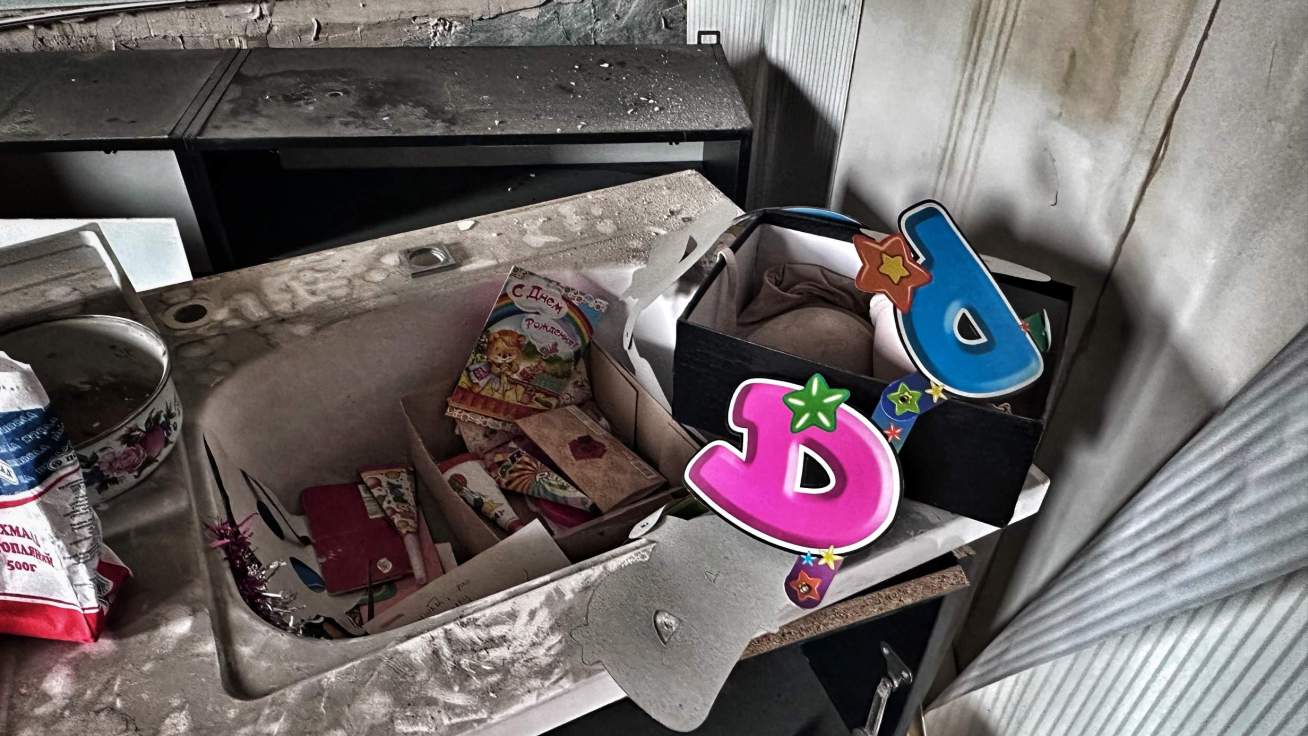
In these places, you smell unexpected scents. Not the rotten flesh that permeates the parallel, crushed rooms – sometimes tombs – just meters away, but here something preserved. The aromas of spilt herbs and unfinished curry dishes. The sight of two toothbrushes, askew in a cup in a casual embrace in a bathroom. Boxes of birthday cards in hastily-fled living rooms. And these rooms, abandoned but not destroyed, with their toys and their underwear and their uneaten beans and borscht and pickles, may make you feel like you are an intruder. So, you step away from these nameless flats with a sense of shame, as if you’ve broken in.
You walk outside, down the nine flights, down to where the rain falls down and a once noisy city suburb lies silent. And in the distance comes a sound of rumbling that rises towards you, and you are not sure if it is the drum of thunder or that of a metallic death.

The Hidden Suffering of Zapporizhzhia, Ukraine’s Counteroffensive Hub
The trauma of loss and the fears of a bigger catastrophe around the nearby nuclear power plant haunt Ukrainians living near the reactivated front line
There have been no missiles in Saltivka for a while now, says Mikhail Titeshko as we drive down the Avenue of Nations that bifurcates this suburb, some 13 km to the north-east of the city of Kharkiv and about the same distance away from the Russian border. But their impact has left a deep stain.
A few years ago, as many as 400,000 people lived here, one of the largest residential areas of Ukraine. At least a quarter have left, Mikhail says.
It was once a sleeping district for the workers of the Soviet Union. The Russians named this road to signify how close we all were to Moscow, he says. But we feel so far from Moscow now.
This is a place built with such proletarian utility that the residential blocks once all looked the same, radiating away from a centre that you never seemed to arrive at.
But it’s not so hard to tell them apart now. These buildings bear new marks – the smoked and blasted tattoos of war – each a terrible distinction that separates one from another. Some have been destroyed by bombing and fire. Some stand with shrapnel marks thrown, like paint from an artist’s chaotic brush, up and away from the missiles’ point of contact. Some stand untouched, just their windows boarded up for anticipated future violence.

Once three cinemas, a ‘Victory’ park and a major sports field offered entertainment and relaxation for here. Then came the bombardments last spring and over 4,000 buildings were damaged in Kharkiv, and these streets felt the worst of that horror.
Mikhail points out a shattered market to the right.
“Eight people were killed there,” he says. “There were six ‘Hurricane’ missiles”.
A volley of the BM-27 Uragan, a 220 mm multiple rocket launcher once designed in the Soviet Union to deliver cluster munitions, rained down here.
“Two more were killed,” and he directs a finger towards a broken house, above which a tower block rises. Some of its windows are taped with Xs, like the dead eyes of comic character.
An alert on our phones sounds. It warns of another air strike, but people are out buying food for their Sundays and turn away from the forewarned disaster.
It takes more to send people running than an incessant alarm. War has a habit of becoming not an important threat – until a bomb falls and everything changes.
Beyond us, the damaged blocks of flats stand sad exclamation marks against a pewter sky. Beneath are the blackened hulks of cars; shopping malls mauled; sheets of aluminium on the side of buildings like enormous band-aids on unconscionable wounds.
They say that hunters in the forest can tell you where the north lies by looking at the side of woodland trees for the direction of the moss. Here you can tell the north by looking at where the most windows are broken, because Russia lies that way, and that’s where th