
 Subscriptions

An in-depth investigation by Abi Kay has revealed that a food manufacturer was passing off huge quantities of foreign pork as British
Reprinted with kind permission from Farmers Weekly
British farmers are being ripped off by an industrial-scale country-of-origin fraud in a scandal that has engulfed almost the entire food retail sector, as well as some major food service outlets.
An in-depth investigation by Farmers Weekly has revealed that up until at least the end of 2020, a food manufacturer was passing off huge quantities of foreign pork – sometimes tens of thousands of tonnes a week – as British.
See also: Farming Weekly Editor’s view: Meat trade duping us daily and that must end
The processor, which cannot be named for legal reasons, has also been accused by former employees of regularly “washing” hams that are visibly off, or mixing rotting pork with fresh product for further processing.
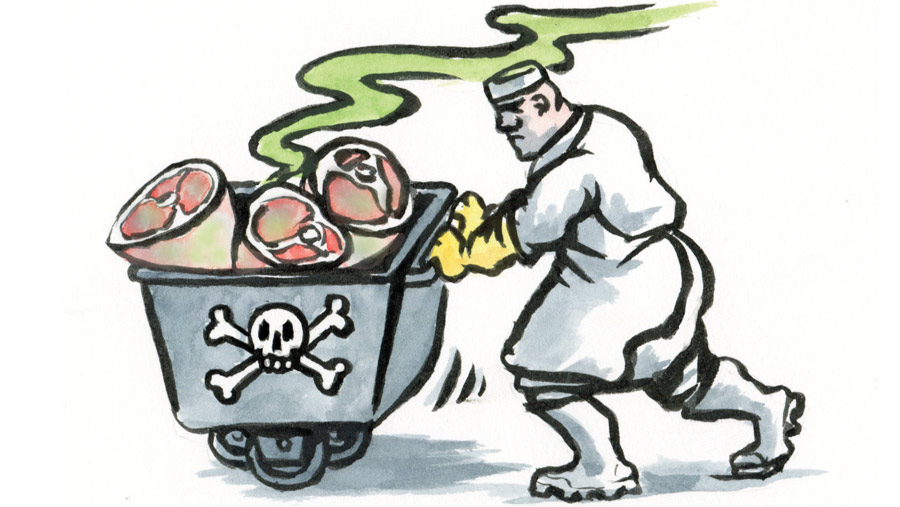
Other products such as ox tongues were not heat treated properly, and meat was sometimes thawed out on the factory floor, posing a serious food safety risk.
Two former employees also said the paperwork for sampling, which would pick up bacteria such as listeria and E coli, was falsified.
Wake-up Call
Industry leaders approached for comment have said Farmers Weekly’sinvestigation should act as a “wake-up call” for the sector and questioned the response of the Food Standards Agency (FSA) and National Food Crime Unit (NFCU).
Both bodies have been aware of the activities taking place at the processor since 2020, but at least one source claimed to have sent photographs and information about the practices to the FSA several years before that.
Meat processed by the company ended up in products such as ready meals, quiches, sandwiches and other produce sold in Tesco, Asda, Co-op, Morrisons and Marks & Spencer.
Food manufacturer and distributor Oscar Mayer, which supplies Sainsbury’s, Aldi, Ikea, Subway and airline food producer Dnata, was another customer, as were major brands Princes and BidFood.
Bakkavor was a customer until 2019.
Schools, hospitals, care homes and prisons were also indirectly supplied, with one source alleging the most rotten meat would end up there.
“I used to tell them about it,” they said. “I used to [say] ‘you can’t do this’. [The reply was] ‘Do you want the effing job? Get back in there’.”
Audit Deception
There is no suggestion that any of the processor’s customers were aware of the criminal practices, which took place for at least two decades and very likely beyond 2020, as auditors who visited the site were deceived.
One former employee said: “They did surprise audits, but they’ve got 15 minutes to be in. I’ve been there before when that’s happened.
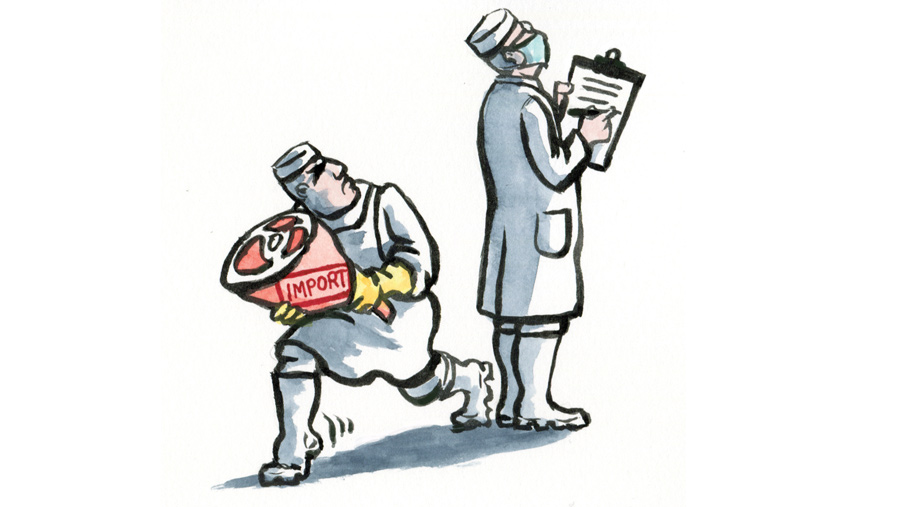
“It was 6 am and they’re knocking on the front door to come in. The first thing they do is bring them in, give them a cup of tea.
“By that time, there’s a text message come down to one of the phones [and] everybody is on the job, pushing stuff onto lorries, getting rid of them. So when they walk in, it’s all nice.”
Another source said if the meat was not hidden on lorries, employees would push any suspect product around the top of the circle-shaped factory.
“The auditor would be walking round with the management and they would get employees to push it round at the same time, so they never met it,” they said.
Prior to 2018, some of the meat that wasn’t seen by auditors would be hidden in a secret chiller, but its location was eventually reported to authorities, which forced the processor to put it on the site plan.
This incident led to “a lot of supplier audits”, according to one source.
Ex-workers Speak Out
Almost all of the former employees Farmers Weekly has spoken to said country-of-origin fraud was embedded in the company’s operating model.
“It was all one big fiddle,” said a source,
The business would buy a relatively small volume of British meat from a retailer-approved supplier, then use the traceability information from this delivery for all the products it made in that week – with the majority coming from elsewhere in the world.
One source said they were 100% confident that all the retailers the company supplied have been victims of country-of-origin fraud.
For pork, the price differential between British and imported product could be as high as a few pounds a kilo.
Another former employee claimed, at one point, EU bacon medallions were being bought at £1/kg and sold on, as British, for about £12/kg.
Farmers Weekly has seen evidence that showed Danish pork, which was only allowed to be sold on the mainland of China, was delivered to the factory.
Other products, such as ox tongue sold direct to Morrisons, were subject to the same fraud.
A source said: “What they are supposed to do is buy it from Woodheads [Brothers Meat Company]. They are basically owned by Morrisons.
“We would then buy that ox tongue to send them, but then also we could buy a small bit from other approved suppliers.
“Obviously, the UK is expensive, but Ireland would be cheaper. So all they would do is buy some from Ireland that is not approved and mix it in with the Woodheads. But then on the traceability again, everything would say Woodheads.”

Falsified Records
According to one source, the processor kept two separate sets of records – a fraudulent set and the originals, which were hidden in the factory and could be used to trace product in case of a food poisoning outbreak.
All of Farmers Weekly’s sources say employees knew about the widescale criminality taking place, but most were kept silent with threats of job losses, as there were few other work opportunities in the local area.
“If you did anything wrong, you were given the s******t job they could find you, like cleaning the drains, or you were bullied and bullied and bullied until you left,” said one source.
“There aren’t many places around here. It was either shut up, carry on or get out.”
Now, sources are speaking out to clear their conscience.
“It used to get me to a point where I’d be thinking ‘we’re going to kill someone, we’re going to kill someone, we’re going to kill someone’,” said one.
Another said: “There were days I’d sit outside in my car crying because I didn’t want to go in. It was that bad.”
There is also a fear among some sources, which Farmers Weekly believes is rooted in fact, that other businesses may be acting in the same way.
“You wonder if there’s anyone else,” said one. “They’ve learned it from somewhere haven’t they.”
Regulator Response
Darren Davies, head of the Food Standards Agency’s (FSA) National Food Crime Unit, said: “The FSA’s National Food Crime Unit is carrying out a criminal investigation into how a supplier was allegedly providing products labelled as British when they were in fact sourced from elsewhere.
“This is a complex and live investigation and we are looking into all new lines of enquiry with our partner organisations, including any potential food hygiene breaches at the premises. If any evidence of a food safety risk is found, then necessary action will be taken.
“The FSA advised retailers last year to check their cooked meat supply chain and to apply extra due diligence in their checks. We don’t give out these alerts without a reason.
“We will not name the supplier while we painstakingly gather evidence to support our investigation so as not to prejudice any possible future action by the courts.
“As a national regulator, we are the last line of defence. At a time when cost pressures and other challenges mean the risks of food fraud might be increasing, it is vital that everyone involved in the food system remains extra vigilant to ensure that food is safe and what it says it is.”

Retailer Responses
The British Retail Consortium (BRC) issued a statement on behalf of all the affected supermarkets.
It said: “The role of the FSA [Food Standards Agency] is to work with retailers to prevent fraud. While we cannot comment on an ongoing investigation, retailers will support the FSA with its investigation into the individual supplier in question.”
An Ikea spokesperson said: “The safety and quality of our food is an absolute priority and we take claims of this nature very seriously. In addition to necessary legal requirements, we require all food suppliers to be Global Food Safety Initiative certified.
“We also have additional, mandatory requirements, processes and systems in place for every Ikea supplier, and are therefore concerned by these allegations.
“An investigation by Ikea has now been established to look further into them, and we will support the FSA and relevant authorities as part of their ongoing investigation.”
Brand Responses
A Princes spokesperson said: “We take food safety and authenticity extremely serious