
 Subscriptions

Daniel Morrison looks at the Trump campaign origins of the ‘gamified’ global conspiracy theory which has now evolved into active Coronavirus denialism
The influence of perception is one of the defining features of modern life. Ever since Thomas Barratt used a nice painting to make Pears Soap more appealing, people have competed to change our minds about things. De Beers created the idea that diamonds had something to do with marriage. Edward Bernays put cigarettes in the hands of marching suffragettes to make them “Torches of Freedom”.
Political campaigns also employ agencies to influence public perception of their clients. Take the case of Donald Trump, who prior to announcing he was running for President has a chequered reputation nepotistic, a history of bankruptcies, allegations of tax fraud and openly bragged about sexual assault. His campaign would require the creation of a completely Alternative Reality. One where he was a strong, powerful, righteous hero, on a selfless mission to save the world from the clutches of an evil democratic cabal of deep state operatives.
Step forward curious character called “Q”, who claimed to be from military intelligence, with inside information on how it was all going to go down.
The 2016 Trump Campaign
Let’s start by going back to 2016. Roger Stone had finally succeeded in making Donald Trump the Republican candidate for President. Stone’s whole career (and partnership with Trump’s campaign manageer Paul Manafort) had been a long list of dirty tricks, and this job was going to be no exception. And in an election, political propaganda isn’t just about building your guy up. Taking the other side down is just as effective. And so he set his sights on the democratic candidate: Hillary Clinton.
Again, with a candidate as qualified as her, it was going to take the creation of an Alternative Reality. And with the advent of the internet, that was easier than ever.
Jeff Giesea was a digital businessman, pro-Trump agitator, and associate of Peter Thiel who, drawing on the ideas of Chuck Johnson, published a paper called “It’s time to embrace memetic warfare”. In context, it was pitched as a way to fight ISIS. In practice, it would become a key part of the Trump campaign’s strategy.
There is now an entire industry serving this space. Psy Group is an Israeli company founded by Joel Zamel, which specialised in online perception management, through social media manipulation, influence campaigns, opposition research, honey traps, as well as clandestine on-the-ground activities.
In April 2016, during the Republican primaries, Trump Campaign offical Rick Gates asked Psy Group for a proposal. They responded with a quote for $3,125,000 plus media costs, and promised to make it virtually untraceable.
Three months later, Erik Prince arranged a meeting between Zamel, Donald Trump Jr., and George Nader (an emissary for two wealthy Arab princes) in Trump Tower.
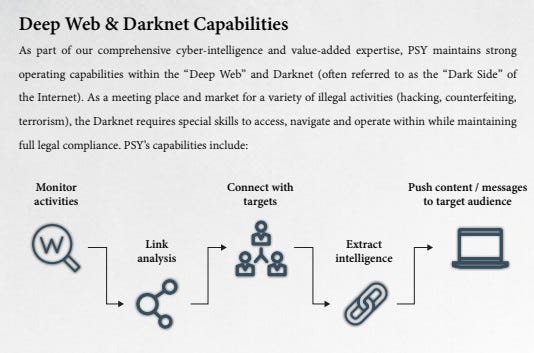
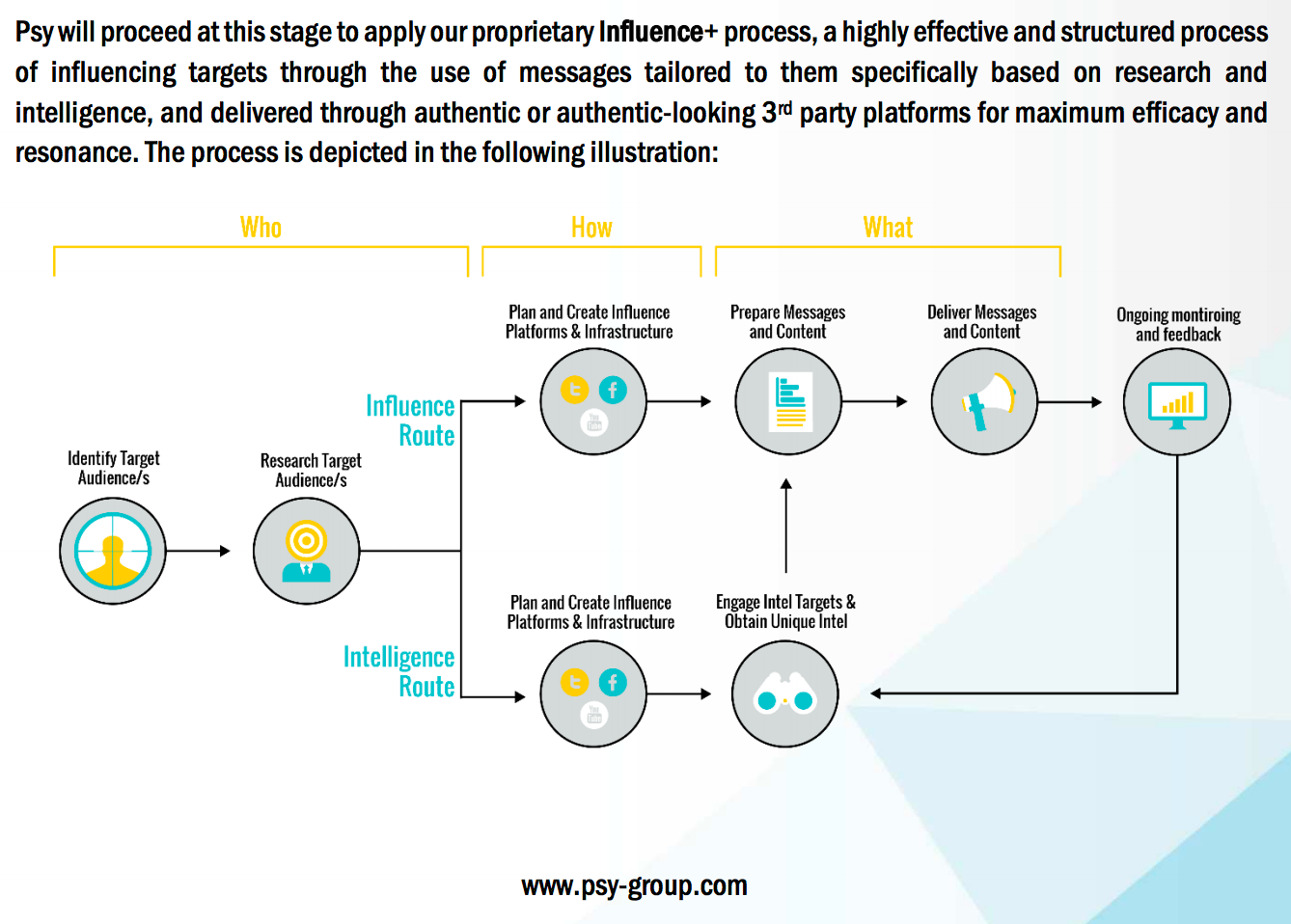
The “Deep Web” that the brochure above refers to, likely refers to Anonymous message boards like 4chan. 4chan is a place with basically no rules. It’s a fascinating environment that gives people a chance to express themselves in a way they never could, for better or worse. The tradition that we will focus on here is known as LARPing. The term comes from Live Action Role Playing, which is where people dress up as characters from a film, book, game or series that they like, and go out and enact the storylines.
Online, however, you don’t have to sew a costume and go outside. You just need a keyboard and an internet connection. People would pose as anyone they wanted, including people purporting to be from inside government agencies.
FBIAnon – the Precursor
On 2 July 2016, when the FBI was conducting their investigation into Hillary Clinton’s use of a personal email server, a character appeared, who will come to be known as FBIanon.

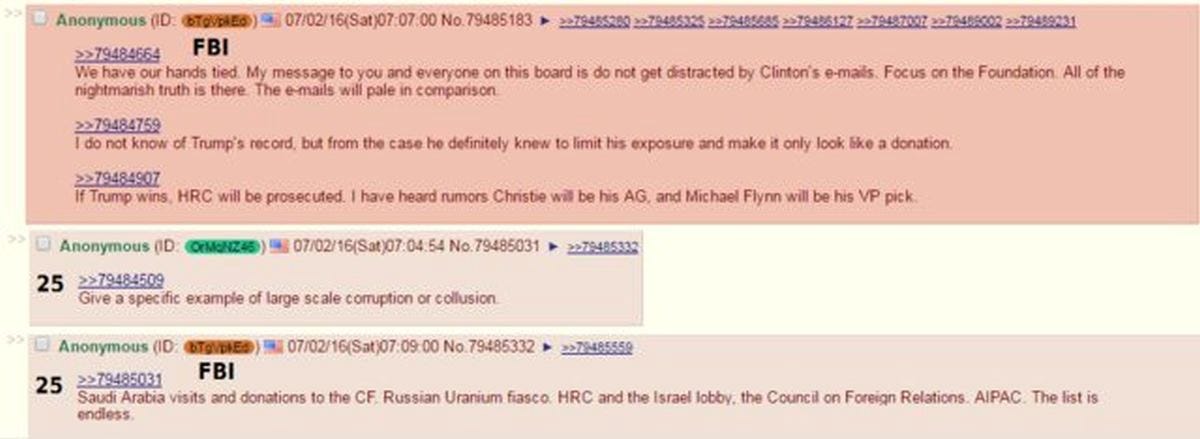
Over hundreds of posts from July to October 2016, FBIanon systematically created and nurtured the idea that there was actually far more going on with the Democratic candidate — including occult rituals, and abusing trafficked children. If it had stopped there, perhaps we could consider it to be a LARP/prank. But it didn’t stop there. Because a handful of people on 4chan isn’t going to be able to make a difference in an election, FBIanon gave the following instructions (over many posts which are edited together here):
“The task is this: unleash every meme, image, and horrible story about HRC that you can muster… In order to be effective, you must proselytize… For example: Start a website aggregating the images/facts and then try to get it linked to Drudge. Shove the images down every news anchor/journalists throat. Push out to people who you normally would have nothing to do with… Why don’t you invade their circles? … We should be spreading memes to subs on Reddit.… blitz Twitter, Tumblr, and all social media with memes on the Clinton Foundation tonight, the last night of the DNC… We need TrumpGen with us, and the meme division blasting the Tumblr tags. Bring up the old methods that /b/ used to use during their Tumblr raids… We’re going to war tonight …Repeat something often enough and it becomes the truth. Repeat after me: ‘Hillary is evil and will destroy the planet.’…”
It’s possible that a passionate volunteer had the same singular devotion to getting Trump in office as Roger Stone. But they also intimated:
“More leaks will come. The time is not right yet. Expect an October Surprise.”
And when the second leaks did come, they added:
“When you are reading Podesta’s e-mails, remember that the Clintons deal in weapons, drugs, and people. Some terminology in use is far more nefarious than many of you suspect.”
This indicated that whoever was posting as FBIanon was working with Wikileaks and/or Roger Stone. Russia had hacked into the DNC, and given the contents to Wikileaks, who told the Trump team. Sure enough, a few weeks later, right before the election, Wikileaks released 20,000 of Clinton campaign manager John Podesta’s emails.
While it was handy for the Republicans to have the other side’s material, there was literally nothing incriminating in there.
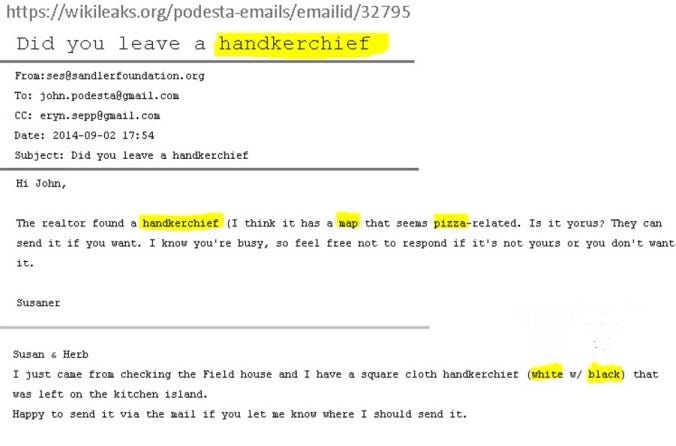
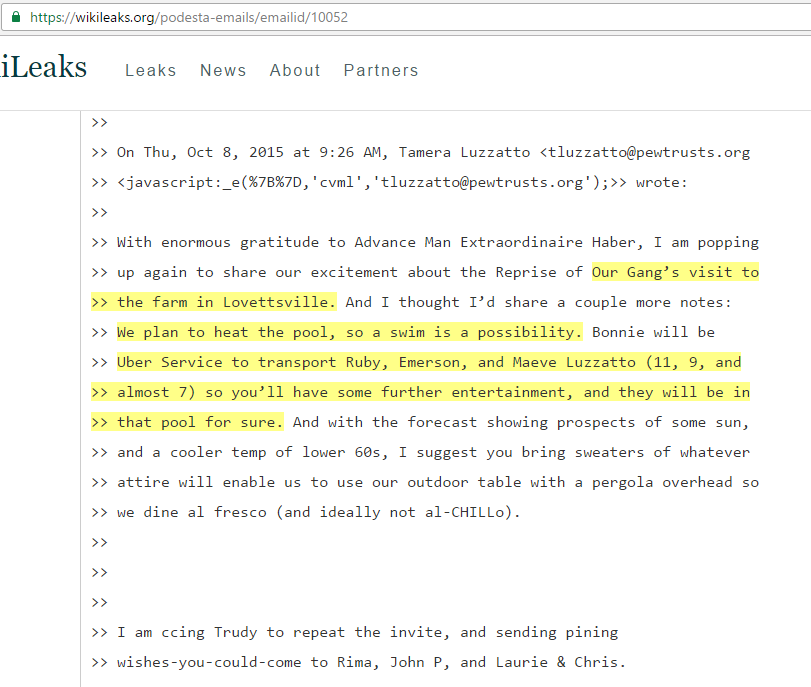
But if you change some of the words, and tell people it’s sinister, an Alternative Reality begins to emerge, in which ultimately people are less likely to vote for Clinton.


‘Pizzagate’ wasn’t their only trick. They also created the story that Seth Rich was assassinated and a story that other key people in the campaign had an illegitimate child. It’s important to keep an eye on the people at the centre of creating these narratives such as Erik Prince, Ed Butowsky, Matt Couch, Sean Hannity, Steve Pieczenik, Jerome Corsi, and Julian Assange.