
 Subscriptions
Read our Monthly Magazine
And support our mission to provide fearless stories about and outside the media system
Reform UK converted a £613,000 loan from deputy leader Richard Tice into a donation to the party, raising further questions about the origins of the party’s funds.
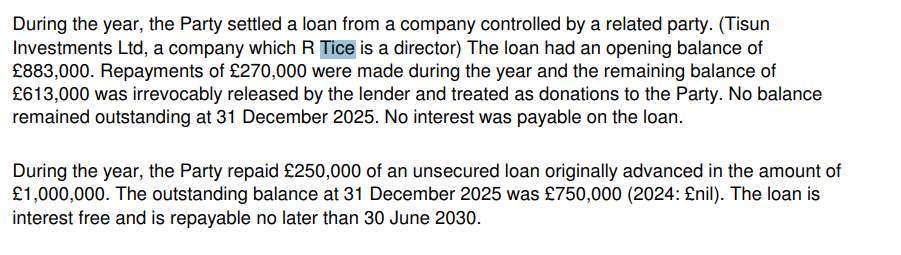
New accounts published by the Electoral Commission show that Reform UK began 2025 with an outstanding debt of £883,000 to Tice’s Tisun Investments, then repaid £270,000 of the interest free loan. The rest was converted by Tice into a donation to the party.
The Financial Times reported that the conversion of the loans into donations appears to have been partly financed by Fiona Cottrell, the mother of convicted fraudster and Farage confidant, George Cottrell.
On June 10 2024, Fiona Cottrell gave £1,075,000 to Tice’s firm Britain Means Business Ltd.
This was almost the exact amount Tice was owed by Reform UK, for the loans he made to the party through his other company Tisun Investments.
On the same day Britain Means Business donated £500,000 to Reform UK.
On the same day Reform paid back £200,000 of Tice’s loan and the accounts state that a further £270,000 was repaid in 2025.
According to the accounts, the remaining £613,000 of the loan was converted into a donation in 2025.
However, the accounts of Britain Means Business, filed with Companies House show that by the end of 2024, the company had just £10,500 in capital.
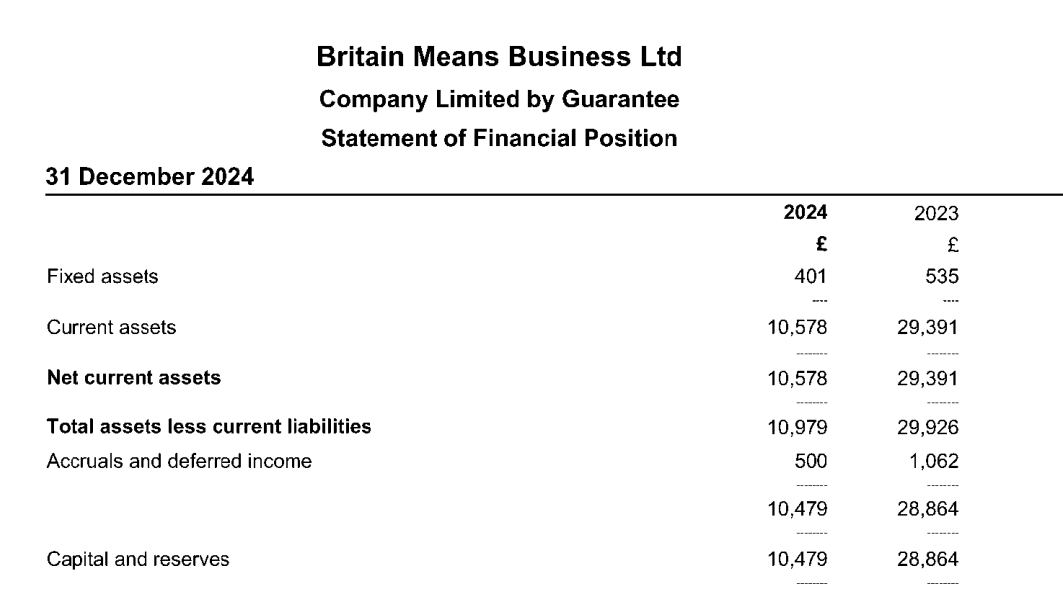
This raises questions about what happened to the remaining £575,000 of Fiona Cottrell’s transfer to Britain Means Business.
The chain of donations and transfers suggests that Tice may have used Fiona Cottrell’s transfer to his own company to convert the loan into a donation.
This poses awkward questions for Reform UK about the ultimate source of these donations, which are currently under investigation by the Metropolitan Police over alleged breaches of electoral law. It would be a criminal offence to obscure the source of a political donation.
Elections Watchdog Assesses Reform UK’s £30,000 Private Flights Donation
Exclusive: Watchdog escalates inquiry into Nigel Farage’s party amid questions over whether the true source of the money was concealed
The accounts also show that the party received an interest free loan of £1 million last year, £250,000 of which has been paid back.
The Electoral Commission’s donations database shows that this loan was from a Mr Malcolm Robinson, who remains to be identified.
Other notable revelations from the accounts show that Reform UK is the party that is most reliant on donations and has built up a £11 million+ war chest.
The documents show that Reform UK is the party that is by far the most reliant on political donations, relative to other forms of income such as membership dues and sales of merchandise, with donations representing 71.1% of its income.
The party that was second most reliant on donations was the Conservative Party, with donations representing 48.3% of the party’s total income.
The Labour party’s total income, at £44,601,000 was greater than Reform UK’s £31,862,420. However, Reform received the most money in donations overall, raking in over £22.8 million compared to the Tories, £14.9 million and Labour’s £6.4 million.
The Greens took in over £2.7 million, largely in small donations, which came to 37.9% of its total income. The Liberal Democrats meanwhile took in £2.6 million in donations which represented 31% of the party’s total income for the year.
The Labour Party’s income almost halved from the general election year in 2024, and the party has been left with a £2.5 million deficit that it will need to fill. It is understood that the party’s accounts, which are made until 31st December 2025, do not reflect the current state of the Labour Party’s finances or the size of the party membership.
Reform UK on the other hand had a cash surplus of £11.9 million, giving the party a substantial war chest.
The party has been in near permanent campaign mode since the election in 2024, holding rallies, press conferences and stunts all around the country.
This high-intensity campaign is being financed through Reform’s donations and is evidenced in their accounts. The party’s campaign spend increased between 2024 and 2025, despite 2024 being a general election year.
In the general election year 2024 Reform UK spent £4.24 million on campaign costs. But, in 2025, a year in which there were only local elections and a by-election in Runcorn and Helsby, Reform UK spent £4.37 million on campaign costs. Reform UK did not respond to Byline Times’ questions about what this £4.37 million had been spent on.
The accounts also show that beyond treasurer Nick Candy’s outreach to the multi-millionaire and billionaire tax exiles who make up much of the party’s donor base, Reform UK’s fundraising efforts seem to be falling flat. In 2025 the party spent £3.4 million on fundraising, but only returned £1.4 million in “fundraising income”. Reform UK did not respond to Byline Times’ questions about the gap between fundraising spend and fundraising income.
Green Party peer Natalie Bennett said: “The party donation system is in urgent need of a radical overhaul. Large donations from corporations and rich individuals distort our politics in favour of the rich and powerful at the expense of everyday people and the natural world.
“Reform has received millions of pounds from crypto billionaires and fossil fuel interests and has the climate-wrecking and dodgy-money incentivising policies to match.
Bennett added: “The Green Party has longstanding policies on capping donations and increasing state support for political parties based on their last election results which will help clean up our politics.

Reform UK Donations From Collapsing Firms Are ‘Not Under Investigation’ Says Elections Watchdog as It Calls for Loopholes to Be Closed
Anti-corruption campaigners warn the UK’s political system is open to abuse and infiltration by unlawful foreign finance
“I tabled amendments on restricting donations to the Conservative government’s Elections Act which were rejected by other parties. Getting Big Money out of politics is essential to restoring public trust.”
A Liberal Democrat spokesperson said: “There are serious questions relating to Reform’s political donations with unclear answers coming from Nigel Farage and the party.
“The public have the right to know where political donations come from and the Liberal Democrats welcome complete transparency.”