
 Subscriptions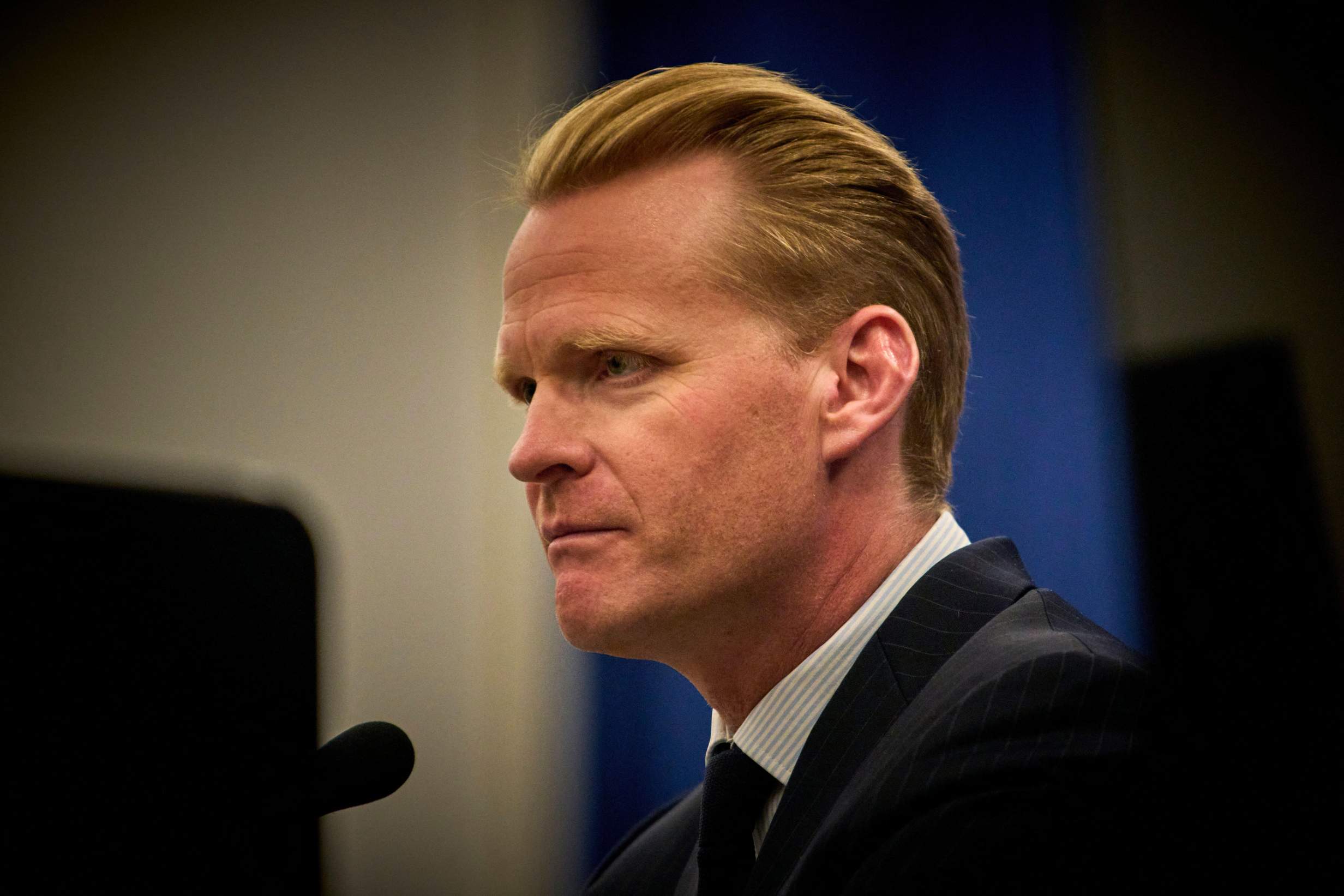

Read our Monthly Magazine
And support our mission to provide fearless stories about and outside the media system
“What is democracy, if not majoritarianism?”
The speaker was James Orr, Reform UK’s philosopher-in-chief. The setting was picturesque Hay-on-Wye in Wales. The event was HowTheLightGetsIn, a festival of philosophy and ideas. The audience was sceptical to say the least.
Orr was trying to make a distinction between “good” and “bad” law.
“Too much law today is about disagreement resolved through democratically unaccountable, technocratic, opaque, inaccessible procedures,” he continued.
When pressed on what precisely he meant, Orr fell back on a familiar populist shibboleth: the “will of the people”, which he contrasted favourably with unelected judges and bureaucrats.
The murmuring in the audience – punctuated at times by the odd heckle – made clear that Nigel Farage’s favourite philosopher had a different conception of democracy from the rest of the room.
Nevertheless, it wasn’t hard to see why Orr’s profile has risen in recent years.
He cut a dashing figure on stage – his outfit consummate old Wykehamist: blazer, cream trousers, casual loafers. He spoke in polished tones that betrayed a classical education.
Unlike so many others on the populist right, it is not a performance that comes with an array of pseudo-working-class affectations. Orr prefers literary allusions to dropped aitches or hard-knock stories about growing up on a council estate. He doesn’t purport to be a man of the people. Instead, he is an elite anti-elitist: a much more interesting proposition.
It is hard to get away from the sense that, for Orr, democracy means the ability of the majority to do as it pleases.
As anybody who has tussled with the Reform set in the years since the Brexit Referendum will be aware, any deviation from this line leaves one susceptible to accusations of elitism – that most unfashionable of monikers in these populist times.
It’s, by now, a familiar schtick.
It is also fundamentally at odds with what most of us – and most of those in the audience in Hay, judging by the hooting and hollering that greeted many of Orr’s remarks – take to mean by democracy. And yet, it is central to the Reform worldview. Orr is, after all, the party’s Head of Policy.
At least two members of the panel informed Orr that there is more to democracy than elections every five years. Indeed, one speaker – the lawyer Philippe Sands – likened Orr’s arguments to those of the German political theorist Carl Schmitt in the 1930s. Schmitt, who joined the Nazi Party in 1933, became one of the regime’s most notorious legal theorists, offering a justification for emergency rule and the subordination of law to political authority.
But let’s not get ahead of ourselves. One doesn’t need to indulge in overblown comparisons between the Britain of today and 1930s Germany to recoil from loose and irresponsible talk of the ‘will of the people’. The Nazis, to be sure, ruled by decree rather than majoritarianism.
But it seems incontrovertible that majoritarianism can lead to some dark places. And one need not draw on Nazi Germany to find them: the recent example of Hungary demonstrates how an elected government can use democratic mandates to hobble pluralistic institutions.
Perhaps it’s no coincidence that, before Viktor Orbán was ousted in April, leading figures in Reform treated the country as a shining city on the hill.
“I’ve just spent four days in Hungary, a conservative country criticised by elites across the West,” wrote Reform politician Matthew Goodwin in 2024. “I saw no crime. No homeless people. No riots. No unrest. No drugs. No mass immigration. No broken borders. No self-loathing. No chaos.”
Orr’s intellectual hero, the late philosopher Roger Scruton, was a regular guest of the regime in Budapest: he accepted ‘honours’ from Orbán in 2019 and was canonised following his death in 2020.
Some of these intellectual fellow travellers have been associated with institutions benefiting from Budapest’s largesse. The Good Law Project has reported that Goodwin received a salary of up to €10,000 a month from a Hungarian-based pressure group (Reform has disputed the figure).
Meanwhile, Orr sits on the board of the Roger Scruton Legacy Foundation. According to the Good Law Project, the foundation received more than £512,000 from the Mathias Corvinus Collegium (MCC) – Hungary’s largest government-backed private educational network – representing more than 90% of its funding.
Learning and Breeding
Born in November 1978 in Brussels, Belgium, Orr’s CV is establishment to the marrow. Winchester, Balliol, City law, Oxford, Cambridge. But he has since become one of the more important intellectual operators around the insurgent right.
He chairs the Edmund Burke Foundation, the organisation behind the National Conservatism movement. In 2025, he became involved with the Centre for a Better Britain, the Reform-adjacent outfit based in Millbank Tower. Orr has suggested that the CBB will work with “any promising young person who is dedicated to a politics of national preference”.
Like a number of national conservatives, Orr appears to have passed through two stages of radicalisation.
The first followed the EU Referendum of 2016.
In Orr’s telling, this marked the end of what he calls the “long 20th Century” – a play on a phrase used by historian Eric Hobsbawm to describe the period that fell between the outbreak of the First World War and the collapse of the Soviet Union. In a 2025 interview with The House magazine, Orr described this as “the twilight of liberalism”. He believes that we now live in a post-liberal epoch in which the old certainties are being swept away.
He may well be onto something.
If the people have lost faith in the ‘technocracy’ (of which Keir Starmer is perhaps the standard bearer) then that may be because competent stewardship of the system is no longer a priority for many voters.
How could it be when so many believe that the present system is decrepit and failing to deliver?
Managerial centrism is merely the latest in a long line of gods that failed. And so the door has swung invitingly ajar for those, like Orr, who hold out the tantalising promise of national renewal if only we extricate ourselves from the tyranny of these technocratic elites.
Many of Orr’s arguments will be familiar to anyone who has followed politics closely over the past decade. They are not especially original; what matters is the function they serve.
He believes that the Brexit Referendum shattered old tribal loyalties and represented a revolt against global elites. He espouses a politics that, in his own estimation at least, is beyond left and right.
The second stage of Orr’s evolution arguably came in 2020, when the George Floyd protests both here and in the United States convinced many on the right that liberalism had hardened into a rival faith.
It is here that Orr’s writings betray a lopsided and tendentious conception of politics: liberals seek radical change while the right merely reacts to it.
In this account, Trumpian lawfare is a response to liberal judicial overreach. Islamophobia is a blowback linked to rapid demographic change. The insurrection of January 6 was a product of the disorder of the George Floyd protests.
Every outrage of the right is an outgrowth of the radicalism of the left.

Orr is far from the first to attempt to tie up right-wing radicalisation into a neat and tidy ‘equal and opposite’ formulation. As the historian William Hogeland has argued, the claim that political violence migrated from left to right after the Floyd protests requires a convenient amnesia about the American right: its militia movement, the standoffs with government, the paramilitary fantasies, and the anti-government violence that long predated 2020.
What is undeniable is that 2016 and 2020 were pivotal moments for post-liberals or national conservatives or whatever else one prefers to call them. This is the world inhabited by Orr and his Reform UK stablemate MP Danny Kruger, not to mention their mouthpieces in the media such as GB News.
There may also be something else going on of course.
As has been observed by Orwell and others, English public life has a peculiar tolerance for people who look and sound as though they were born to rule. Give a man the right accent, the right school, the right tailor, and a booming voice and ascension is all but guaranteed.
James Orr has these things in abundance – which might explain some of the obsequious profiles that have appeared in recent times.
Amol Rajan recently introduced Orr on the BBC podcast Radical as the “intellectual architect of Britain’s new right”. Politico has described him as “the philosopher king”. Other media outlets have referred to him as Nigel Farage’s Svengali.
This appeal extends beyond the corridors of the establishment media.
During the event in Hay, I was struck by one conversation I overheard as the event wrapped up, in which one audience member said quite plainly that he was almost taken in by Orr’s polished prognostications. “First of all I thought he was alright,” the man told his friends. “He talked quite well, but then I realised his politics are horrific and he’s just trying to get me on side.”
The feeling was shared by several others I spoke to there.
They ultimately saw through the veneer of learning and breeding – though one wonders how much this matters when so much of Westminster media culture remains credulously susceptible to the penumbra of Oxford rooms and old school ties.
Liberalism After Christianity
James Orr has described himself as “functionally atheist” as a student at Oxford. Having earned a reputation for partying during his student days, he later rediscovered Christianity via the Holy Trinity Brompton Church in London’s South Kensington and its ‘Alpha’ course. From there, in Orr’s telling, “the politics followed”.
That sequence is important.
Orr’s reactionary politics is not merely a set of positions on Brexit, judges, immigration, or ‘wokeism’. It is downstream from a recovered metaphysics.
“Can we still have an ethos if we don’t have an ethnos?” Orr asked Reform MP Kruger during a recent podcast appearance. Kruger defected from the Conservatives to Nigel Farage’s party in September.
For Orr and his allies, the post-Floyd backlash is evidence that secular liberalism has generated its own surrogate religion: wokeism is “liberalism on steroids” for Orr. In common with others on the radical right, he considers left-wing progressivism to be a surrogate faith.
John McWhorter’s book Woke Racism was subtitled How a New Religion Has Betrayed Black America. Andrew Sullivan has described wokeness as a creed for a post-Christian age, filling the spiritual hole once occupied by Christianity. In the Spectator, the response to Floyd’s killing was cast in explicitly religious terms: rituals, hymns, almsgiving (though more excitable pundits preferred the comparison to Maoism).
The point, made with varying degrees of hysteria, is always the same: liberalism, having abolished God, has ended up reinventing sin.
If woke is the name given to liberalism after Christianity – a substitute creed of guilt, purification, and moral discipline, untethered from the nation and hostile to inherited, not to say hierarchical, forms of belonging – then a healthy politics, according to Orr, must be grounded in the “pre-political”. Otherwise secularism creates a vacuum filled by ideological substitutes.
Orr blames secularism for “all of the nightmares of the 20th Century”, including Stalinism and fascism. It is a familiar argument among apologists for religion, and not a persuasive one.
The horrors of the 20th Century were not simply atheism with banners. But the historical crudeness matters less than the political function of the claim.
If secularism is at the root of modern tyranny then liberal neutrality becomes the gravedigger of the open society. Indeed, Danny Kruger has described liberalism as a “false faith”.
‘Politics of Community and Home’
Orr is that rarest of beings: an intellectual of the radical right. This is not to elevate him to the role of “philosopher king” of British populism, as the BBC seemed to. But, up to now, Reform has been so intellectually barren that a fluent political theologian can begin to look like one.
In Orr’s hands, Reform’s familiar complaints – about borders, judges, quangos, woke institutions, and liberal elites – are folded into a larger narrative about metaphysical disorder. Britain is not merely badly governed, but has lost the sacred canopy under which government, law, and belonging once made sense.
This is also why Orr’s language so often sounds less like ordinary conservatism than a species of political restorationism. The object is not simply to win elections or trim the size of the state, but to resurrect a moral order that liberalism is said to have dissolved.
It is also perhaps why he gets on so well with spokesmen for the ‘Blue Labour’ tradition such as Maurice Glasman. Both operate through the prism of nostalgia, harking back to a vanished post-war order that valued hierarchy, continuity, and tradition. Liberalism is accused of having washed all of that away, whether via Thatcherite economics or woke identity politics.
It is Orr’s contention that “no society can be free if its members are free to do as they please”. As he writes: “Loyalty, honour, obedience, humility, responsibility, moderation, trust: none of these virtues can take root in a society of individuals who refuse to fetter their egos and their appetites or who insist that the bonds that stitch any commonwealth together should be severed rather than strengthened.”
And yet, Nigel Farage will strike most observers as an unlikely agent of community and moral virtue.
The Reform Leader is an unrepentant Thatcherite who wants to see more, not less, privatisation. He has been married twice and built his public persona around pints, cigarettes, and the accumulation of wealth. Farage’s thoughtless past remarks about everyone from Romanians (he would be concerned if a group of men moved in next door) to British Muslims (a “fifth column”) hardly smacks of Christian charity.
Orr and Kruger may talk a good game when it comes to communitarianism, but any future Reform government with Farage at the helm would almost certainly seek to go the other way. For all of his highfalutin theological prognostications, Reform’s resident theologian has yet to adequately explain how tax cuts for the rich and the privatisation of state assets will strengthen the “commonwealth”.
It is very well to rail against the “atomisation of modern society” and “the shattering of civic and economic harmony”, it is quite another to throw your lot in with a policy offering that precludes any reversal of such trends.
It wasn’t the phenomenon that Orr belittles as “wokus pokus” that flayed the bonds between citizens, nationals, and residents – it was the market, whose ‘invisible hand’ Farage threatens to unleash still further.
Last year, Farage said that a Reform government would prioritise deregulation and “free businesses to get on and make more money.” This vision of a minimalist state would leave many of the things that Orr professes to care about to the winds of fate.
Indeed, charismatic self-confidence can only take the Reform coalition so far.
It doesn’t take a soothsayer to predict which ideological tendency is more likely to get what it wants from a Reform government. For all of Orr’s woolly talk of the politics of community, it is hedge funds and speculators who will surely be cheering a Reform victory the loudest.
The contradiction becomes still more apparent when Orr turns from the UK to Ukraine.
For a thinker so invested in sovereignty, nationhood, and the moral claims of ‘home’, Russia’s invasion ought to present an open and shut case. Here, after all, is a smaller nation defending its borders, its language, its institutions, and its right to exist against an imperial aggressor.
But among the post-liberal right, Ukraine has often become not a test of national sovereignty but a proxy for globalism, liberal interventionism, and the hated European order.
Orr has dismissed the war as a “regional Slavic conflict” and urged Reform to prioritise “Kent over Kyiv”. He has also accused those who demur of suffering from “Ukraine Brain”. The language of national sovereignty, it seems, stops at Dover.
This is why the Hay exchange matters.
Orr’s majoritarianism belongs to a larger vision in which the people, England itself, and the moral order are imagined as one; meanwhile the institutions that restrain power are depicted as the enemy.
The danger does not come from a well-bred ideologue indulging in intellectual peregrinations from the sidelines. It comes from the veneer of respectability he provides to a politics that seeks fewer restraints, fewer mediating institutions, and less liberal democracy – all in the name of restoring England to past glories.
As Associate Professor of Philosophy of Religion at the Faculty of Divinity at Cambridge University, James Orr is no doubt familiar with the biblical injunction to beware of false prophets. Those tempted by Reform might usefully reacquaint themselves with it too.