
 Subscriptions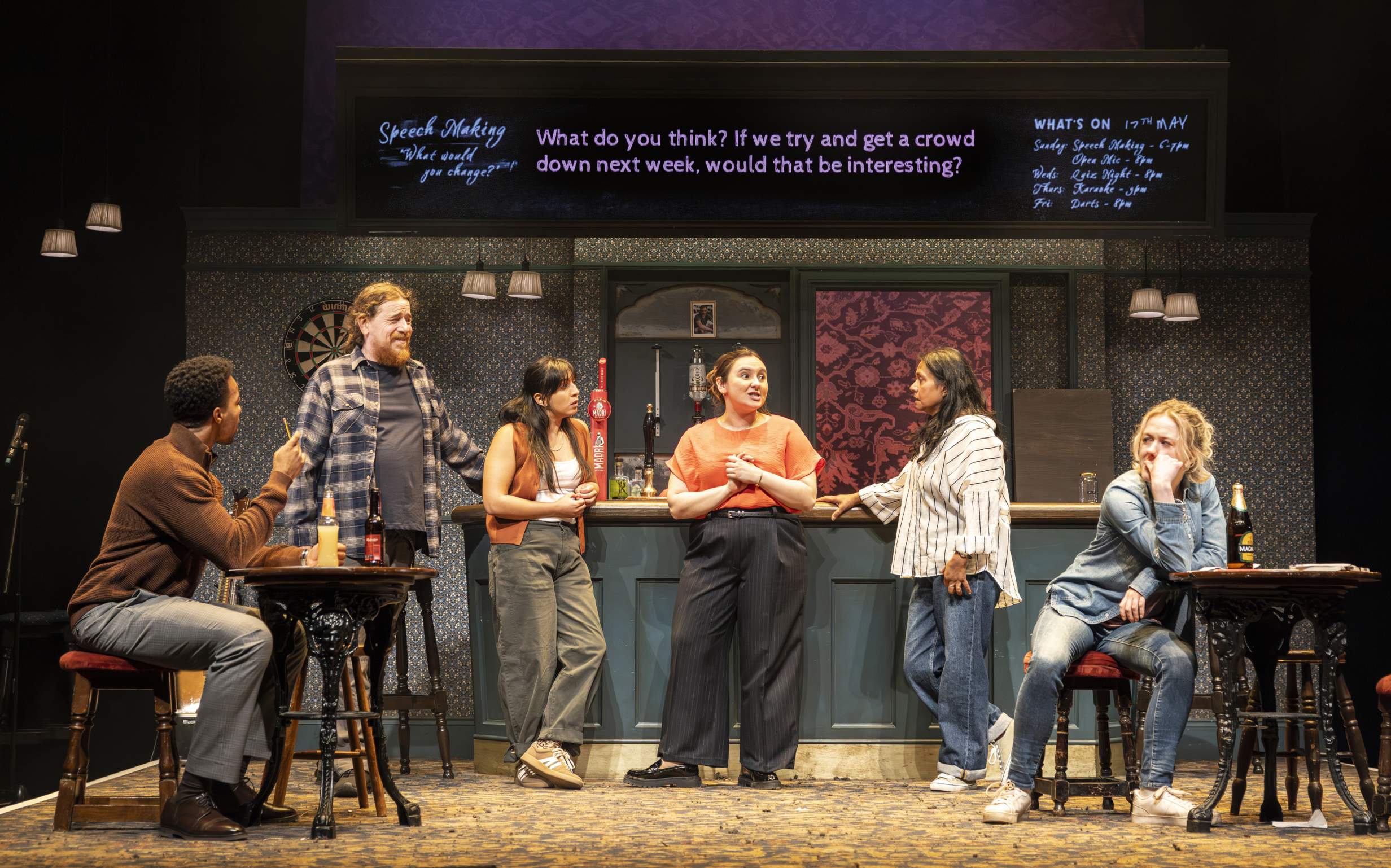
Read Our Monthly Magazine
And support our mission to provide fearless stories about and outside the media system
Our Public House is a ‘state of the nation’ musical drama exploring the alienation people feel with politics through the lens of community, identity, change, and grief. How did this timely project come about?
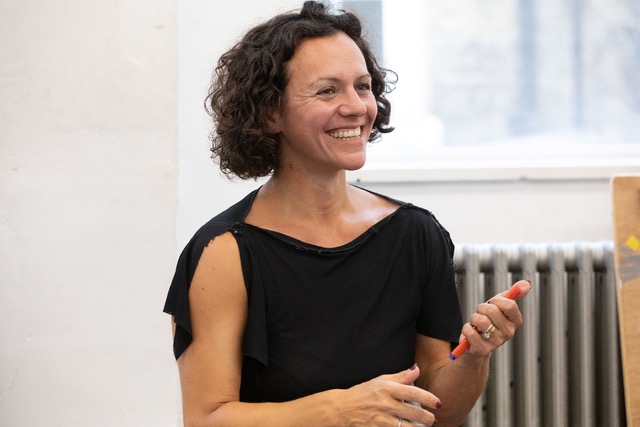
JB: I wanted to do a show that explored who we are as a country. At Dash Arts, we had been thinking about what it was to be European, and then our gaze turned to Englishness and England and how to create a ‘state of the nation’ piece of theatre. In that search for a narrative and a story and an idea, I met an academic, Alan Finlayson, Professor of Political and Social Theory at the University of East Anglia, who said ‘you know, we all have this ability to articulate the things we feel passionate about but we don’t necessarily have the tools to do it’. So we conducted a workshop programme around the country helping people to talk about what they felt wasn’t working and what could change. I had this instinct that the stuff, the data, the thoughts, the reflections, the dreams, and the ambitions would be an incredible reflection of who we are as a country and who we could be.
We heard a lot of incredibly diverse reflections because we built a research process that enabled us to go to council estates, deaf communities, women’s prisons, schools, activist groups, old age homes, working men’s groups; to Cornwall, Sheffield, Liverpool, Norwich, all over the country, bits in between and above. Then I found a wonderful playwright, Barney Norris, and we thought about what the play could be. I had a feeling it would be great to set it in a pub, that this would be the place to talk about who we are as it is quintessentially English, but also it is somewhere some people feel included and some people don’t feel it’s for them – I thought that was an interesting metaphor for where we are at [as a country] at the moment.
I also had a feeling that it might be interesting to use The Tempest as an inspiration, as opposed to a direct adaptation of the text. Barney and I sat down and started saying ‘who are the characters in The Tempest and what is the magic that could be wrought on the place like Prospero creates the storm? What’s our storm?’. Barney had this brilliant idea that, rather than the play following a group of people who don’t want to vote, they would take an active position – so the plot developed of people in a constituency who decided to spoil their ballots because they didn’t feel the politicians [on offer] represented them. So, much like Prospero creates the storms on the seas that brings everyone onto the island, in our play we have a storm of this mass spoiling of an election ballot which brings all the attention and focus on the place, the pub, which is called ‘The Albion’. The six characters have definite connections to Shakespeare’s Miranda, Ferdinand, Prospero, Caliban… they are very much well-rounded, naturalistic characters in their own right. Barney and I explored the conversations that could happen in a pub. Then we brought in some music.
We’ve also woven in speeches from our participants in the workshops into the play because that felt incredibly important – we didn’t just want to be inspired by these voices and then not have them have anything to do with it going forward. We met over 700 people in the workshops and every character in our play delivers a real person’s speech which I felt had some resonance with the character. Our composer, Jonathan Walton, turned those speeches into songs.
And, really importantly, every night across the run, at the very beginning of the second act, we have two speeches [delivered by] local people who have been working with us [through the speech-making workshops]. As the world of our play expands, so does the cast.
What were the issues that people were raising as affecting their lives in the workshops again and again that you found striking?
I learned how complicated the country is and, yet, how many people still think that the issues are the same – everyone is struggling with the cost of living, with housing, with waiting lists for the NHS.
But it’s not that I went around the country and heard everyone air their grievances – it was an incredibly productive process that was positive and inspiring. We’d go into the room and say ‘we’re here to help you make a speech about the future’ and what we could do to make things better for everyone. People would explain their life experience and what had happened to them and there was always a proposed solution. Because it was always from people’s lived experience, [there was a sense of]: this happened to me, and as a result, I feel like I’ve seen a different way of doing it.
One of the characters in our play, Tom [who plays a special advisor to the Labour parliamentary candidate], shares a speech by an individual we met in a workshop in Norwich about how, when he was 17, he came home from school one day in the middle of his ‘A’ Levels and his mum had packed up their car [with their belongings] because the landlord had put their rent up [which she couldn’t afford to pay so] that night they moved to Luton. He believed no child should ever have that happen to them and that’s why we need rent controls.
The speeches represent hope, a sense of possibility. We are definitely left feeling [at the end of the play] like there’s new stuff on the horizon – because we all need that.
What has it been like to craft a piece of art about politics against an ever-shifting political backdrop in which people are increasingly turning to alternatives to the main parties because they are so disillusioned with all establishment politics?
When we started writing the play in January 2024, it was still the Tory Government, and many of the speeches people wrote were about the dying embers of 14 years of Conservative rule. There was a sense of optimism and possibility for change in that there would be a change of government which might come in and sort things out. In the play, after the ballots are spoiled, another election is held – and into the pub walks a Labour candidate, Mary, and her special advisor. Mary is a politician who might do politics differently and is played by a brilliant actor, Gabriella Lyon, who is deaf, as is her character. So there is this irony that a deaf politician is the first one to really listen to the community. Obviously now, to be playing a Labour politician in 2026, is really very different from playing a Labour politician in 2024.
There was a moment earlier this year, around the time of the Gorton and Denton by-election [won by the now Green MP Hannah Spencer], when Barney and I sat down and asked each other ‘should Mary be standing for the Green Party?’ – because can anyone possibly imagine that Labour could win a by-election at the moment? [This interview was conducted before the Makerfield by-election was announced, after the Labour MP Josh Simons stood down in a bid for Labour’s Greater Manchester Mayor, Andy Burnham, to return to Parliament].
But we decided to stick to our guns and keep Mary as Labour because, in a way, she could be any politician for any political party who wants to do politics differently – she says ‘I want to create spaces and provide a platform for you to be heard, I want you to feel represented by people like you’. She sells that as her politics and it’s on that basis that she is elected, despite the party that she represents.
Last year, ‘Operation Raise the Flag’ saw Union and St George’s flags being put up around towns across the country –a campaign supported and organised by far-right activists such as Stephen Yaxley-Lennon (‘Tommy Robinson’) and Britain First. At the same time, ethno-nationalist thinking around who can be ‘English’ has been voiced by the far-right, and figures within Reform UK, positing that only ‘blood’ can make someone English or British. How does Our Public House aim to explore some of these complicated and contentious issues of political identity?
We made one of the characters in our play, Scott, Reform-leaning, and it takes a while to establish that but he outs himself as voting for Reform, because we deliberately wanted to set up a situation in the piece where he is confronted by accusations of racism because we really wanted to talk about it.
Our English pub is run by a British Asian woman, Sanjana, and her daughter, Anika, and to have one of the regulars potentially making racist comments in that space is very powerful and shocking. We talked in the rehearsal room about the permissiveness that this man now feels he has to come out and say something problematic, and how we feel that Reform has given him permission to do it and to do it more publicly than he would have felt able to even two or three years ago.
Since discussions in politics and the media around identity can often descend into simplistic soundbites and ‘culture wars’, it feels as if questions around difference and belonging can be explored in a more multifaceted way through art…
Despite the fact that we go to dark places, we have the space and time, and work with professional actors who have deep wells of emotional intelligence and physical experience in their bodies, to look at things in more nuanced, more interesting ways.
On first glance, Scott may appear to make a racist comment and the other characters judge him, and we as the audience will judge him – but then we have another hour to see beyond the surface and to understand that this character, this person, is much more complicated than that and that he loves his community, that he loves these people, and that he’s deeply kind, and yet, misguided. I think theatre can give you that – through the fact that you step into the space and time stands still; you choose to spend a ‘capsule’ of your life with characters who you can fall in love with and be troubled by and get to know. We all have those uncles and aunts and grandparents who say these things – and we still love them.
Theatre is a medium that allows you to look deeper, to understand, to put yourselves in other people’s shoes, to have empathy. Literature and film is brilliant at that too.
According to the British Beer and Pub Association, 161 pubs closed in the first three months of 2026 in England, Scotland, and Wales – the equivalent of approximately two pubs closing a day. Why are these types of community spaces so important to retain?
The majority of my new theatrical pieces are based in those spaces – in places that are almost like an extension of your living room and where you feel at ease and maybe more open to being confronted by stuff that you wouldn’t otherwise necessarily be prepared to [engage with] because it’s still somewhere you are familiar with and where you know people. But there is also a tension between that and the public and the unfamiliar. So it’s this very journalistic idea of afflicting the comfortable and comforting the afflicted. I think that’s what ‘third spaces’ do at their best.
Our pub in the play swings both ways – it’s incredibly comforting and lovely and fun and the characters joke; but then it’s also a place of deep tension and the odd fight.
How does class play out in Our Public House? Is it mainly working-class voices that are showcased?
Class is very present. It’s also about ‘them and us’ – there’s a line about ‘them in Westminster’, those “wokie-cokies”, ‘who’ve come up to tell us how we should be and how we should behave, but what do they know about us?’. It’s also about ethnicity and diversity, and that sense of the ‘left behind’. The play is also about grief. And about change: how do we move on and change where we are?
Because I made sure that we worked with speech-making participants of all classes and backgrounds and ages, we wanted to build characters in the piece that would reflect that. So we have the character of Jo, a young working-class woman who has been in prison and has a daughter in foster care. We also have a young Asian woman, Anika, who is a teacher and has come from a much more stable upbringing.
What do you hope people will take away from seeing this piece?
To feel like they have enjoyed themselves in some emotional way. I think real people sharing their speeches [as part of the performance every night] has the potential to be the most powerful part because it’s a moment of deep truth. If people leave having learned something and that inspires them, that would be success.
‘You Can’t Kick Your Shit Out of Somebody Else’
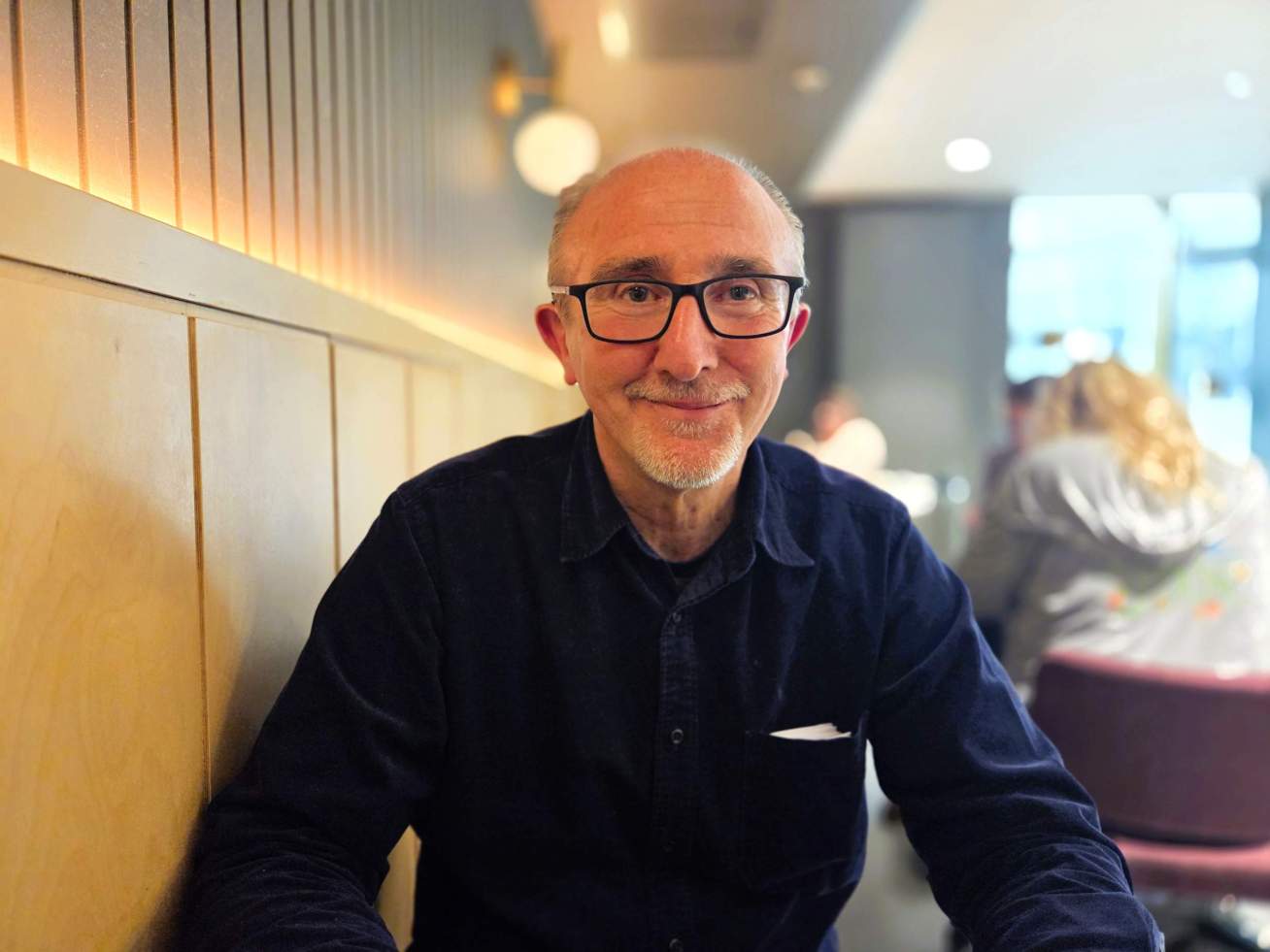
Seamus Doherty, 68, former council customer services manager, was a real-life speech-maker during a performance of Our Public House
What did the speech you delivered as part of a performance of Our Public House at the Leeds Playhouse focus on?
SD: The thing that was uppermost in my mind was the manosphere, Andrew Tate, and all his ilk, and I wanted to express something around that – and it felt personal because of my own history. My father died when I was 11. I didn’t have that male role model, but I also then realised that, even when he was alive, he wasn’t really there emotionally. I’ve had a history of alcoholism and addiction and, through recovery, I’ve learned to deal with and come to terms with my emotions. And I just look around and see so many issues in the world that are directly or indirectly because men don’t know how to deal with their feelings – that they don’t even know what they feel, never mind how to deal with it.
How do you think that notions of masculinity have evolved since you were growing up?
From the 60s onwards, men’s roles were challenged and men kind of lost their way. It’s not because of women’s rights, but a lot of men would see it that way, and I suppose part of the thing for me is that, in many ways, men are as big a victims of the patriarchy as women are. The other thing I’ve realised through my own experiences, and I’ve done it myself, but men in general, we expect to put all the emotional burden onto women and our relationships and expect them to carry all that. But, actually, there are things that I know I can’t [do that with and] I need to talk to a man about. Men need to connect with other men to deal with all sorts of feelings and cultural expectations.
It’s getting better. Well, it was getting better, but since the internet has come along, it’s gotten worse. So I make an appeal in my speech that, as men and especially as fathers, we need to step up, we need to get off the internet ourselves and start engaging with our boys, because otherwise we’re going to lose them to guys like Andrew Tate who step in and exploit that.
Are there any men in public life at the moment that you think are a good counterpoint to Andrew Tate?
[The actor] Pablo Pascal is quite a good example. He’s very tolerant, he’s very open, he will stand up and be honest about what he really thinks rather than like a lot of men who just keep quiet because they don’t want to put their head above the parapet in case it gets shot off. He’s not afraid to speak up [on these issues]. I think [the journalist and author] George Monbiot is another great role model.
Our Public House is a ‘state of the nation’ play exploring national identity and Englishness. What does the term bring up for you?
For me, one of the worst things that’s happened is Brexit. I’m from Derry, Northern Ireland, and I identify as Irish. A lot of people I grew up with would identify as British and call Derry Londonderry because there was always this divide. But the thing was, when [the UK was] part of the European Union, it didn’t matter – [the right to identify as Irish, British, or both citizenships] was baked into the Good Friday Agreement. So I was really worried when Brexit happened, because if they had brought in a hard border [between the Republic of Ireland, an EU member, and Northern Ireland] as they were talking about, we could well have ended up with a lot of scraps starting again and nobody wants to see that. I mean, the peace isn’t perfect, it’s not ideal, but at least people by and large are not shooting each other anymore. And that’s got to be a good thing, you know?
If you grew up where I grew up, people waving Union Jacks didn’t bode well for a weak Catholic boy – [those waving them] were usually the sort of people that, if they knew what my name was, would kick the shit out of me. So I don’t really identify as British. But I do identify as Yorkshire now. I love Yorkshire and I love Leeds, and I’ve lived in Leeds twice as long as I lived in Derry. So, although I have a great love for Derry and my roots are there, I know I’m going to end my days in Leeds and I’ve got really, really deep roots here.
Growing up in Northern Ireland during The Troubles must have provided important background context about understanding your own sense of masculinity and vulnerability?
I left Derry in 1981. Reading the memoirs of an array of men who were part of various paramilitaries and whatever, a lot of them talk about the same things that they grew up with in very deprived areas – and many of them had violent, abusive fathers. It’s not the whole story, but for a lot of them, that was part of it as well.
I know I had a period in my own life where I nearly ended up going on a lot of anti-Nazi league [marches] because I agreed with the cause, but people were telling me ‘oh yeah, come along because we get loads of rocks and we fight with the neo-Nazis’. I remember thinking to myself, hang on, this sounds really attractive – because I was full of anger – but then I had a word with myself and said ‘Seamus, you can’t kick your shit out of somebody else’, so I stepped back.
I think where I’ve shown the most courage in my life is actually just facing up to my own fear, my own insecurity, my own anger. It’s far too easy to prop yourself up and ‘act like a man’. If you face it, you find what looks like a shadowy demon in a cave – but if you turn around, actually, there is a tiny, frightened little child, and the shadow it throws looks like a demon, but it’s not. The bravest thing you can do as a man is look after that little child.
Take a step, and the bridge will appear.
‘I Don’t Understand Why Community Seems to be Much Easier for Some People and Not for Others’
Kylie Tilford, 55, English teacher, was a real-life speech-maker during a performance of Our Public House
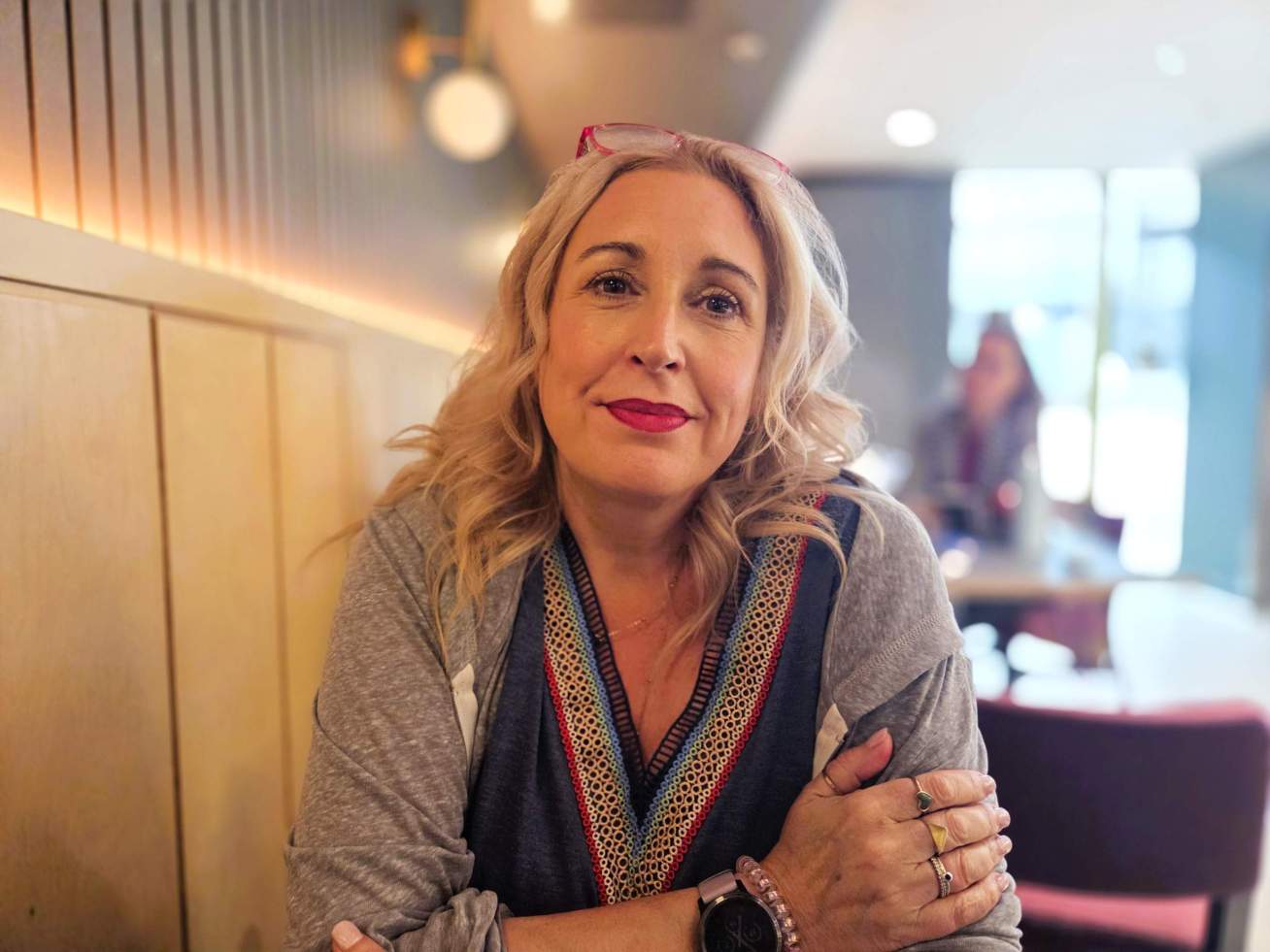
The play explores why people feel so alienated from politics. Why do you think this massive disconnect has happened?
KT: A lot of it is this concept of a ‘bubble’, particularly on social media, because a lot of us probably spend more time in our virtual lives, rather than looking at policy, and hearing the voices of those people around us – and if you’re in your little bubble, your sounding boards are coming back with the same message, and I think that’s the issue. Social media unfortunately breathes alienation. The echo chamber doesn’t allow you to develop a dialogue or understand other ideas.
Reform run on one message and the difficulty for me that I can’t get my head around is why intelligent people that I know look at that one message and say ‘this is what we need to work towards’, but they’re not looking at what Reform [say they want to do] to the Human Rights Act and how that’s going to impact others. Or what Reform are saying about sexual health for women. Or the LGBTQ+ community. If those people could look beyond that one message that the party has, they’d start to understand but they’re in that echo chamber where that one message is repeated again and again by like-minded people. You could argue that I’m in that position where, obviously, I know I’ve got social messages coming to me as well, but I like to think I’m a little bit more open-minded.
It’s the apathy as well that really scares me. We’re looking at 2028 when 16-year-olds are going to be able to vote and, at the moment, we teach them about democracy and what elections mean – but we don’t actually teach them how to be discerning voters.
What did the speech you delivered as part of a performance of Our Public House at the Leeds Playhouse focus on?
My speech might have been a lot different if the workshop had run after what’s just recently happened in the local elections [in which Reform UK made significant gains]. When you think about the narrative of this play, where it’s looking at a community of people who didn’t feel they had any voice and they didn’t feel that any of the politicians were actually listening to them – I think it should be looked at as a cautionary tale, because we do need to understand [who and what we are voting for] rather than just voting for a label; a party. We need to look and see who these [local] councillors are and find out more about them as individuals and what their hopes and dreams are for our community, beyond the badge that they wear.
The speech I made in the play was about the loss of green space. The fact that, in the Victorian era, all of these philanthropic men who had lots of money, they weren’t trying to put cars into space, they built wings in hospitals, they donated money for a library to be built – and many of them donated to their local communities and so there was a lot of community land they paid for to belong to the people. In today’s day and age, the upkeep for these pieces of land, these green urban spaces, where people play football and walk the dogs or take their children out to play – they cost too much and so many councils are selling them, particularly near me.
When my boys were little we had a beautiful big field that everyone played football on and the local football team played on it as well. But then the land was sold to the football team and it put big green fences up and, unless we were prepared to pay for our kids to join the football club, they could only look on. I know from my job as a teacher that many parents can’t afford to pay for the privilege for their kids to actually have an open space to play football on. So it’s just thinking about how we as a community need to come back together again and maybe look at community asset transfers, look at ways that we can actually save this land for young people.
We complain all the time about young people being sucked into social media, about the manosphere, and the idea of young men being disillusioned with life. And yet, I feel we’re almost driving them online because there aren’t any physical spaces, and what spaces there are we’ve given them grief for hanging out there or for being there at night because people say that they’re frightened of them. So we need these spaces to be conserved. That is what those philanthropists did, they left this land for our young people and for our communities, and we’re just losing that.
The play explores Englishness. What does it mean to you?
As a teacher, we teach British values, but British values are a respect for justice, taking care of one another – if you look at what British values are, it’s not about putting a flag up, it’s not about saying ‘I’m British because I look like this and you’re not because you look like that’. It’s about saying ‘we’re all part of this country, of this community, and it’s about living together in a melting pot of different ideas’. Our country wouldn’t be what it is today if it wasn’t for all the immigrants – European immigrants who came over in the war, the Windrush generation… I think we’re incredibly foolish if we think that, somehow, immigration is the problem. Immigration is actually what makes Britain great, and that is something we talk about when we teach British values.
We should all celebrate this incredible melting pot that is our islands, that has invited people to live here and join us. I have white privilege. I’m a white middle-class woman so I can’t pretend to understand what I know some of my students, for example, have experienced. I have probably made mistakes and said things that are inappropriate. But, for me, I don’t see anybody from any other culture who’s telling me that I have to be like them, so why are we telling people what they have to be like? I don’t understand why community seems to be much easier for some people and not for others.
Our Public House is touring until 4 July. For more information visit www.dasharts.org.uk/our-public-house
Hardeep Matharu is the Editor in Chief of Byline Times