
 Subscriptions
Read our Monthly Magazine
And support our mission to provide fearless stories about and outside the media system
The weekend before Sadiq Khan was first elected as London Mayor in 2016, the Mail on Sunday ran a full page article about him, written by his Conservative opponent Zac Goldsmith, which was illustrated with a blown-up London bus. The headline, “On Thursday, are we really going to hand the world’s greatest city to a Labour party that thinks terrorists are its friends?” made its message crystal clear.
For Khan, who was bidding to become the UK’s first directly-elected mayor of Muslim faith, it crossed a dangerous line in our politics that he believes his opponents have never stepped back from.
“If you recall [Adam] we had a conversation in advance of that election in May 2016 about one of the reasons why we were nervous… was what impact this dog whistle, megaphone type of racist, anti-Muslim, Islamophobic campaign would have [on our politics]…” Khan tells Byline Times.
“At the time, that was the first outrageous campaign of its type which, rather than an exception, has now become normalised.”
In the end Londoners rejected Goldsmith’s campaign, electing Khan not just once but three times. Yet for many on the far rght, these victories merely became a symbol of how London had “fallen” to Islam
Chief among these was the US President Donald Trump. From early on in Trump’s first term, the US President repeatedly amplified and directed those attacks against Khan, using social media and interviews to accuse him of seeking to impose “Sharia law” on the UK capital. It is a message that has since been picked up enthusiastically by Trump’s followers on both sides of the Atlantic
Two years ago the Trump-supporting Conservative Vice Chairman Lee Anderson repeated the sentiment, telling GB News that “Islamists” had “got control of Khan, and they’ve got control of London.”
At the time Anderson was suspended from the Conservatives by its then leader Rishi Sunak over his comments, before defecting to Reform UK.
Yet as Nigel Farage’s party rose in popularity, so too did the Conservative appetite for this particular form of Trumpian anti-Muslim politics.
Earlier this year the Conservative Shadow Lord Chancellor, Nick Timothy, attacked Khan for holding Iftar celebrations in London’s Trafalgar Square, describing it as an “act of domination” by Muslims. Yet while Anderson had been suspended for his similar suggestion, Sunak’s successor Kemi Badenoch defended her colleague, insisting that he had merely been defending “British values”.
Watch Our Full Interview With Sadiq Khan
For Khan, who has repeatedly held similar events, not just for Muslims, but also for Jews, Christians and followers of other faiths, it felt like another line had been crossed.
“I say this in a respectful way, the British Muslims I speak to don’t seek to dominate,” Khan says.
“They seek to do good. We don’t seek to take over. We try to give back.
“And I’m worried about this mainstreaming of things that were on the periphery, not from the BNP or the English Defence League or from Stephen Yaxley Lennon, but from Her Majesty’s official opposition’s Shadow Lord Chancellor, backed up the next day by the Leader of the Opposition…”
“And It troubles me. It upsets me. It makes me angry”.
This mainstreaming of anti-Muslim politics has had a direct impact on his own safety.
Unlike Khan’s predecessor Boris Johnson, who felt safe enough to cycle freely around the city as mayor, the constant racist threats against Khan and his family have forced them to surround themselves with a 24 hour security team.
“I’m not asking for sympathy,” Khan says.
“But it can’t be right, it can’t be fair that I require police protection. This can’t be right. I mean, I’m somebody who enjoys riding around, using the Tube, using buses, going for walks, going to the cinema, going to restaurants, seeing mates. It surely isn’t fair that I need police protection to do those things.”
Khan fears the treatment he has received as the UK’s most prominent Muslim politician will have a knock on effect on those considering following in his footsteps.
“Now here’s the problem,” he says.
“The problem is, if you’re a young person, if you’re particularly a woman or an ethnic minority, a Muslim, thinking about politics, why would you put your head about the parapet? Why would your parents encourage you to do so when they see my experience?
“It’s not great in terms of the experience I’ve had. And I say this in the context of having been friends with Joe Cox, I knew David Ames. The mayor of Gdansk was assassinated, the former Prime Minister of Japan was assassinated. President Trump had a threat to his life. You know, that’s not normal in democracies and that shouldn’t be the price you pay to stand for office.”
Big Tech Target
One of the things that has changed since Khan became mayor is the dominance of social media algorithms over our politics.
During his first campaign for London mayor, the biggest media obstacle he faced was a series of critical newspaper sandwich boards plastered across the city by the now defunct Evening Standard newspaper.
Ten years on and the city’s only dedicated daily newspaper has long since shut its doors. Yet it has been replaced by an increasingly deafening social media space in which London and its Muslim mayor are routinely used and monetised by far-right accounts with huge global audiences.
The result is a massive proliferation of disinformation, says Khan.
“I think what we have now is an outrage economy.
“And this outrage economy is built on a division dividend. You can call it ‘decline porn’, and you have people and companies profiting from poison and division.
“So I recognise I’m clickbait. I recognise that I’m being monetised. But also London is being monetised in this outrage economy.”
Last year Khan commissioned some research which uncovered the global nature of the problem.
“There are people in Vietnam and Sri Lanka making huge amounts of money from denigrating London, spreading disinformation. We know that there are Russian state-backed, Chinese state-backed, MAGA-backed groups amplifying this disinformation.
“We recently did some analysis. Thirty-nine per cent of negative stories around knife crime were pushed by the extreme far right. Twenty-five per cent of misogynistic stories dealing with violence against women and girls were pushed by the extreme right.
“And there’s two things happening which are both fascinating and scary and should be addressed.
“One is people monetizing this outrage economy, the ‘division dividend’ that I talked about, across the globe. Secondly, people pushing this narrative for their own self interest, and you mentioned President Trump, let’s be quite clear, objectively speaking, if President Trump was here, he would say himself, ‘I’m a nativist, I’m a unilateralist, I’m a protectionist’. If you’re somebody who believes in mono-ethnicism, who believes in the superiority of Christianity. He’s somebody who’s a nationalistic and he’s obviously got a problem with London. Why? Because we are diverse, we are liberal, we are progressive…”
“So if you’re President Trump or one of his supporters and acolytes and the coterie, you’re thinking, ‘oh my God, London is the antithesis of all I believe in, and that’s why we’ve got a target on our back.”
Khan believes the Big Tech platforms hosting this disinformation need to be held to account.
“I think Big Tech is in danger of making the same mistakes as Big Tobacco,” he says.
“So Big Tobacco knew six decades ago that nicotine is addictive. Tobacco is a killer, makes you sick, causes all sorts of problems. Yet they hid that and advertised tobacco, got people addicted on this stuff.
“There was huge litigation which made sure they were culpable and liable. Well, actually, Big Tech is similar. It’s addictive. We know this from infinite scrolling. There’s been two cases recently in Los Angeles and New Mexico. We know they are monetizing this division dividend. And we also know that some of the consequences of their amplification is the extremes. You know, people have been cited, groomed, radicalised, to do bad things. And I’ve written to the [managing directors] of all these big companies putting them on notice.”
Air Wars
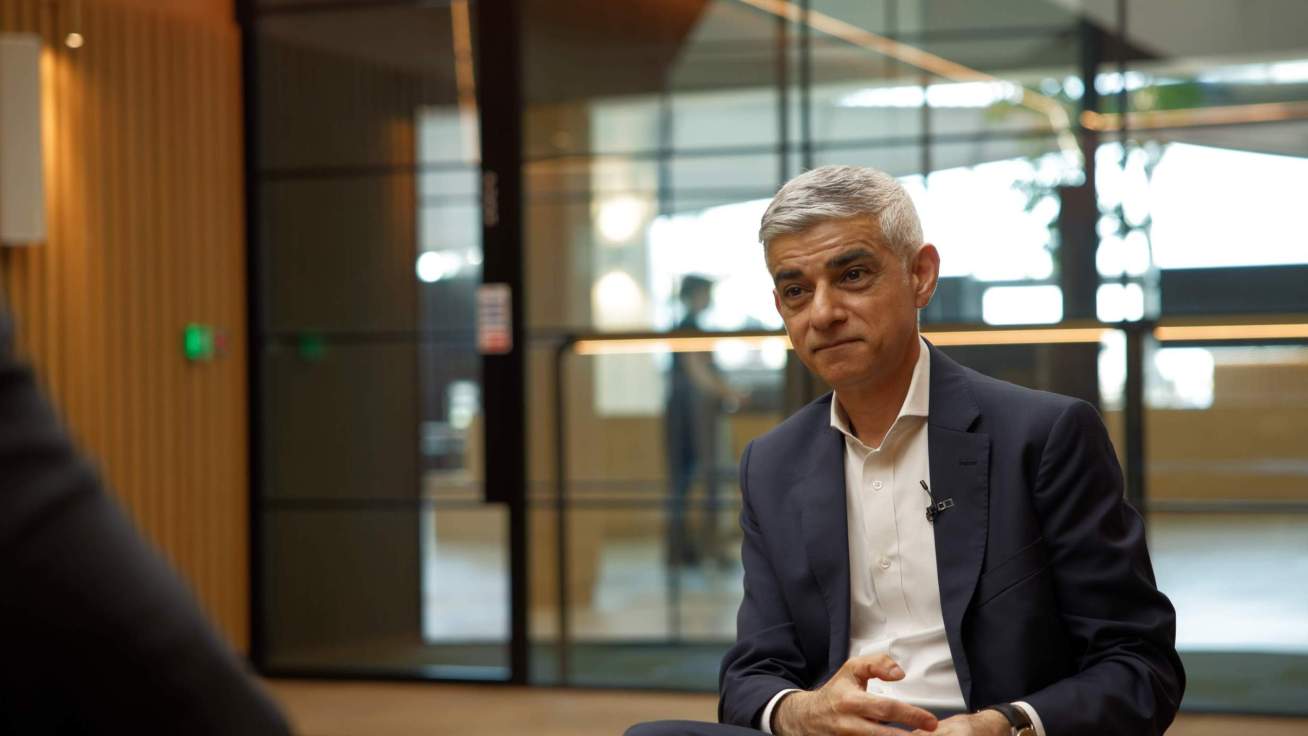
It’s not just Khan’s political opponents who he has clashed with over the past decade, but his own party colleagues as well. In 2023 the Labour party narrowly lost the Uxbridge by-election in outer London to the Conservatives, following a campaign in which Sadiq Khan was heavily criticised over his plan to extend the city’s ‘Ultra Low Emission’ vehicle charging zone to the outer suburbs. Faced with a surprise defeat in what should have been a winnable seat for the party, Labour’s leader Keir Starm