
 Subscriptions
Read our Monthly Magazine
And support our mission to provide fearless stories about and outside the media system
The United States is a competitive autocracy. The constitutional architecture that once sustained American democracy has become the very mechanism driving its decline: a rigged Supreme Court, an unamendable constitution, structural overrepresentation of rural conservative states, and a self-reinforcing feedback loop between oligarchs, the courts, and the ruling party.
Whenever I speak with Canadians or Europeans about what has gone wrong with the United States, there is always a mixture of sadness and hope — hope that America will come to its senses. When I try to explain why that hope is forlorn, there is usually a “well, what about if…” in response. Most people cannot see how the individual pieces of the puzzle lock together into a single, irreversible picture.
The best-case scenario is that every once in a while, the country will get an ineffectual centrist government before spending another decade doing its best impression of Hungary. The more likely trajectory – and, in my view, the emerging one – resembles Putin’s Russia.
The danger to other democratic countries, and particularly the UK, is real. Reform UK bears all the hallmarks of a right-wing populist party resembling Fidesz, the Republican Party, or United Russia. Its policies on immigrants and transgender people are eliminationist and inflammatory. Its “Britain First” foreign policy amounts to thinly veiled pro-Russia positions indistinguishable from those of Donald Trump or Viktor Orban.
Canada has looked at what remains of the United States and decided it wants no part of it. The UK, by contrast, appears to be watching the same collapse and concluding that Reform UK will somehow produce better results than its counterparts in the US.
Each of the interlocking structural failures that have locked the US into this trajectory is examined below – and each reinforces the others.
ENJOYING THIS ARTICLE? HELP US TO PRODUCE MORE
Receive the monthly Byline Times newspaper and help to support fearless, independent journalism that breaks stories, shapes the agenda and holds power to account.
We’re not funded by a billionaire oligarch or an offshore hedge-fund. We rely on our readers to fund our journalism. If you like what we do, please subscribe.
Americans Hate and Fear Each Other
The most critical and intractable problem is that, fundamentally, partisans on both sides want to see the other obliterated. Trump won the popular vote with 49.8% in 2024. Voters knew full well who and what he was. His supporters begged him to “hurt the people he’s supposed to be hurting”. Each side believes the other to be evil. If the election were held again today, he would still command at least 40% of the vote.
The competing visions for the country are completely incompatible. Europeans and Canadians may forget that the US fought one of the bloodiest civil wars imaginable over whether chattel slavery should be legal everywhere, after the Dred Scott decision by the Supreme Court. There is still a fight over whether the champions of slavery and oppression should be honoured.
Any democratic system would be hard-pressed to survive in such an environment. One as structurally weak and flawed as that of the US has almost no chance. The dynamic is similar to – if not worse than – the one that prevailed in the 1850s, when the issue of slavery turned politics into armed camps, quite literally.
Don’t miss a story
There is No Room for Political Compromise
There are only two viable political parties in the US because of its particular first-past-the-post election system (more on this below). One is a vaguely centre-left coalition. The other is a far-right collective that is built around the social grievances of voters without university degrees in rural areas and the interests of oligarchs. Because of the two-party system, and how voters on each side see the other, almost any politician who crosses party lines is likely to be destroyed in the party’s internal selection contests by their own members. In the case of Republicans, they are beholden to the President, who will punish any in the party who cross him.
The days when President Ronald Reagan and Speaker of the House Tip O’Neill could hash out a bipartisan agreement over drinks in the Oval Office are long gone. There has been almost nothing but winner-take-all partisan warfare since Newt Gingrich became Speaker of the House in 1995. Politicians can see the problems in the system as clearly as the political scientists who point them out. They will not commit political suicide by doing anything that might disadvantage their own party. Neither side will ever agree to do the things necessary to fix American democracy.

Why Americans Need to Get Much Angrier About Donald Trump
Hope is not a strategy and my fellow Americans need to wake up to the far greater damage to the US this President could still cause, argues Alexandra Hall Hall
The Supreme Court
A great deal has been written about the Supreme Court, but it is an intractable problem. The court has been effectively rigged by the incumbent party to a degree that borders on the absurd. It has ruled that the President enjoys immunity for acts carried out as “official business” – a doctrine that, taken to its logical conclusion, would permit the use of military force against political opponents. Federal agents can arrest and detain anyone they choose if they are brown or speak a foreign language. Political parties can draw electoral boundaries such that elections are no longer meaningful.
Anything is constitutional if the Supreme Court says it is – but only Republicans can wield this power. When Joe Biden was President, the court ruled that he had almost no authority to act, down to restructuring student loan debts owed to the Government. The result is a system in which the court appears to make up the rules as it goes, in order to favour Republicans.
The court is currently split 6–3 in favour of conservatives, and the imbalance will only deepen over the coming years. Because these are lifetime appointments, and the rules for removing justices make it functionally impossible to do so, the US is stuck with a court that serves largely as a rubber stamp for competitive autocracy and oppression.

Mark Carney’s Speech Showed America and Britain the Sort of Global Leadership They Have Now Abandoned
The Canadian Prime Minister’s powerful response to the growing threat from Donald Trump has put other world leaders to shame, argues Simon Nixon
Legislative Gridlock
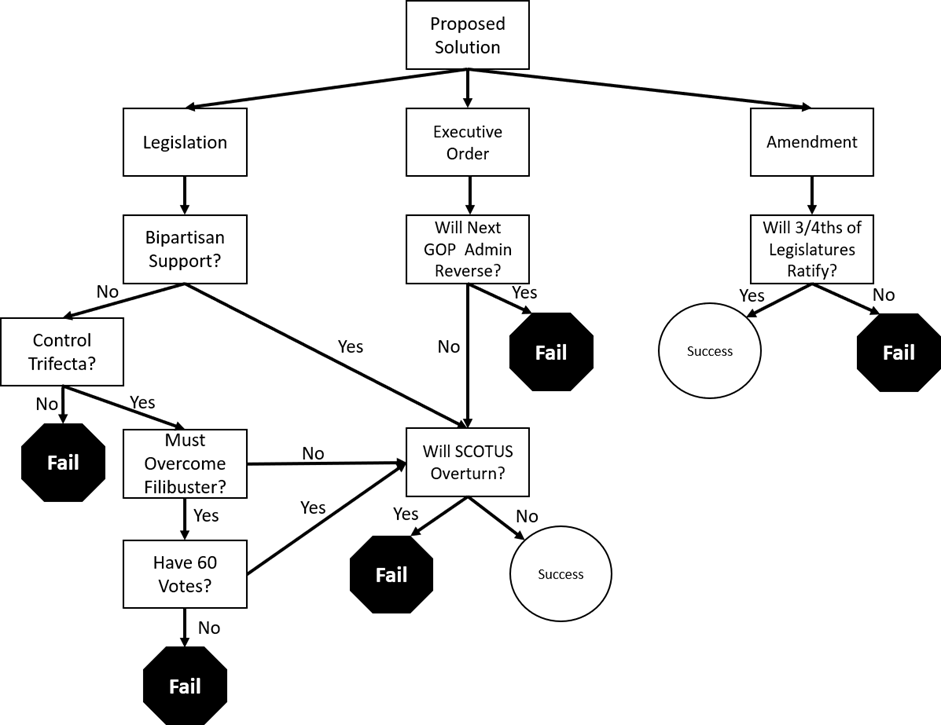
The US cannot effectively move legislation through the federal Government. One party needs to control all three branches of government and then get legislation past the Supreme Court afterwards. A simple majority in the House and Senate is insufficient if the bill involves matters unrelated to spending. Any bill unrelated to spending must secure 60 votes in the Senate (out of 100 seats) due to the filibuster – a procedural rule that allows a minority to block legislation.
Given that both parties hold mutually exclusive visions for the country, and Republicans are perversely incentivised to vote with the President, nearly every vote falls on party lines. Almost nothing can get through the US legislative system, even spending bills. This has led to record-setting government shutdowns over the past year. Even if both sides can see the problem, passing legislation to address it is functionally impossible – particularly if one side sees such legislation as favouring the other politically or ideologically.
The Undemocratic System
The Senate itself is something of an institutional appendix: no other functional democracy has an upper chamber of the legislature with so much power. Over time, other democracies have weakened the upper chamber or done away with it entirely. The US Senate also features deeply disproportionate representation: the smallest state by population (Wyoming) has as many Senators as the largest (California). A vote in Wyoming is worth 67 times as much as a vote in California.
Gerrymandering – the drawing of constituency boundaries to favour one party – and the apportionment of two Senate seats per state compound the problem. Both give disproportionate power to smaller, more rural states that tend to vote for Trump’s movement. For Democrats to split the Senate 50–50, they would have to win the national vote by approximately six percentage points. In states with extensive gerrymandering, winning the popular vote by more than 15 points is insufficient to dislodge the incumbent party.
Further structural problems include first-past-the-post voting, which forces the US into a two-party system. The electoral college – an indirect system in which each state appoints electors who formally choose the President – compounds the dysfunction: it has failed in its original purpose of preventing an unqualified demagogue from coming to power, while making it possible to become President while decisively losing the popular vote.

‘Trump Has Already Rigged the 2028 Presidential Election’: US Defence Insider
Regardless of how people vote, the chances of a Democrat Government coming to power in 2029 is now virtually nil, argues Brynn Tannehill
The Constitution Prevents Fixing Itself
Many of the systemic problems the US faces could be fixed by amending the constitution. In practice, however, amending it is impossible. To amend the US constitution, two-thirds of both the House of Representatives and the Senate must vote in favour of the proposal. Three-quarters of state legislatures must then vote to ratify the amendment.
There is zero chance Republicans would ever vote to eliminate gerrymandering, change Senate apportionment, adopt proportional representation, or abolish the electoral college. There is zero chance either party would control two-thirds of either body of Congress. There is zero chance that three-quarters of the states would agree on an amendment that removed a Republican or Democratic structural advantage – and most of the structural advantages currently favour Republicans.
Many of America’s worst problems are the result of flaws in the US constitution that can only be solved by amending it. Amending the constitution is impossible because the current political dynamic and the constitution’s own amendment threshold make it so. The system cannot fix itself.
Embedded Autocracy and One-Way Ratchets
Even if, by some miracle, Republicans do not successfully capture the 2028 election, a Democratic President will be unable to do much to set things right. Trump is leaving behind a court packed with conservatives. The media is almost completely controlled by his billionaire allies. The federal government civil service has been filled with loyalists screened for their ideology – and removing them would likely be blocked by the courts. The oligarchs remain firmly behind Trump and his movement.
A Democratic President would be unable to accomplish much of anything between a hostile court and a Senate that requires 60 votes to make any sort of substantive change. Many of the vital changes needed require a constitutional amendment, as described above. Republican Presidents, by contrast, will be able to continue to rule by executive fiat, with the courts clearing the way.
The ruling party, religious conservatives, oligarchs, and the courts have established a self-reinforcing power feedback loop that only grows stronger over time. Once established, such a loop is nearly impossible to break. To change the court, you must win elections. To win elections, you must first overcome the structural advantages held by Republicans and the courts. To reduce the influence of the ultra-rich in politics, you must affect all three. The result is a conundrum that no democratic system has solved without violent revolution.

The United States is a Zombie Democracy
The United States is a zombie democracy: it might still look and sound a little like the country its allies remember, but it is a shambling corpse screaming and biting other countries, trying to infect them with fascist autocracy too. Zombies do not come back. Canadian Prime Minister Mark Carney has been keenly aware of this and spoken bluntly: Canada needs to move on without the United States while protecting itself against it.
It is not too late for the rest of the world to learn from the US example – to observe the weaknesses in democracy that allowed the United States to fall, and to correct them while they still can. In the case of the UK and Canada, this means eliminating first-past-the-post elections and instituting proportional representation. There are signs that both countries are beginning to fall into the two-party radicalisation trap. It also means protecting the media from becoming a right-wing monoculture that constantly stokes fear and urges hatred of trans people and immigrants.
Canada has looked at what is left of the United States and decided it really does not want to become a zombie democracy. Many in Britain , however, seem to have looked at what is happening in the US, and decided that this is what they want – and that Reform UK will somehow produce better results than its counterparts across the Atlantic.
Brynn Tannehill is a US defence analyst and author of American Fascism: How the GOP Is Subverting Democracy