
 Subscriptions
 Subscriptions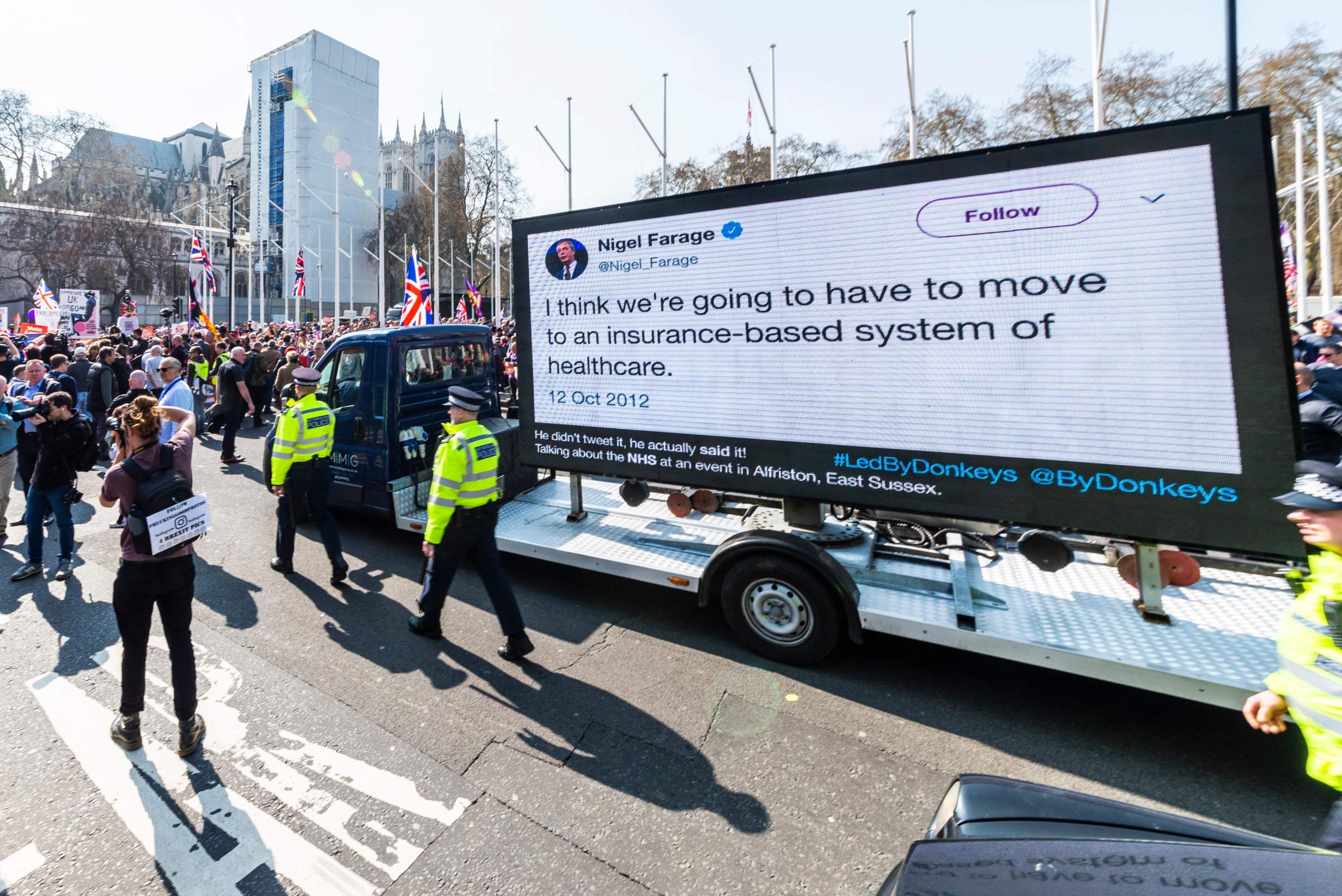

Read our Monthly Magazine
And support our mission to provide fearless stories about and outside the media system
Four of the seven healthcare policy pledges in Reform UK’s 2024 manifesto, “Our Contract With You”, commit taxpayers’ money to expanding private healthcare services. None provides any additional resources directly to the NHS.
The party’s leader, Nigel Farage, has made his intent explicit. “I do not want it [the UK’s health service] funded through general taxation,” he has said. The manifesto commits an additional “17 billion per year in healthcare-related spending” – none of it directed to the NHS itself.
“Free At Point of Use”
Reform UK’s manifesto pledged to keep the NHS “free at the point of use”. But the defining characteristic of the NHS is not that it is free at the point of use – it is that it is a tax-funded, publicly owned, universal healthcare system. The absence of charges at the point of care is a downstream effect of that model.
This is a crucial distinction. India operates a healthcare system that is nominally free at the point of care. But it is so underfunded that most of the population seeks private treatment whenever possible, according to World Bank data. Reform UK’s policies – which redirect public money to private providers while offering no new investment in the NHS itself – follow a comparable logic.
Measuring the legitimacy of a political party’s plans for a health service has to go beyond whether or not it keeps the service “free at the point of use”. A depleted public healthcare service can still be free to use while providing substandard care. The more important question is whether patients can access the right medical treatment at the right time and without facing financial hardship.
The Beveridge Model
During the conception of the NHS in the 1940s, Sir William Beveridge, then director of the London School of Economics, argued that it made more economic sense for the public to employ healthcare professionals directly than to pay private providers a fee for each service. Doing so removed profit from the system and avoided the higher costs of administering insurance-based models.
Beveridge’s reasoning was economic rather than ideological. Financial barriers to treatment – such as the copayments inherent in insurance-based systems – would lead to delays in accessing care, higher levels of disability, and a greater dependency on the state. Healthcare, he concluded, should be paid for by taxation and delivered free at the point of use.
In the late 1940s, the UK Government bought out most of the country’s health service providers and began paying healthcare staff directly. It was this nationwide public ownership that gave the National Health Service its name. Over subsequent decades, Canada, Sweden, Norway, Spain, New Zealand and Italy adopted variants of what became known as the Beveridge model.

Spinning on His Axel: The Right-Wing Politics of the Billionaire Businessman Taking Over the Telegraph
Julian Petley investigates what really motivates the German media mogul taking over Britain’s leading conservative broadsheet
Public Money, Private Providers
Reform UK’s manifesto set out a programme of redirecting public finances to private healthcare providers – continuing a trajectory that successive Conservative Party governments have pursued, but going significantly further.
The manifesto proposed using taxpayers’ money to expand private healthcare capacity while redirecting NHS funds to private providers directly via the patient. The practical effect is the replacement of publicly owned health services with private providers.
The Voucher Scheme
Under the manifesto’s “NHS Voucher Scheme”, private providers would be able to draw money directly from NHS budgets without the need for any formal NHS contract.
The mechanism works as follows. A GP refers a patient for a test or specialist review. If the waiting list for that service exceeds a specified timeframe, the patient receives a “voucher” redeemable at a private healthcare provider. The private provider submits the voucher to the local NHS Trust, and the Trust makes the payment.
The structural dynamic is clear. The resources the NHS requires to provide services – and thereby reduce waiting times – are redirected to the private sector. With fewer resources, the NHS is less able to deliver services. Waiting lists grow. More vouchers are issued. As the publicly owned healthcare system contracts, privately owned capacity expands.
The expansion of the private sector, under this scheme, would be funded entirely through general taxation.
ENJOYING THIS ARTICLE? HELP US TO PRODUCE MORE
Receive the monthly Byline Times newspaper and help to support fearless, independent journalism that breaks stories, shapes the agenda and holds power to account.
We’re not funded by a billionaire oligarch or an offshore hedge-fund. We rely on our readers to fund our journalism. If you like what we do, please subscribe.
Two-Tier Tax Dynamic
A further Reform UK policy reinforces the dynamic. Within the first 100 days of government, the party proposes 20% tax relief on payments towards private healthcare insurance or services. The manifesto states that the aim is to ensure “independent [private] healthcare capacity will grow rapidly”, encouraging those who can afford it to become private patients.
The combined effect of these policies – an under-resourced public system, a private sector expanding through public funds, and tax incentives to move patients into private care – points towards a two-tier model.
In the absence of any concurrent strategy to invest in the NHS, the likely outcome is that only those who cannot afford private healthcare would rely on the public system. They would wait longer, have less access to treatment, and face a higher chance of dying from treatable conditions.
A spokesperson for Reform UK distanced itself from these proposals, saying: “Reform UK formally and publicly dropped the 2024 manifesto in October 2025, so this analysis is outdated and does not reflect our current health policies. We are currently in the process of developing our healthcare policy, which will include a firm commitment to an NHS that is free at the point of delivery… In terms of Nigel’s comments, these reflect the fact that the NHS is in crisis and the majority of the public are dissatisfied with how the NHS is run.”
However, it is not clear what Reform UK’s vision of the NHS is. Nothing in its 2024 manifesto – which still has not been replaced – proposes additional investment in the NHS itself. If implemented, the programme set out in “Our Contract With You” would progressively replace public ownership of healthcare with private provision – funded by taxpayers.
This suggests that while the NHS branding may survive under a Reform UK government, the tax-funded, publicly owned model that has defined the National Health Service for more than 75 years would not.
The Cost of Reform
To help citizens understand the implications of Reform’s NHS plans, a new NHS Cost Calculator built by The Message Hub, a nonprofit dedicated to combatting misinformation, has gone live on Monday (30 March). The calculator allows anyone to find out how much their healthcare could cost without the NHS.
People can enter their details to see a personalised comparison of the NHS, private insurance, and the French social insurance model (the system Nigel Farage has said he admires which relies on upfront payments reimbursed by state and private insurance).