
 Subscriptions
Read our Monthly Magazine
And support our mission to provide fearless stories about and outside the media system
When the journalist Andy Twelves took a look through Matt Goodwin’s latest book – Suicide of a Nation – he uncovered a litany of false quotes, misinterpreted data, and a heavy reliance on the deceptive output of ChatGPT in the first five chapters alone. There are 12 references in the book; five are to Goodwin’s own Substack; three indicate they were sourced via ChatGPT; plus one Telegraph article, which quotes… Matt Goodwin.
At first, Goodwin’s response was to crow on X that the Left were “driving the algorithm” and simply contributing to the sales of the book. After 24 hours of consistent pressure, he returned with a long attempt at rebutting the objections, titled with his characteristic pompousness, ‘A response to my critics’. But while he dismisses criticism of his use of AI – claiming he simply used it to “[obtain] datasets… [which were] cross-checked with the original source” – defends his use of statistics and argues that the book’s paucity of references is not a problem, he does not address the issue of fabricated quotes.
In Twelve’s original thread of X, he identified quotes that Goodwin attributes to Cicero, Hayek and James Burnham that do not exist in the published works of the three men. I’ve also been through Suicide of a Nation and found other examples of what appear to be fabricated quotations. A particularly bad example can be found early in Chapter one when Goodwin claims that the American lexicographer Noah Webster wrote: “Language is the tie that connects past with future, and binds together the citizens of the same nation.”
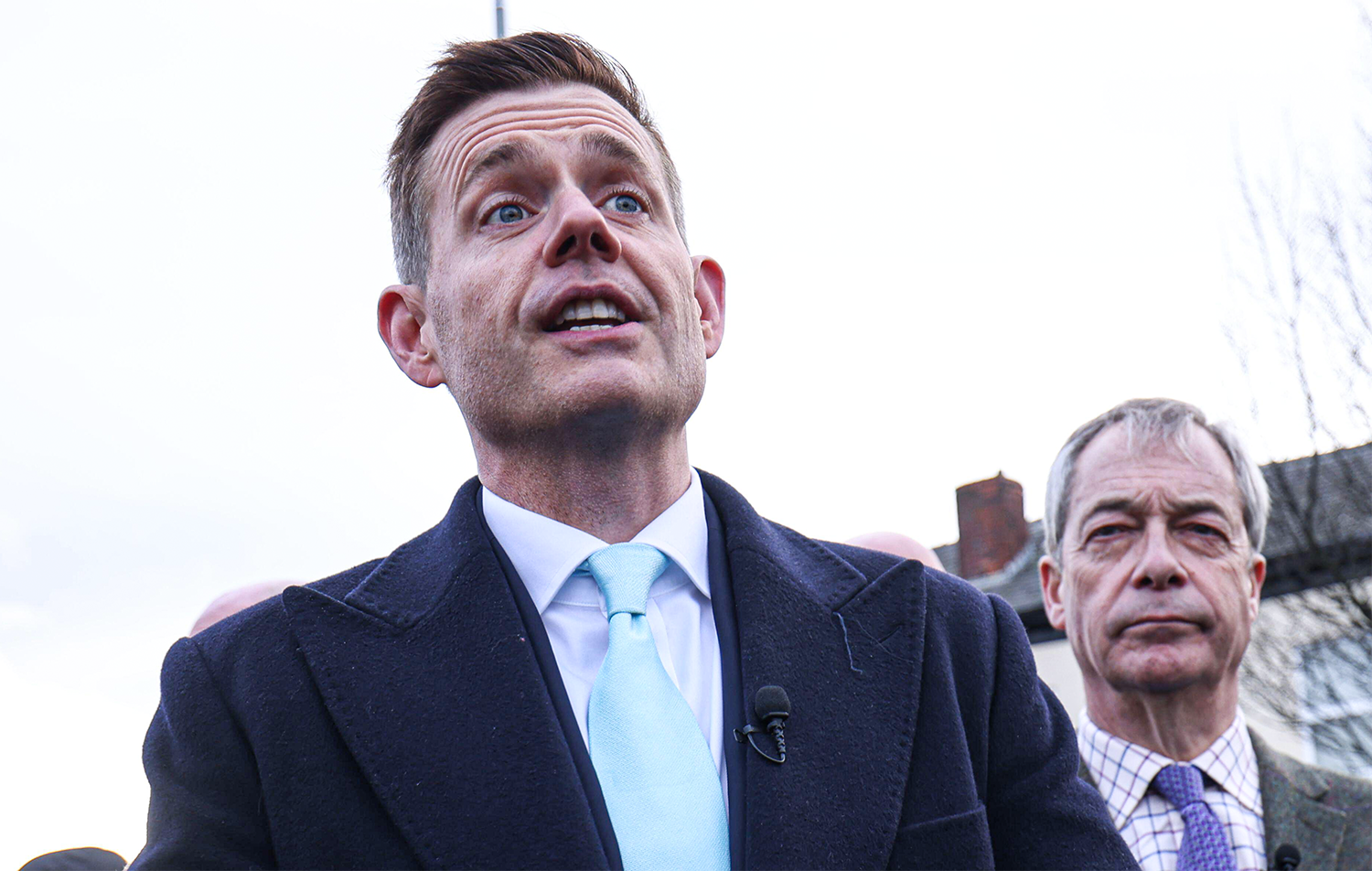
Revealed: Reform UK Matt Goodwin’s Academic Ties to Rebranded Nazi Eugenics Front
Reform’s Gorton and Denton candidate, who has said that genetics will expose the “inherent differences between groups” has links to multiple organisations tied to discredited racist pseudoscience
Webster, whose central project was the evolution of a distinctly American English, did not compose that quote. Instead, he wrote: “A national language is a band of national union.” Goodwin attempts to bolster his false claim that “millions no longer speak the national tongue” with a quote that appears to be fabricated and is spun off from an entirely different argument made in a totally different context.
I don’t use ChatGPT or any other generative AI tools in my work, but it’s clear from the book references and his subsequent statements that Goodwin does, so I asked ChatGPT about Webster and the line “language is the tie that connects past with future…” At first, it claimed that the quote was taken directly from Webster’s work, but when I asked for the source, it said it is attributed to him but “not found verbatim in his major writings”.
It then went on to caution that “if you need to cite it academically, avoid using the quote as a direct citation”. That suggests that ChatGPT has a more stringent approach to referencing than the former professor, Matt ‘MattGPT’ Goodwin.
Let’s look at another of the seemingly fabricated quotes. Also in Chapter one, Goodwin writes: “As the American writer Christopher Lasch once warned: ‘A country without collective memory, shared identity, and emotional loyalty cannot withstand the centrifugal forces of individualism and group difference’.” Again, the quote doesn’t seem to appear in any of Lasch’s publicly available published work or interviews, and that clunky triad at the beginning has all the hallmarks of AI writing.
Where Goodwin cites statistics or research in the book, they’re almost always presented in the same way as they appeared in a newspaper article, usually from the Daily Telegraph, but occasionally from the Daily Mail or The Times. For example, Goodwin writes:
“In 2025, the NHS spent £64m million solely on translation services, enough to cover the annual salaries of nearly 2,000 nurses.”
In a Daily Telegraph report published on 13 September 2025, the line reads:
“The data show that the total spending on translation and interpretation over the five financial years was £243m – equivalent to the cost of employing nearly 2,000 NHS nurses.”
Notice that Goodwin’s removes any reference to interpretation. As NHS consultant, David Oliver wrote for Byline Times back in 2024, in reference to similar stories published by the Daily Express, “£100 million on translation might sound like a big number, but it is a tiny fraction of expenditure and would make little dent in nurse staffing across all NHS organisations.”
Goodwin doesn’t just regurgitate lines from the newspapers. He’s also very keen on a partial quote and a tossing aside of context. One example of that is when he writes: “Andrew Neather, speechwriter to Tony Blair and his immigration minister Barbara Roche, admitted in 2009, [that] mass immigration had been a deliberate policy. The aim, he said, was to ‘rub the Right’s nose in diversity’.” Now, Nether did write those words, but in an Evening Standard column headlined Don’t listen to the whingers – London needs immigrants and in a paragraph that read in full:
“I remember coming away from some discussions with the clear sense that the policy was intended – even if this wasn’t its main purpose – to rub the Right’s nose in diversity and render their arguments out of date. That seemed to me to be a manoeuvre too far.”
With that context, the line becomes a lot less punchy than the six words dropped into the heart of Goodwin’s anti-immigration invective.
Putting aside the intellectual dishonesty that runs through Goodwin’s work, like the message in a peculiarly poisonous stick of Blackpool rock, there’s a wider danger from this kind of book. Those fabricated quotes will enter the information stream and, when generative AI gobbles them up, will end up being treated as real. Goodwin tells his readers, “The elites will attack me because I wrote this for you. They will call me every name under the sun because I dare to tell you the truth.” These are the words of a man making a preemptive strike, of someone who knows full well that his book is a carnival barker’s act that he’s trying to pass off as a statesman-like argument.
This is about more than a bad book by Reform’s notorious bad loser. Goodwin is explicit that he aims to further shift the Overton Window of acceptable political discourse. He assumes that he can wave his book around and use it to justify his position as a commentator and thinker, safe in the knowledge that most people – even those who buy it – won’t read it.
Not only is it a badly written, self-satisfied, and smug book, but it’s also filled with falsehoods and inventions. If they go unchallenged, they pile up over time and ossify into received wisdom, raised as proof purely because someone stuck them between covers. MattGPT is as bad for the intellectual ecosystem as ChatGPT is for the environment.
ENJOYING THIS ARTICLE? HELP US TO PRODUCE MORE
Receive the monthly Byline Times newspaper and help to support fearless, independent journalism that breaks stories, shapes the agenda and holds power to account.
We’re not funded by a billionaire oligarch or an offshore hedge-fund. We rely on our readers to fund our journalism. If you like what we do, please subscribe.