
 Subscriptions
 Subscriptions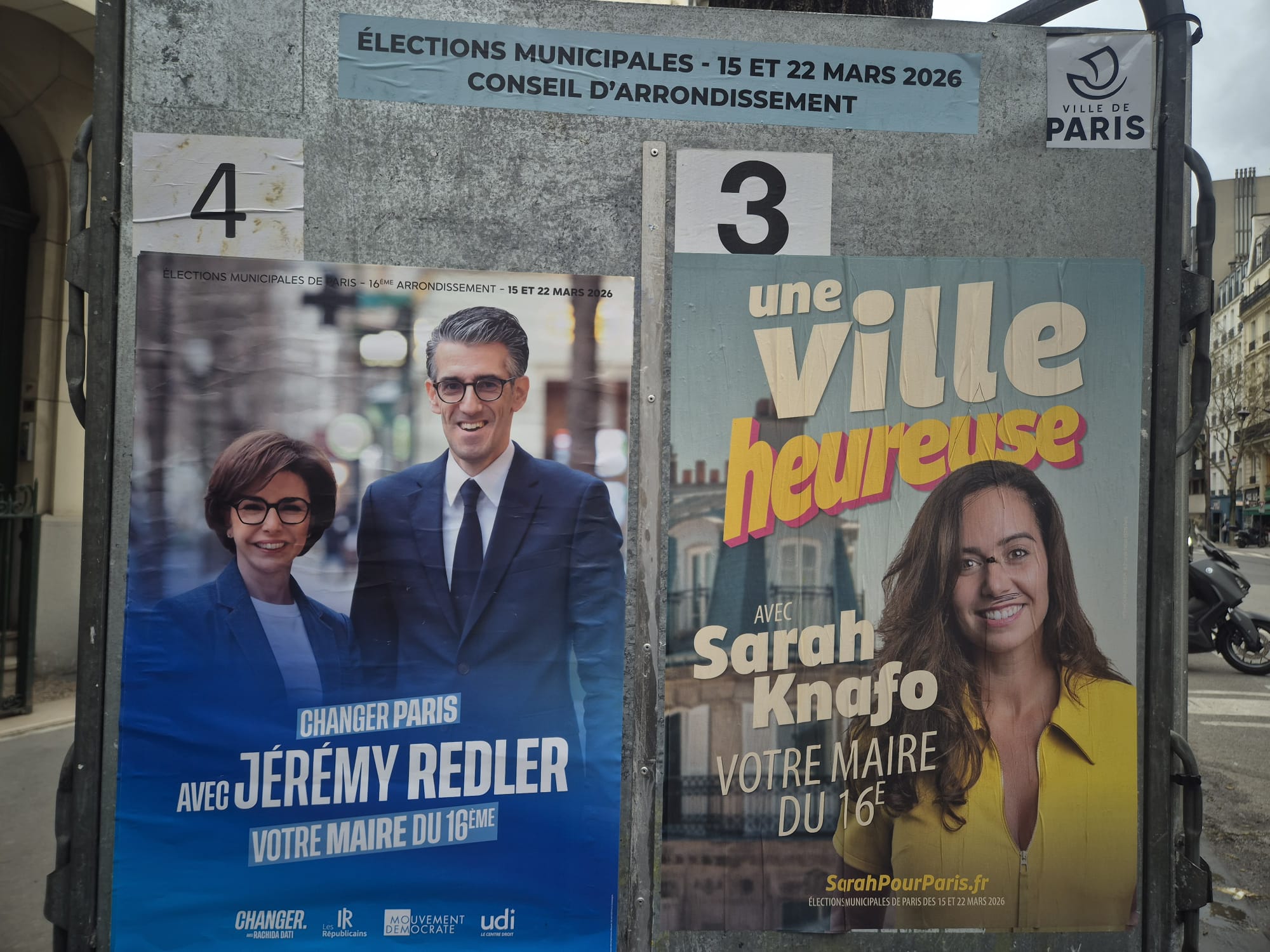

Read our Monthly Magazine
And support our mission to provide fearless stories about and outside the media system
The centre-left Parti Socialiste (PS) has governed Paris for over two decades, but in the upcoming municipal elections, the second round of which takes place, just three days before the 25th anniversary of Bertrand Delanoë’s election victory, when the PS first took the office, the centre-left’s ability to hold on to the mayoralty is anything but assured.
As Paris heads to the polls for the first round of voting this Sunday, a fractured vote on the left and the possibility of unity between the right and far-right could see the first right-wing mayor of Paris in a quarter-century.
As is increasingly common in European politics, multiple candidates, each representing various ideological stripes, have put themselves forward, indicating the fractured nature of the political field.
On the right, the frontrunner is Rachida Dati, a former minister under Nicholas Sarkozy, who went on to serve as Culture Minister between 2007 and 2010 under the first two Macronist governments during that period.
Dati is a controversial figure who will stand trial later this year on charges of corruption and influence peddling relating to her stint as an MEP between 2009 and 2014. She is accused of defending the interests of Renault-Nissan in the European Parliament after having received € 900,000 from a subsidiary of the group between 2009 and 2012, despite not working for them formally. The suspicion on behalf of the EU is that covert lobbying took place. The affair has dogged Dati’s campaign and her response, attacking the journalists asking the questions, has been compared to Trump. Similar lobbying allegations also swirl around the candidate, regarding her relationships to gas companies in Azerbaijan and the Qatari government.

How Far-Right Billionaires are Destroying French Politics – and What the UK Must Learn
The French media have boosted the far-right National Rally party. Are the British media doing the same in the UK?
Dati’s campaign for Mayor has rested largely on promises to clean up the city, cut “wasteful” spending and institute a crackdown on crime and the seemingly contradictory promises to deepen certain pedestrianisation measures while also promising to end the “stigmatisation” of motorists that she argues was a guiding principle of the PS mayoralty under the outgoing Anne Hidalgo.
There is a second candidate coming from the Macron bloc, Pierre-Yves Bournazel, of the Horizons party, which is part of the President’s coalition. However, his poor polling, weak campaign and the fact that he has ruled out any alliance with either Rachida Dati and Emmanuel Gregoire, the candidate of the PS, means that bar a sudden change of heart, he is unlikely to have a significant impact on the race.
This leaves Sarah Knafo on the far right. The 32-year-old is a close friend of Elon Musk’s and a member of the far-right party Reconquête!, which positions itself to the right of Le Pen’s Rassemblement National, and is reportedly the girlfriend of its leader, Éric Zemmour, a journalist who has been charged multiple times with racial hatred. Knafo’s campaign has been unusually positive for a figure on the far right promising a “happy city” and echoing Dati’s promises to clean up the city, rid it of rats, crackdown on crime and make parking easier.
Contained within Dati’s program are also several cultural policies aimed at preserving or returning to tradition such as ending the dance parties that have become prominent during the annual Fete de La Musique, and instead returning to saxophones, guitars and singers (plenty of which remain during the festival) as well as a promise to turn Paris into a pioneer city for bitcoin.
Knafo is doing comparatively well in the campaign for a far-right candidate, building upon Zemmour’s surprisingly good score in the presidential elections among older, bourgeois right-wing voters who have radicalised in recent years. Despite the happy slogan, bright yellow jacket and discarding the usual apocalyptic rhetoric of her party, Reconquête!, the implications of her candidacy have at times surfaced during the campaign. When she created a platform for comments and suggestions from her supporters in January, she quickly had to close it when the highest-voted comments included a comparison of Paris to Kabul and the comment “negroids pollute every street like cockroaches”. Knafo’s friendship with Musk has also led to speculation by the newspaper Le Canard Enchaine and social media analysts for the firm Arago that her outsized profile on X.com is due to boosting of her algorithm, though she has denied this.
Knafo’s strategy is premised on a union of the right in the second round so that her list can be integrated into Dati’s. If she scores above 10% she will qualify for a place in the second round, but could withdraw in order to support Dati, in exchange for places on her list.
There is a demonstrable ideological affinity between parts of Dati’s campaign and that of Knafo – one of the candidates on Dati’s list, Max Guazzini, had to delete his X account recently after it emerged he had shared fake news from a Reconquête! activist about supposed no-dog zones in the UK, which the activist claimed had been created to appease Muslims.

How French Activists Are Leading an ‘Urgent’ Fight Against the Surging Far Right
Melissa Chemam details the multifaceted resistance mobilising against far-right groups, Islamophobia and racism across the Channel
Dati, for her part, initially refused such a union, pointing to the fact that Reconquête! sits with the AFD in the European parliament. However as Knafo’s polling has climbed towards the end of the campaign, with the first round on Sunday 15 March, she has appeared to relent. In an interview with CNews (France’s equivalent of GB News) she refused to classify Knafo as far right and neither agreed to, nor ruled out, an alliance.
Knafo’s voters seem to be voting for her in the hope of forcing an alliance on the right. Bertrand, a well-dressed man browsing at a bookshop in the 16th arrondissement, told me that he is normally a centre/ centre-right voter, but will be voting for Knafo “because she is very intelligent and he likes her ideas” and hopes that an agreement can be found between them to oust the PS in the second round.
Such a fractured situation on the right would normally benefit Emmanuel Gregoire of the PS, who is still in the lead going into the first round with 32% compared to Dati’s 27%, according to the latest polling. However, there is similar fracturing on the left, with Sophia Chikirou, the candidate of the left-wing La France (LFI) Insoumise party polling around 13%, enough to qualify for the second round.
There are notable points of convergence on key issues between the two programmes, to the point that Chikirou has accused Gregoire of copying her manifesto. The differences on issues like housing and childcare between the PS and LFI are of degree rather than kind, with LFI proposing more social housing and a greater expansion of creches, so Chikirou has repeatedly proposed a “technical fusion” of the two lists if she qualifies for the second round.
On his part, Gregoire has repeatedly ruled out a fusion because a war over who gets to lead the left is playing out between the leadership of the two parties at a national level, and the PS wants to retain a centrist vote that doesn’t like LFI. Though, as polling day approaches, he, like Dati, may find himself having to accept a fusion of lists.
There are several possible outcomes going into the second round. If Gregoire, Dati, Knafo and Chikirou all qualify and neither Dati nor Gregoire merge their list with their more radical counterparts, then it will be a 4-way fight whose outcome is impossible to determine with vote splitting on either side.
Equally, Bournazel is within touching distance of the second round, so Paris could experience a 5-way Mexican standoff if he also squeaks through.
If Chikirou qualifies but not Knafo, and Gregoire sticks to his guns by refusing to ally with Chikirou, then that same poll has Dati winning, with Knafo’s voters moving to Dati and Bournazel’s splitting between Dati and Gregoire.
French polling is notoriously unreliable, and there remains everything to play for all factions, but one possibility from Sunday’s results is that the City of Light could change hands between left and right for the first time in 25 years, with the wall between the right and the far-right continuing to crumble as it does so.
ENJOYING THIS ARTICLE? HELP US TO PRODUCE MORE
Receive the monthly Byline Times newspaper and help to support fearless, independent journalism that breaks stories, shapes the agenda and holds power to account.
We’re not funded by a billionaire oligarch or an offshore hedge-fund. We rely on our readers to fund our journalism. If you like what we do, please subscribe.