
 Subscriptions
 Subscriptions
A senior White House official has confirmed that the United States aims to seize control of Iran’s oil reserves – the third largest in the world – at the precise moment America’s own shale production is entering irreversible decline. The admission undermines the administration’s stated justification for the war: an imminent Iranian nuclear threat that Washington’s own intelligence agencies said did not exist.
Jarrod Agen, executive director of the White House’s National Energy Dominance Council, told Fox Business eight days into the war that the administration’s goal is to “get all of the oil out of the hands of terrorists”. The Trump Department of Energy’s own projections show US oil production peaking before entering sustained decline over two decades. And the head of the American Petroleum Institute had already pledged in January that the US oil industry is “committed to being a stabilising force in Iran if they decide to overturn the regime”.
The convergence of energy decline, dollar weakness and geopolitical crisis that produced this war was forecast 18 years ago. A 95-page strategic assessment by this author, prepared for the Nobel Peace Prize Laureates Conference in Stavanger in 2008, identified the exact conditions under which a US administration would consider a military strike on Iran rational – and predicted every major consequence now unfolding.
The role of energy in the conflict appears to have converged with other key factors, including the influence of a neoconservative lobby inspired by an Israeli blueprint that drove the post-9/11 ‘forever wars’ and Christian nationalism at the highest levels of the Pentagon.
In apparent response to oil prices having briefly risen over $100 a barrel, rattling global markets, President Donald Trump has issued contradictory statements to different audiences over the past day. He described the conflict as “very complete, pretty much”, then later said the US will not stop “until the enemy is totally and decisively defeated” and “we’re going to go further”. If Iran continues to block the Strait of Hormuz, Trump separately promised, “death, fire and fury will reign upon them.”
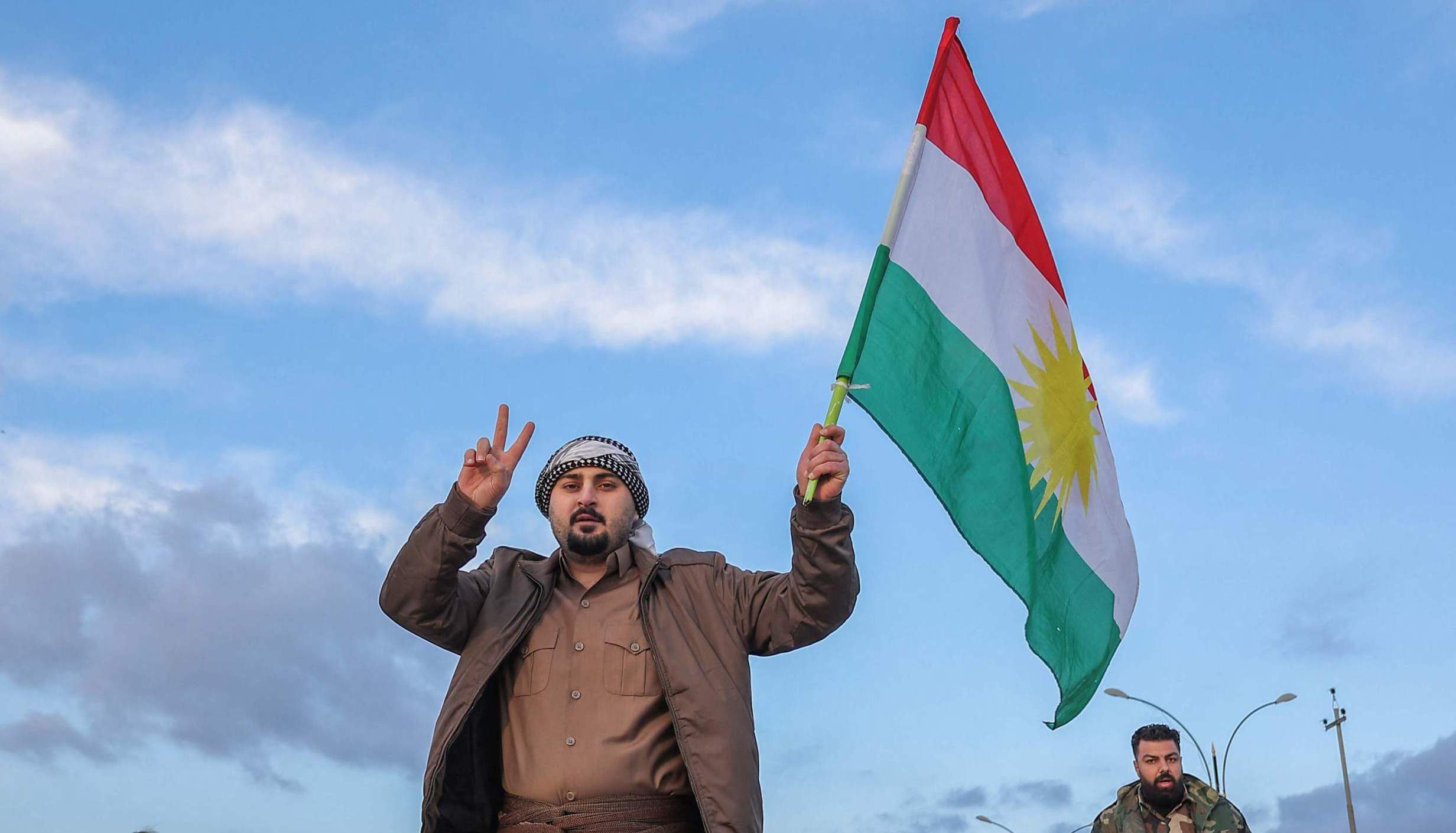
The Kurdish Attack on Iran That Never Happened
False media reports of thousands of Kurdish fighters launching a ground offensive against Iran ended up endangering the very people living under the bombs, reports Dr Charles Kriel
Why the War Is Happening Now
The US Energy Information Administration’s Annual Energy Outlook 2025 projected that US crude production will peak at approximately 14 million barrels per day (mbpd) from 2027 through 2029, then enter a sustained decline to 11.3 million by 2050 – a drop of nearly 20%.
Even in the EIA’s most optimistic scenario – high oil prices pushing production to nearly 18 million barrels per day up to the early 2030s – crude output still falls after 2030, because wells yield diminishing returns until drilling becomes unprofitable.
Yet just a few weeks before the Iran War, the EIA published a new Short-Term Energy Outlook showing that even this forecast was too bullish. It confirmed that US oil production never made it to 14 mbpd. Instead, in 2025 it had hit at an average of 13.6 mbpd, remaining at that level through 2026, and forecasted to drop by 2% to 13.3 mbpd in 2027.
The new EIA projection reveals not merely that the US shale boom is over, but that it is about to decline far faster than Trump’s Department of Energy previously thought.
“Drill, baby, drill” is a fantasy. America’s own oil industry knows it.
In this context, Agen’s full remarks to Fox Business were explicit about the administration’s intentions:
What we want to do is to get such massive oil reserves in Iran out of the hands of terrorists. Ultimately, we’re not going to have to worry about these issues in the Strait of Hormuz. We’re going to get all of the oil out of the hands of terrorists.
Agen compared Iran to Venezuela, which has effectively handed control of its oil industry to US energy companies following Washington’s capture of President Nicolas Maduro.
Iran holds approximately 11% of the world’s proven oil reserves, making it the third largest after Venezuela and Saudi Arabia, and 15% of its natural gas reserves – second largest after Russia. Some 80% of its oil exports go to China.
With US shale entering major decline and Venezuela’s heavy crude involving high costs and producing low energy returns, Iran is the real prize.
When asked about seizing Iran’s oil, President Trump told NBC News it was “too soon” to talk about it, but added, “You look at Venezuela… Certainly people have talked about it.”
One of those people is Republican Senator Lindsey Graham, widely credited with coaching Prime Minister Benjamin Netanyahu on how to lobby Trump for the strike, and personally persuading Trump himself, including at a White House meeting less than 48 hours before the start of the joint US-Israeli operation.
“Venezuela and Iran have 31% of the world’s oil reserves,” Graham told Fox News a week into the war. “We’re going to have a partnership with 31% of the known reserves. This is China’s nightmare. This is a good investment.” He added: “When this regime goes down, we are going to have a new Mideast, and we are going to make a ton of money.”
The Nuclear Pretext
There is no substantive evidence that a nuclear threat was imminent. The 2007 US National Intelligence Estimate, the CIA’s own classified assessment, and successive International Atomic Energy Agency (IAEA) reports all concluded Iran had not pursued a nuclear weapon. The Obama-era Joint Comprehensive Plan of Action (JCPOA) placed severe constraints on enrichment in exchange for sanctions relief.
The Trump administration’s withdrawal from the JCPOA in 2018 and the collapse of the inspection regime altered that landscape: Iran had since enriched uranium to 60% purity and the IAEA’s access was curtailed.
But the official justification for the war does not hold. As Byline Times previously reported, the intelligence underpinning the claim Iran would have a nuclear bomb in “weeks” was generated by Palantir’s MOSAIC predictive AI platform. Trump’s Director of National Intelligence Tulsi Gabbard had testified to Congress that the US intelligence consensus was Iran had not pursued a nuclear weapon since 2003.
During the February 2026 US-Iran nuclear talks, mediators from Oman reported a “breakthrough” in which Iran had agreed to zero stockpiling of uranium. Then the US bombed Iran.
What the War Has Unleashed
The initial strikes targeted leadership, military infrastructure and nuclear sites. Iran responded with missiles and drones. The US and Israel have since escalated to more than 3,000 strikes.
Iran has effectively shut the Strait of Hormuz – the transit route for up to a fifth of the world’s oil – through mines, missile threat and insurance withdrawal. While the US has so far destroyed some 30 Iranian naval vessels, the vast majority of Iran’s asymmetric ‘swarm’ fleet remains operational. A week of hostilities has seen Iran destroy 2.7 billion worth (and counting) of US anti-missile radars.
The vectors of Iranian retaliation are extending across at least ten countries in the Gulf region in the form of missile counterattacks on Israel and US bases. The risks of escalation are rapidly widening.
Oil has surged more than 10%. European natural gas futures jumped 30% after Qatar’s LNG facilities were hit. QatarEnergy has halted production, removing roughly 20% of global LNG supply. Saudi Arabia is also restricting exports. A week into the war saw oil prices rise above $100.
Kpler, the energy data firm, notes that the conflict is materially improving Russia’s competitive position in crude oil markets. India and China face strong incentives to deepen reliance on Russian supply.
Great power involvement could radicalise the conflict further. Russia is already supplying intelligence and satellite data for Iran’s targeting of US assets across the Gulf, while US intelligence reportedly has received indications China is mulling provision of financial aid and weapons components to Iran, from which it imports 1.38 million barrels per day.
ENJOYING THIS ARTICLE? HELP US TO PRODUCE MORE
Receive the monthly Byline Times newspaper and help to support fearless, independent journalism that breaks stories, shapes the agenda and holds power to account.
We’re not funded by a billionaire oligarch or an offshore hedge-fund. We rely on our readers to fund our journalism. If you like what we do, please subscribe.
A War Foreseen
The convergence of energy decline, dollar weakness and geopolitical desperation that produced this war was not merely predictable – it was predicted.
The 2008 assessment by this author, published by the Transcend Research Institute founded by the late ‘godfather’ of peace studies Professor Johan Galtung and titled The Iran Threat: Why War Won’t Work, argued that a US strike on Iran would only be attempted if imminent domestic energy decline portended a reversal in American global power. It identified control of Persian Gulf oil reserves as the mechanism by which Washington would seek to reverse that decline.
The paper stated:
If the world peak in oil production along with other impacts of financial speculation and so on generate a fuel security crisis which combines with a plummeting value in the dollar – both of which would signify an unprecedented and potentially permanent collapse in American global pre-eminence purely due to the unfolding of internal systemic failures within the global political economy – a war on Iran might be viewed in this context as a last resort mechanism by which to re-establish US power by consolidating control over Persian Gulf oil supplies.
The assessment concluded that the war would not be launched until these conditions materialised: “If this analysis is accurate, then a war on Iran will be postponed until macro-economic, geopolitical and resource-supply trends independently generate circumstances in which the US is likely to suffer unprecedented and potentially permanent energy and economic crisis.”
This conditions appear to have transpired this year. The dollar index fell 11% in the first half of 2025 – the same year US oil production peaked. This was the dollar’s steepest decline in more than 50 years, abruptly ending a 15-year bull cycle. The Iran war has temporarily boosted the dollar’s value. Simultaneously, global debt has reached a record $348 trillion.
It warned that Iran would shut the Strait of Hormuz, triggering a global energy shock. It cited the Pentagon’s own $250 million war game, Millennium Challenge 2002, which showed Iranian forces sinking 16 US ships – the worst simulated naval defeat since Pearl Harbour – to argue that US naval superiority would not neutralise Iran’s asymmetric capabilities.
The assessment warned that the war would not be contained. The CIA and Defence Intelligence Agency had war-gamed a pre-emptive strike and found it would escalate uncontrollably. The paper laid out specific vectors of Iranian retaliation across the entire region and warned that a prolonged conflict could drive oil prices as high as $200 or even $300.
The resulting inflation, the 2008 paper emphasised, could trigger cascading defaults across the global financial system.
The assessment also warned that multiple simultaneous protests across the Gulf monarchies could endanger their survival. Saudi Arabia, the UAE, Qatar and Bahrain are rentier economies that purchase domestic stability with hydrocarbon revenue. If state revenues decline under sustained disruption to their oil exports, domestic unrest will follow, potentially extending the arc of the conflict and unravelling regional order.
The report identified the Pakistan nuclear wildcard: Pakistan has maintained a secretive defence agreement with Saudi Arabia since 2003 that includes nuclear and missile technology sharing, and specifically tasks Pakistan with protecting the Saudis from nuclear attack. Pakistan is simultaneously in “open war” with the Afghan Taliban along its western border. Its economy is fragile and its political legitimacy thin. An estimated 1,500 to 2,000 Pakistani troops remain stationed in Saudi Arabia.
If the conflict escalates further – if Iran targets Saudi oil infrastructure more directly, Pakistan’s own border regions are destabilised, or the Taliban offensive intensifies amid the regional chaos – the calculus in Islamabad could shift. A Pakistan overrun or fractured by extremist forces, in possession of nuclear weapons, in the middle of a regional war involving Israel, is a scenario no Western war planner has modelled.
The 2008 assessment predicted that the war would accelerate the shift toward a multipolar order – the very outcome it was designed to prevent. Russian or Chinese proxy support for Iran – intelligence sharing, naval escort operations, covert resupply – could fundamentally alter the equation in the Gulf and increase risk of a global war between the great powers.
Most ironically, the 2008 report cited former UN weapons inspector David Albright’s warning that an attack on Iran offered no assurance a nuclear programme would be set back – and might force the leadership’s hand, launching a Manhattan Project-style undertaking in defence of the homeland. Far from eliminating the threat of an Iranian nuclear weapons programme, the US-Israeli strikes are at risk of incentivising them. A regional nuclear arms race is a plausible consequence.
A System That Refused to Transform
For two decades, the US shale boom underwrote the global economic order. Cheap, abundant American oil dampened price volatility, gave Washington leverage over allies and adversaries alike, and sustained the illusion that the fossil-fuelled growth model could continue indefinitely.
That period is over. While the war’s boost to oil prices lends some breathing room to the industry, US oil production is still peaking, and after 2030 will enter irreversible decline. The material foundation on which American hegemony rested – and with it, the architecture of globalisation as we have known it – is giving way.
The 2008 assessment recommended redirecting investment from military intervention into a crash programme for renewable energy infrastructure.
If the risks it outlined are accurate, then the war with Iran will achieve the precise opposite of what it was designed to do: not the consolidation of American power, but its accelerated decline.