
 Subscriptions
 Subscriptions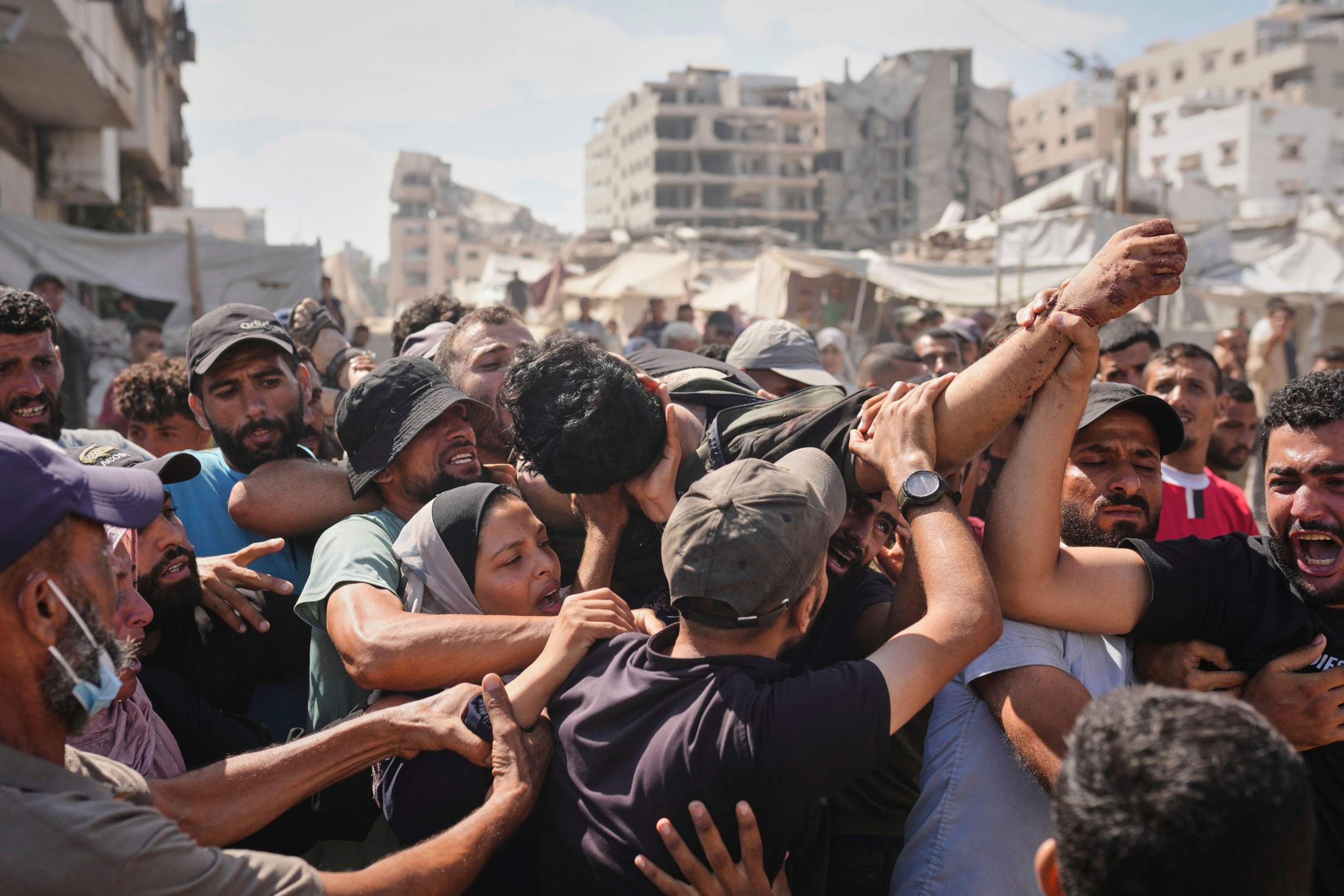

Read our Monthly Magazine
And support our mission to provide fearless stories about and outside the media system
On 16 January, the White House unveiled a “20-point plan” for ending Israel’s war on Gaza. The plan involved the establishment of a “Board of Peace”, with confirmed individuals sitting on its executive board including Jared Kushner, Marco Rubio, Tony Blair, Marc Rowan of Apollo Global Capital and the representatives of various regional and global powers.
On 21 January, Netanyahu also stated that he would join the board, despite previously criticising the initiative, and Vladimir Putin has confirmed that he is considering the invitation from the Trump administration, though he did not attend the first meeting.
Despite these invites, no Palestinian representatives have been placed on the Board of Peace, nor on the parallel Gaza Executive Board. The only Palestinian representation is on the separate National Committee for the Administration of Gaza, which includes Palestinians as heads of various services in the proposed “New Gaza”.
At a signing ceremony for the “Board of Peace” at the World Economic Forum in Davos at the end of January, Trump unveiled plans for a “New Gaza”; including Dubai-esque cities of skyscrapers along the strip, with a zone reserved for coastal tourism and an industrial complex of datacentres to serve as a hub for advanced manufacturing.
At Davos, Trump told attendees that: “We’re going to be very successful in Gaza. It’s going to be a great thing to watch.”
“I’m a real estate person at heart and it’s all about location. And I said: ‘Look at this location on the sea. Look at this beautiful piece of property. What it could be for so many people.’”
Byline Times spoke to four prominent Palestinians in Gaza about what they really think of the Board of Peace and Trump’s plans for their home.
‘Slow Genocide’
Ahmad Abu Riziq, a teacher and founder of Gaza Great Minds Foundation, a charity which provides tent schools so that Palestinian children can continue learning despite the devastation, told Byline Times that rather than a board of peace, Trump’s proposals constitute a “board of new, slow genocide”.
Rather than a city of skyscrapers, Mr Abu Riziq said: “I want to see the old houses, I want to see and sit next to the olive trees that the Israelis destroyed . I just want to go to the mosques and pray as I used to do. I want to go and hang out with my friends all over the Gaza Strip, without being afraid of Israeli-backed gangs or the drones hovering 24/7”.
The topic of the drones led him to again question the idea that this is about peace: “I’m talking to you right now and the drones are still hovering over our heads; this is nothing related to the peace plan and the hostages. They already destroyed everything in Gaza. They killed most of the leaders of the government, the educators, teachers, professors, scientists, so why are the Israeli drones still hovering noisily? Because they want to destroy Gaza and this ‘peace plan’ is just the second stage of the genocide.”

Israel’s ‘Grotesque’ Detention of Palestinian Bodies Is Intended to Silence and ‘Traumatise Families’
Since the October 7 attacks, the number of Palestinian bodies held by Israeli state incommunicado has soared
‘The Old Colonial Logic’
Nahil Mohana is a writer and human rights activist from Gaza City, where she lives by the seashore. She is also the author of Voices of Resistance: Diaries of Genocide, a book documenting her experiences during the war following 07 October 2023, which is widely considered by genocide scholars to have constituted a genocide.
Similarly to Ahmad Abu Riziq, in her view, “this is not a plan, nor is it a peace council”, instead she argues, “it is the transformation of a cause of liberation and rights into an investment project”. She believes the proposals amount to a subversion of the Palestinian struggle for self-determination, “replacing rights with benefits”.
“It is as if they are telling us that they will not end the occupation but will improve our living conditions. This is an old colonial logic, pacifying the victim instead of delivering justice. They also treat poverty, unemployment, and destruction as if they were a development crisis, when in fact they are a direct result of occupation, siege, and displacement. In addition, theories of opening markets in the absence of an independent state result in projects that are subject to the conditions of funders, yet carry within them complete restriction of Palestinians rather than their empowerment”.
From her perspective, “any investment that is not preceded by ending these root causes is cosmetic treatment of the catastrophe, and any future plan that does not place at its core the end of occupation, the right of return, and the right to self-determination is an unethical and hypocritical plan. These plans are not built for Palestinians, but built over them. They use Palestinian suffering as an entry point for investment, not as a question of justice”.
The lack of Palestinian representation on the two main boards proposed by the US has led to fears among some Palestinians of a return to a situation similar to the British Mandate of Palestine, in which external powers administer the territory.
Ms Mohana agreed, telling Byline Times that: “When Palestinians are excluded from the decision-making table and summoned only to the table of services, we are not talking about partnership but about a colonial division of roles. International powers decide the future and Palestinians get to clear the rubble”.
In this sense, Ms Mohana views what is being proposed by Trump and the “Board of Peace” as a direct extension of what Palestine has suffered over the last 100 years. She told Byline Times that: “What is happening today cannot be separated from the historical context that began with the British Mandate, and the legitimisation of foreign control in the name of administration and stability. Today, the scene is repeated in a new language. Land is not taken by force alone; it is also taken through planning, re-engineering, and turning the homeland into a project.
When Gaza is redrawn as an investment space, and stripped of its character as a homeland to become a development zone, we are facing legal economic dispossession that is no less dangerous than military dispossession”.
The ‘Gaza Riviera’
As well as fears that it neglects the rights and sovereignty of the Palestinian people, some people in Gaza think that the project of the “Gaza Riviera”, as Trump has described it, avoids even the most basic practical questions about the feasibility of construction in Gaza, and the immediate needs of the population.
The infrastructure in Gaza is devastated, following years of constant bombing by Israel. Unicef reports that no hospital is fully functional in the Gaza Strip, and that “among primary healthcare centres, 1.5 per cent (3/200) are fully functional and 46.5 per cent (93/200) are partially functional”.
Meanwhile, the water infrastructure has been severely damaged, causing manifold risks to public health, and malnutrition is rife, with the WHO reporting that 1.6 million people in Gaza are expected to experience acute levels of food insecurity until at least April 2026.
Dr Ibrahim Sharif, a dentist in Gaza City and volunteer with Gaza Soup Kitchen who has also worked administering basic medical care to the injured, told Byline Times that given these conditions, the proposals for data centres and gleaming skyscraper cities were completely disconnected from the reality he sees on the ground while trying to feed or treat people.
He said: Regarding turning Gaza into a Dubai-like city, I think from my experience working with the displaced people of Gaza, this idea feels completely disconnected from the reality here in Gaza. Gaza right now doesn’t need skyscrapers or luxury redevelopment like Dubai city, in fact, we need clean water, functioning hospitals, schools, housing, trauma care and psychological treatment for the people here. And they are talking about a Dubai model while people are struggling to eat and to survive. We are in the ceasefire, but the people here have lost everything. Most people here are empty and broken, the displacements consumed all of what they have. So talking about a Dubai model while we are struggling to eat, I think it’s out of reality”.
Dr Sharif added that countries genuinely committed to peace should stay away from the Board of Peace proposed by Trump. He said: “The countries that want peace and the end of genocide should focus on civilians, protection of civilians and the rights of Gazan civilians, not on economic or technocratic solutions. In other words, any international involvement should support Palestinian self-determination”.
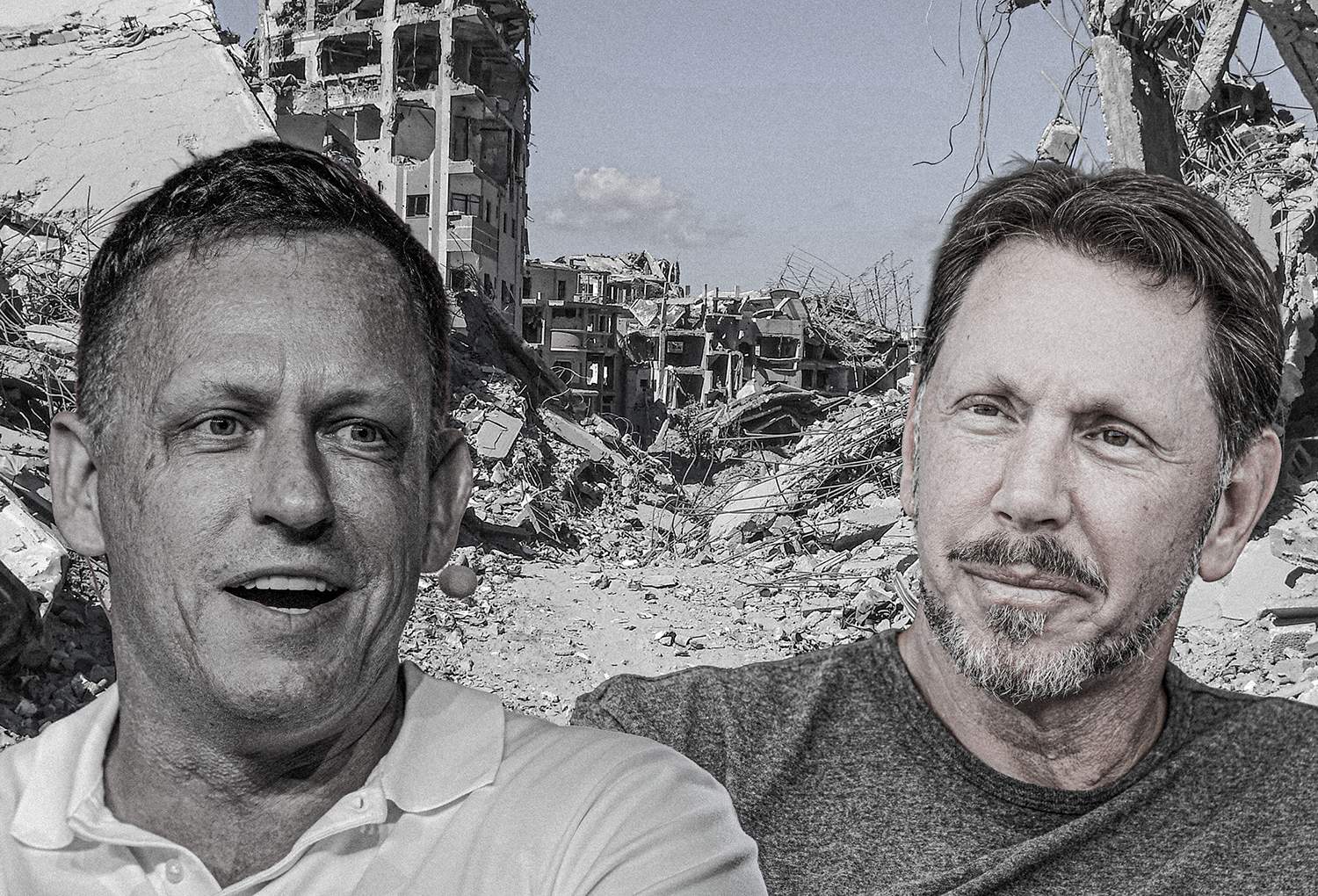
Pro-Trump Tech Billionaires Are Poised to Cash In on Gaza’s ‘Peace’ Deal
The same digital technologies that helped the Israeli military target Gazans are now being embedded in its peacetime infrastructure, with Trump-supporting billionaires poised to benefit
The Fragile Hope of Gaza’s Tech Sector
Gaza’s tech sector, restricted by the conditions as it is, might be able to do well out of a settlement built on data centres and the future of AI, but Mamoun Abu Salah, was also sceptical of the plans.
Mr Abu Salah is the founder of Gaza Tech Mentorship, a program that helps develop students’ tech and engineering skills and match them with mentors around the world. He told Byline Times: “From where I stand, the real story is not about political plans or visions. It’s about students and young engineers in Gaza who are trying to continue learning, building and staying connected to the world despite the circumstances”.
He said, “what people don’t realise is that rebuilding Gaza is not only about buildings. It’s about rebuilding human capacity. The engineering and tech students the Gaza Tech Mentorship supports are often very community minded, in contrast to the individualistic, investor’s vision put forward by Trump and Kushner. Nadeen, one of the mentees, said that she wanted to use the skills developed while working on smart systems during the menteeship to advance the needs of underserved communities.
Mr Abu Salah said: “The engineering and tech students we work with today are the same people who will design, build and connect Gaza to the world tomorrow”, but their thoughts for the future are more “community-focused and human-centred than infrastructure-centred”.
Like Dr Sharif, Mamoun Abu Salah felt that the lofty promises don’t connect up with the reality as it currently stands, “there isn’t any comprehensive or clear recovery plan on the ground”.
There is, however, a “fragile hope” remaining among Gaza’s youth, he said and his personal goal is scaling Gaza Tech Mentorship, “with over 3000 graduates each year the potential is huge”.
Ahmad Abu Riziq’s dream for Gaza was to go and see the old houses as before without fear of drones, Dr Sharif wants for “Gaza to be the most beautiful city in the world, in which people can have safety dignity and freedom” and For Nahil Mana, a sustainable future for Palestine would be one in which it was “a state, not an economic zone”.
She added: “I wish for its children to grow up knowing that the world did not bargain over their blood and did not reduce them to a file. The Gaza I dream of is not measured by the number of floors, but by the number of lives that have returned to breathe freely”.
ENJOYING THIS ARTICLE? HELP US TO PRODUCE MORE
Receive the monthly Byline Times newspaper and help to support fearless, independent journalism that breaks stories, shapes the agenda and holds power to account.
We’re not funded by a billionaire oligarch or an offshore hedge-fund. We rely on our readers to fund our journalism. If you like what we do, please subscribe.