
 Subscriptions

Read our Monthly Magazine
And support our mission to provide fearless stories about and outside the media system
With her appointment in September as Home Secretary, Shabana Mahmood has become one of the country’s most senior politicians, responsible for tackling migration, refugees and policing, core challenges for the Starmer Government.
A self-declared social conservative – “If you were trying to put me in a box you would say social, small-c conservative,” Mahmood admits to a “natural affinity for the faith, family and flag element of Blue Labour.” Her appointment was seen as another triumph for Starmer’s Chief of Staff and behind-the-scenes kingmaker Morgan McSweeney.
Unsurprisingly, her appointment was met with acclaim by the Blue Labour leadership. Maurice Glasman called the move “fantastic”, compared Mahmood to Elizabeth I and declared, “she’s now clearly the leader of our part of the party” while Jonathan Rutherford with hyperbolic exaggeration hailed her as “perhaps the most astute and able politician of her generation”. Yet, until now, she had remained unknown to most Labour supporters and the wider public. So what do we know about her politics?
What is Her Background?
Mahmood’s grandparents came to Birmingham for work from Azad Kashmir in the 1960s. Her father was a civil engineer who worked in Saudi Arabia where Mahmood lived for the first seven years of her life. She then lived and went to school in Birmingham before gaining a place at Oxford University, where she took a degree in law. She then worked as a barrister until her election as Labour MP for the safe seat of Ladywood in inner-city Birmingham in 2010. She had no discernible track record of political activity prior to her selection but her dad was the chair of the Birmingham Labour Party. In the words of one long-standing, local councillor, “she was manoeuvred into the seat.”
In her maiden speech she proudly promoted the diversity of her constituency and gave a clear, positive definition of multi-culturalism. “…..while the people of my constituency might have come from different places, the destination they seek is the same—a place of greater opportunity and the same chance as everyone else to succeed.”
She recalled how “My grandfather came to this country from Pakistan in the 1960s. He worked long hours on a low wage and made sacrifices so that his family could access greater opportunity.” She paid tribute ”…to the successes of the Labour party and the Labour Government, who created the opportunities that made my family’s journey and that of so many ordinary hard-working families possible. I believe that opportunity and the chance to fulfil one’s aspirations is the birth-right of every one of our citizens.”

The ‘Pink Ladies’ Laundering Anti-Migrant Views Into the Mainstream
An anti-migrant movement backed by Reform and Conservative politicians and regularly invited onto news channels is funded by a far-right group and has platformed a Neo-Nazi activist
The Hostile Environment Revisited
As Home Secretary Mahmood had an opportunity to make her grandparents’ aspirations come true for successor generations of migrants. Instead, she is aping recent Tory predecessors in her role – Theresa May, Priti Patel, Suella Braverman – by instituting a “hostile environment” for them. On 29th September as Home Secretary she announced a new contribution-based settlement model to reduce net migration, boost integration and reduce pressure on public services. This stated that “To ensure people contribute to the economy and society before being able to settle in the UK, under the new model they will have to be lawfully resident in the UK for the minimum of 10 years, double the current period.” Furthermore she set out tough new criteria for gaining indefinite leave to remain in the UK, including learning English to a high standard – defined in other briefings as equivalent to A level – not having taken any state benefits, and giving back to the applicant’s community, such as by volunteering for a local cause.
Just six weeks later she turned her attention to asylum seekers. She tore up the UK’s commitment to the international post-war refugee framework by announcing an end to permanent sanctuary and stating the time limit for acquiring indefinite leave to remain in the UK was be quadrupled to twenty years. In her speech to parliament on 17th November Mahmood declared “We will (be) making refugee status temporary, not permanent. A grant of refugee status will last 2 and a half years, not 5. It will be renewed only if it is impossible for a refugee to return home. Permanent settlement will now come at 20 years, not 5.” This means that refugees will face a test of their right to residence – and possible deportation – eight times over the 20 year period before they can settle permanently.
Hence the tropes and falsehoods of the national-populist right now make their way into official government documents, Mahmood’s speeches and the interviews justifying her new policy. She talks repeatedly of the “generosity of our asylum offer”; the UK’s “golden ticket asylum system”; and how “many now “asylum shop” their way across the continent, in search of the most attractive place to seek refuge.” In her Foreword to the Home Office official document she claims that “We have become the destination of choice in Europe, clearly visible to every people smuggler and would-be illegal migrant across the world.”
GB News Accused of ‘Circling the Wagons’ to Downplay Nigel Farage Racism Scandal Engulfing Their Star Presenter
The Reform UK leader is being paid hundreds of thousands of pounds to present shows on the channel
Debunking Falsehoods
These claims are simply untrue. That’s clear from examining data from the House of Commons latest official publication on asylum statistics.
In terms of absolute numbers, in 2024, Germany received the largest number of asylum applicants among EU countries (250,550), followed by Spain (166,145), Italy (158,605), and France (157,460). Together, these top four countries received almost three quarters (73%) of all asylum applications in the EU27. In 2024 UK received 108.134 applications.
In terms of relative numbers, Cyprus had the largest number of asylum applications per 10,000 people (95) in 2024, followed by Greece (71), Ireland (35) and Spain (34).Across the EU27 there were 22 asylum applications for every 10,000 people. ), In 2024, there were around 16 asylum applicants for every 10,000 people resident in the UK. In terms of the number of positive asylum decisions granted at first instance per 10,000 population, in 2024, the UK granted around four positive asylum decisions for every 10,000 people. This is less than half the EU average where there were nine such grants for every 10,000 people.
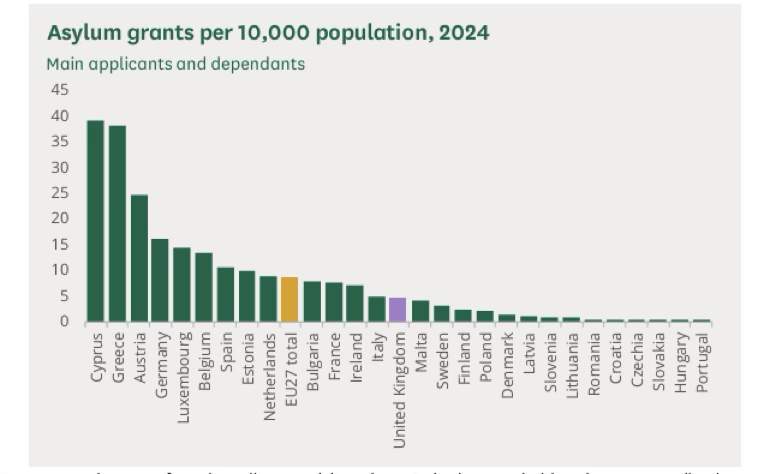
Thus, the facts show a completely different picture from the one painted by Mahmood. The UK has fewer asylum applicants and grants asylum to fewer people than the EU average and it’s not the destination of choice. Yet the Labour Home Secretary chooses to repeat, embellish and endorse the assertions of the populist right. These are not casual or chance remarks. They represent deliberate distortions of the facts, designed to mislead the public and justify the draconian measures which Mahmood is proposing.
Furthermore, there’s no attempt to put the issue in perspective. ‘Small boats’ is presented as the pivotal issue rather than being a small, if very visible, element of overall migration numbers. In the official jargon, Home Office data in the year ending June 2025 on all migration flows show there were 852,324 non-Visitor or Transit visas granted in the year ending June 2025 of whom 49,341 were detected irregular arrivals. The table below shows that more than half of those entering the country were international students,(bringing over £21 billion annually into the Exchequer), nearly a third were coming on work visas and less than 6% were arriving irregularly.

Developing an Alternative
There are no simple answers to the issues of migration and refugees that face politicians in the developed world. But rather than join the stampede to the far right, progressives need to stand by their principles. There are plenty of practical steps that a progressive government could take to tackle the problem. The government is doing some of them, such as trying to work with other countries, but others are urgently required.
- Firstly, manage the first job at hand; employ more staff to clear the backlog of asylum cases; set some clear targets. Instead, Mahmood proposes to add extra bureaucracy by imposing new checks every two and a half years for all successful applicants. Given the Home Office’s track record, this seems likely only to increase the backlog.
- Secondly, she complains that “Many refugees remain unemployed several years after being granted protection, depending on taxpayer funded benefits to live in the UK. This must change.” Then why not end the ban on asylum seekers working once their claim has been registered, so that rather than languishing in ‘secure accommodation’ they would be gainfully employed, paying taxes and their own housing costs?
- Thirdly, Mahmood raises the concern of asylum seekers working in the illegal economy, often in unlicensed shops selling illicit cigarettes and other goods. Here she touches on the long-term consequences of running a ‘light-touch’ economy with minimal regulation. When the Chartered Trading Standards Institute, reports that trading standards staffing levels over the past decade have fallen by 30%-50% and when in 2024/25, HMRC successfully prosecuted just three employers for underpaying the minimum wage, it’s not surprising that the scourge of the informal economy runs through our high streets and back streets. Tackling these social ills is not a migration issue: it requires a government determined to end the hollowing out of key state functions and willing to tackle a de-regulated economy.
Then there are a set of broader arguments that the government needs to make. Ageing populations and declining birth rates are a feature of all Western societies. That means that some immigrant labour is necessary in all our countries. After Brexit, the COVID pandemic and the special cases of Hong Kong and Ukraine, UK net migration rose very sharply. It is now falling as sharply, down to 431,000 for 2024 and falling dramatically again to 204,000 for the year to June 2025. Mahmood omits to mention this in her speeches or explain why Giorgia Meloni’s hard right government has issued 452,000 work visas over the period 2023-2025.
Mahmood talks about migrants contributing to society in her new settlement model. In reality she is proposing criteria that her grandparents would have been completely unable to meet. Indeed, requiring A level standard English and a commitment to community volunteering are goals that the majority of UK adults would struggle to fulfil. Just like her predecessors, Patel and Braverman, she is looking to pull up the drawbridge behind her.
Working and paying taxes are the two basic criteria that we should expect citizens to fulfil. That’s what Mahmood’s grandparents did – just like mine (Bloomfield) and the millions of others who have come to this country over the last century or more. Why aren’t these criteria sufficient to assess the citizenship claims of present-day newcomers? The new criteria are simply an attempt to appease the populists and glorify in being “a tough Home Secretary.”
ENJOYING THIS ARTICLE? HELP US TO PRODUCE MORE
Receive the monthly Byline Times newspaper and help to support fearless, independent journalism that breaks stories, shapes the agenda and holds power to account.
We’re not funded by a billionaire oligarch or an offshore hedge-fund. We rely on our readers to fund our journalism. If you like what we do, please subscribe.
Ever since Enoch Powell and the rivers of blood speech, the UK has been moving towards a multi-ethnic, multi-cultural society. It has been a chequered journey but campaigns across civil society and sport, new legislation and local and national political leadership had seen a cross-party consensus emerge on the values and strengths of multiculturalism. For its benefits just go and visit any NHS hospital or look at the England men’s football team.
In the era of Brexit, Trump, Farage and Robert Jenrick that consensus is under serious threat. Prominent right-wing politicians now openly call for mass deportations, a policy once considered too extreme for even the British National Party. The Starmer Government with its ‘island of strangers’ and ‘incalculable’ damage rhetoric is pandering to the populist mood. In her first months in office Mahmood is following suit. Rather than showing the political will and intellectual capacity to face the headwind, she’s not just trimming her sails but giving full vent to the populist gale. This can only end badly.