
 Subscriptions
 Subscriptions

Read our Monthly Magazine
And support our mission to provide fearless stories about and outside the media system

For two decades, Jeffrey Epstein moved through the private networks that shaped modern Silicon Valley — even after his sex-offending conviction.
Newly released House Oversight Committee files, combined with a deep review of archived material, reveal how his money, ideas and relationships flowed into the founders, labs and political circles now defining America’s new tech order.
Part One of this exclusive three-part investigation explores how Epstein was embedded in the Silicon Valley ‘Broligarchy’ brains trust. Part Two uncovers how Epstein intersected with pivotal moments in Bitcoin. Part Three, the channelling of an apocalyptic vision of climate ‘culling’ and eugenics.
Newly released Jeffrey Epstein files reveal that an apocalyptic worldview – blending racial hierarchy, genetic “optimisation” and even climate-driven population culling – was circulating inside the elite, founder-linked networks shaping Silicon Valley’s rise.
These ideas appear most starkly in the convicted sex offender’s private exchanges with the AI theorist Joscha Bach, and sit alongside the longtermist and transhumanist philosophies championed by other influential figures in the same circles.
Joscha Bach, whose work on cognitive architectures and machine consciousness has shaped advanced AI research and influenced figures such as Elon Musk, appears in the documents engaging Epstein in sweeping discussions about race, hierarchy, genetic engineering and the supposed ‘utility’ of mass death, including under conditions of climate stress.
Meanwhile, another philosopher whose ideas underpin much of modern longtermism and whose work helped shape Silicon Valley’s early thinking on artificial general intelligence, Nick Bostrom, moved through the same intellectual and institutional ecosystem.
His published arguments on eugenics, selective population strategies and existential “optimisation” reveal a parallel strand of thinking within that milieu, financed and legitimised by many of the same networks.
Both men were also financed by Epstein.
Taken together, the Bach correspondence and the longtermist ideas circulating in this environment show that human hierarchy, population thinning and genetic destiny were not fringe provocations, but part of the ambient intellectual air inside the circles designing the next generation of AI.
How Trump’s ‘Reverse Algorithmic Capture’ Is Creating the Unseen Curators of Our New Digital Realities
The US Government is shaping by – by stealth – the emergence of a privatised information infrastructure that serves its ideological aims. Caroline Orr reports
Epstein and the Radicalisation of the Silicon Valley Mind
Previous excellent reporting by the Boston Globe first brought to light Bach’s exchanges with Epstein, but focused narrowly on some of Bach’s comments in isolation. What has been missing – and what this investigation provides for the first time – is a clear view of how these ideas moved through Epstein-funded institutions, longtermist organisations and the AI networks now exerting growing influence over Silicon Valley’s emerging political order.
One of the most revealing documents in the House Oversight Committee’s Epstein archive is an email chain from the same month that Trump won the Republican nomination as presidential candidate in July 2016 – between Jeffrey Epstein and the cognitive scientist Joscha Bach.
This was eight years after Epstein’s conviction for soliciting a child following a major criminal investigation into wider sex trafficking allegations. At this time, Epstein was in regular communication with Peter Thiel, who that month would endorse Trump at the Republican National Convention.
By this point, Bach was an integral member of the Edge Foundation – the network of Silicon Valley elites founded by John Brockman but principally funded by Jeffrey Epstein, who, as Byline Times previously reported, was a central fixture and participant in Edge for up to two decades.
Around this time, Bach was working across the Harvard Programme for Evolutionary Dynamics and the MIT Media Lab – two institutions that were recipients of Epstein’s post-conviction donations.
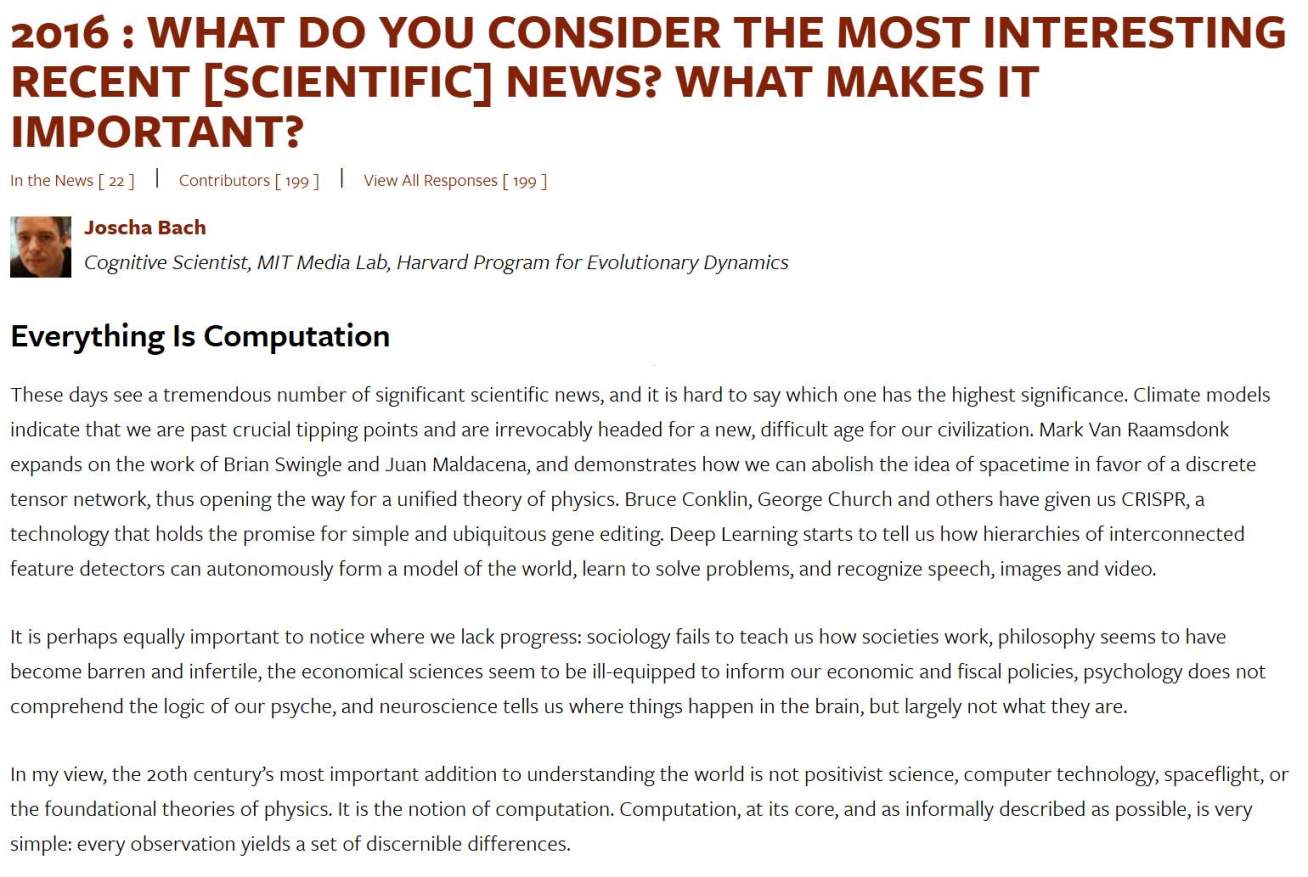
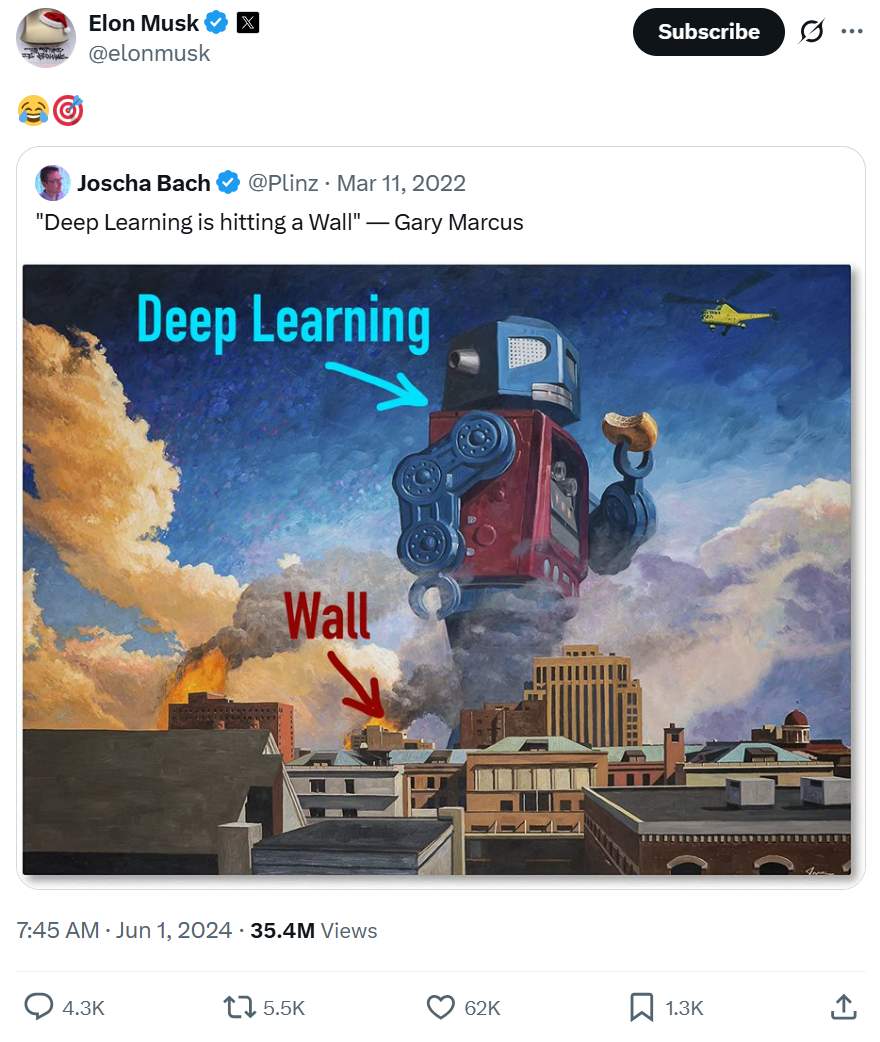
Bach has gone on to become a heavyweight in the AI industry, working with some of its most consequential organisations, including the AI Foundation, the MIT-spinoff Liquid AI and Intel Labs.
His thinking on cognitive architectures, consciousness and “liquid” neural systems has influenced how the top echelons of tech think about the next frontier in machine intelligence. The extent of his influence is reflected in the fact that one of his avid readers is Elon Musk, who has reposted Bach’s tweets on X to his millions-strong audience and engaged with him on the platform.
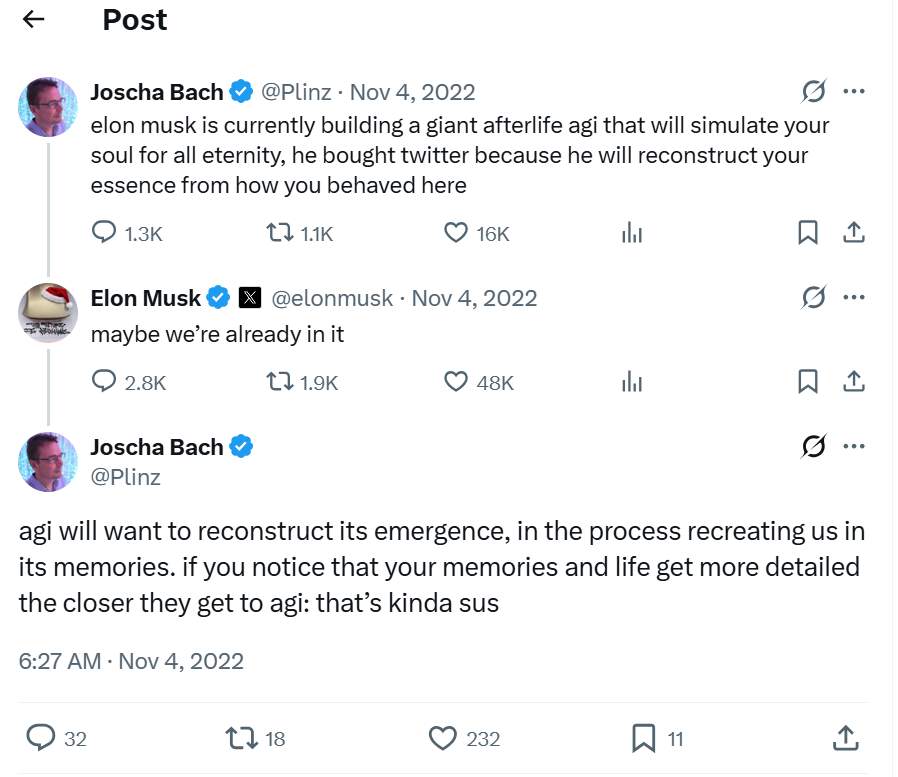
What began in the 2016 email chain between Epstein and Bach as a discussion about human learning quickly mutated into one of the most explicit articulations of race hierarchy, gender essentialism and authoritarian governance found anywhere in the released files.
Bach’s email begins with a pseudo-neuroscientific discussion of “layers” of cognition – a developmental metaphor he and Epstein share. Bach tells Epstein he has “looked up the statistics” and asserts that “black kids in the US have slower cognitive development (and never catch up)”, while outperforming white children in early motor skills. He insists that researchers’ attempts to attribute this to environmental factors are misleading.
He then advances an evolutionary explanation that places African Americans and Europeans on different biological tracks. In his words, black children’s “faster motor development” means “their brains are slower at learning high-level concepts, because the low-level structures are optimised for a shorter time”. Europeans, by contrast, supposedly evolved to master “long-term seasonal patterns” and “delayed gratification for agriculture”, while Africans are framed as adapted for “a more hunting/running style of life”.
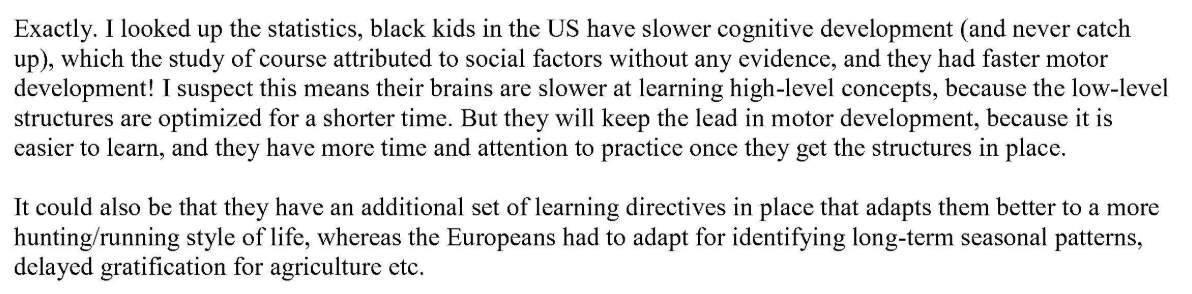
Epstein accepts and extends Bach’s argument into culture, writing that “African music… African primitive” reflects the structure of African cognitive “layers”, while Western music is “rigid” and Chinese music “nature-based”, each supposedly mirroring the underlying brain architecture of its people. The implication is that cultures are determined – and limited – by genetic endowments.
The email moves seamlessly from race to gender. Bach argues that women “find abstract systems, conflicts and mechanisms intrinsically boring”, while men find “elaborate social relations boring.” He writes that “most women in computer science do not write programs because they enjoy solving puzzles,” and claims there are “almost no women in math” because it “does not yield social attention”.
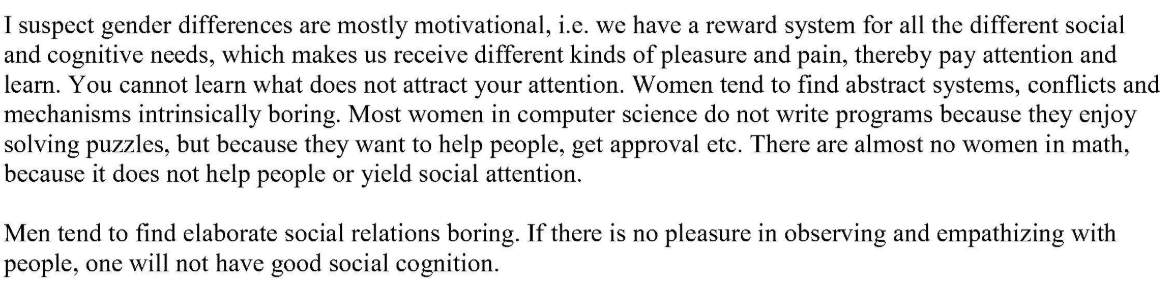
From there, they shift back to ethnicity. Bach characterises “Chinese” people as paying “an inordinate amount of attention to authority” because historically “the authorities tended to kill them a lot if they did not”, while “Jews tend to be intellectually independent and anti-authoritarian”, which he suggests explains their creativity.

Bach and Epstein explore whether cognitive differences could be altered genetically. Bach writes that “changing the time correlations (by genetic switch or other method)” might “make blacks smarter” by adjusting the developmental timing of specific neural layers.
This is an unabashed proposal for genetic and social engineering on explicitly racial terms.
Mass Deaths
From this point onward, Bach speculates openly about mass death. “Maybe climate change is a good way of dealing with overpopulation… the earth’s forest fire… potentially a good thing for the species,” he writes.

He goes further still: “too many people, so many mass executions of the elderly and infirm make sense… if the brain discards unused neurons, why shold socieity [sic] keep their equivalent”.

Bach continues:
“The radical idea of treating individuals in a society as cells and the society itself as a well-Organized organism is fascism, or course. Probably the most efficient and rationally stringent way of governance, if someone could pull it off in a sustainable way… I rather like the treatment Fascism gets in the Amazon Series ‘The Man in the High Castle’, which explores what would have happened if the Germans and Japanese had won the war: A society that tries to function as a brutal and ruthlessly efficient machine, eliminating all social and evolutionary slack. It is very dark, but not a flat caricature of pointless evil for its own sake.”
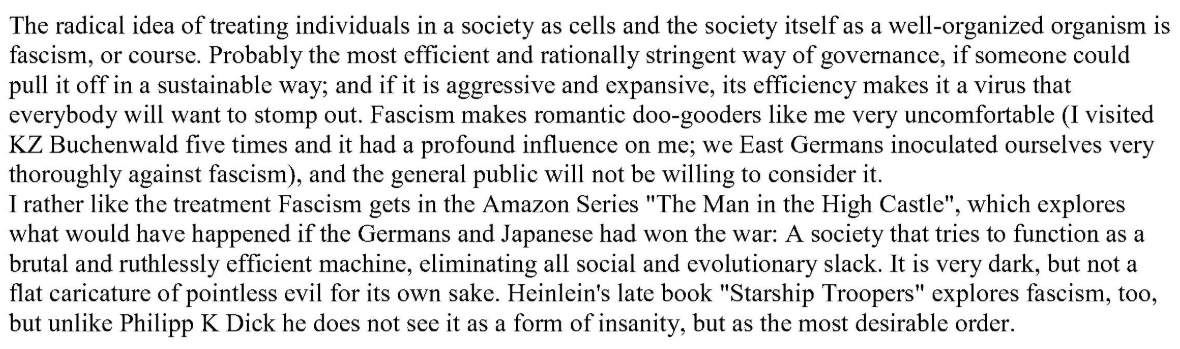
Epstein does not push back, and in turn receives praise from Bach for his unfiltered worldview: “I find your ‘political incorrectness’ very fascinating… I think you are simply entirely unconstrained in your thoughts.”
Their exchange continues with discussions of where different races and genders sit on the “Bell Curve”. This is the name of a 1994 book by Charles Murray and Richard Herrnstein which claimed that black people have lower IQ than white people largely for genetic reasons. The book’s claims have been overwhelmingly refuted by scientific research.

Bach has since partly distanced himself from these views. In response to a Boston Globe piece describing some of his comments to Epstein on race and gender, he wrote:
“Race is itself not causal in cognitive differences of course, and later research brought me to my current view that race is NOT causal for differences in development, and race is NOT a determinant of IQ in children or adults.”
Yet taken together, Bach’s communications with Epstein reveal an entire architecture of thought increasingly common among Edge participants: biological hierarchy; racial destiny; gender determinism; genetic optimisation; population culling; fascism as efficiency.
And it was articulated by a top AI theorist whose work circulated through the same networks that Epstein was funding and infiltrating. Epstein was not out of place in these circles. He was exactly where his ideas fit.
Longtermism
A sense of how deeply they fit is evident from the role of transhumanist philosopher Nick Bostrom – the father of ‘longtermism’ (a moral view that prioritises ensuring humanity’s existence into the far future, if necessary through sacrifices in the present) – in the Edge network. While longtermism today includes many strands and adherents, his early formulations were among the most influential in Silicon Valley’s initial engagement with the field.
Bostrom, whose now-defunct Future of Humanity Institute at Oxford University was financed by Elon Musk, began engaging with Edge regularly a year after Epstein’s 2008 conviction. He attended various Edge events, including several billionaire dinners, was featured as a top thinker on AI and technology, and contributed like clockwork to its annual questions for a decade.
Back in 1996, however, Bostrom had used the N-word and argued that white people were genetically more intelligent than black people on a private listserv. Although he apologised when the exchange came to light, he did not disavow his central contention regarding race and intelligence, and offered a soft defence of eugenics reflecting views he had previously published in a famous paper on existential risk.
That paper, widely recognised as the founding document of longtermism, lamented the “negative correlation in some places between intellectual achievement and fertility”. If allowed to get out of control for too long, “we might evolve into a less brainy but more fertile species, homo philoprogenitus (‘lover of many offspring’).”
As previously reported in Byline Supplement, Bostrom would go on to openly advocate in utero selective breeding to enhance population IQ; total global surveillance by artificial intelligence to prevent human extinction; and the idea that sacrificing a billion lives today might be worth it to improve the chances that ten to the fifty-fourth power (septendecillion) people exist in the future.
In 2009, the same year he joined Edge and became a regular contributor to the network, Bostrom co-founded the World Transhumanist Association (now known as Humanity+).
Two years later, Jeffrey Epstein donated a total of $120,000 to Bostrom’s organisation, including to cover the salary of its vice-chairman Ben Goertzel – a top computer scientist who popularised the idea of ‘artificial general intelligence’ (AGI) and now heads up SingularityNET, which is working to create an “emergent, multi-agent intelligence” network by letting different AIs work together on the blockchain.
AGI and the Singularity
Goertzel received financial support from Edge’s main funder, Jeffrey Epstein, throughout his career.
Deleted archived versions of his 2002 CV acknowledged that Epstein funded his research fellowship to the tune of $100,000. In his 2014 book, Engineering General Intelligence, Part 1: A Path to Advanced AGI via Embodied Learning and Cognitive Synergy, Goertzel mentioned the convicted sex offender in his acknowledgements: “Jeffrey Epstein, whose visionary funding of my AGI research has helped me through a number of tight spots over the years. At time of writing, Jeffrey is helping support the OpenCog Hong Kong project.” OpenCog is used by some 50 companies, including Huawei, Cisco and Goertzel’s own SingularityNET.
Despite their significant differences, both Bostrom and Goertzel are among the most prominent advocates of the notion of an inevitable near-term “Singularity”, a hypothetical point in the future when artificial intelligence surpasses human intelligence, triggering runaway technological growth, rapid self-improvement, and irreversible, unpredictable changes to civilisation – with outcomes ranging from human-AI fusion and immortality, to human extinction.
The most famous early proponent of the AI singularity notion is Ray Kurzweil, who has also been a longtime member of the Edge Foundation, contributing in the form of articles and webinars, and attending two Edge Billionaires’ Dinner events in 2001 and 2005.
Both of those dinners were attended by Epstein associates who were frequent Edge dinner attendees, and who also turned up on a 2011 confidential email thread including Epstein, as previously reported by Byline Times. These individuals included Google founders Sergey Brin and Larry Page, Amazon founder Jeff Bezos, Sun Microsystems founder Vinod Khosla, inventor of the Segway Dean Kamen, and former Walt Disney Imagineering executive Daniel Hillis. In 2012, Kurzweil would go on to become director of engineering at Google.
Joscha Bach, the Edge member with whom Epstein corresponded about the evolutionary utility of fascism, moved through this network under Epstein’s tutelage. He was a research fellow under Nick Bostrom at Humanity+ after it had received funding from Epstein from 2013-2014, before moving to Harvard and MIT’s Media Lab, where he received another £300,000 from Epstein.
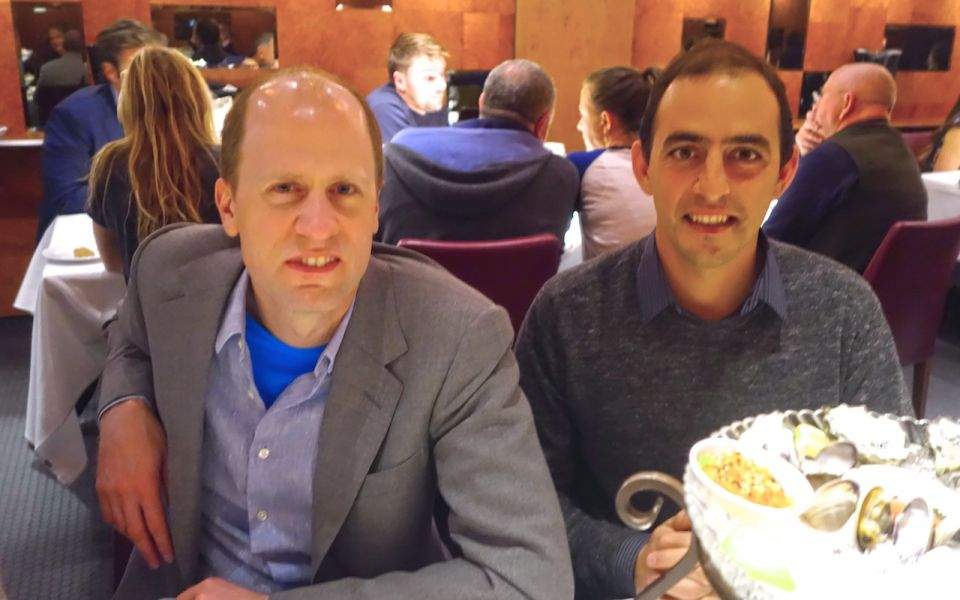
In 2015, Bostrom would be photographed at that year’s Edge Foundation Billionaires’ Dinner next to Salar Kamangar, currently a senior executive at Google. Kamangar was also in 2011 part of the confidential Edge email list, including Epstein, alongside the founders of Amazon, Google, SpaceX, Facebook, Microsoft, AOL and beyond.
As late as 2018, a paper by Bach presented at the International Conference on Artificial General Intelligence credited the Epstein Foundation for “generous support” and “discussions”.
This nexus illustrates Epstein’s sustained, long-term financial influence over thinkers shaping AGI’s intellectual trajectory.

Curtis Yarvin: How the Alt-Right Gets In
Following his appearance on a panel with Alastair Campbell, Byline Times examines the writings of the thinker who is apparently inspiring Silicon Valley Tech Bros and the Vice President of the United States
The Pioneers of “Machine Consciousness”
Bach now heads up the California Institute for Machine Consciousness (CIMC), whose advisors include Karl Friston, widely recognised as the number one most influential neuroscientist in the world, and Stephan Wolfram, whose technology is used in Apple’s Siri and Amazon’s Alexa. The group’s funders remain undisclosed.
Wolfram was also a member of the Edge Foundation since around 2016, and delivered two webinars for the network on AI and the computational universe.
The House Oversight files show that Epstein received an advanced draft of an Edge Foundation anthology on AI published by Penguin and edited by its CEO John Brockman, called Deep Thinking: Twenty-Five Ways of Looking at AI.
The book, released with the title Possible Minds in February 2019, included contributions from several Edge members, including Wolfram, whose chapter claims that the achievement of human immortality – whether biologically or digitally – is “inevitable”.
At least one contributor, AI pioneer Danny Hillis, had been long personally acquainted with Epstein – dining with him at an Edge dinner in 1999, regularly discussing currency trading with him, receiving a package from Ghislaine Maxwell in 2002, and meeting with Epstein at the MIT Media Lab in 2015.
CIMC’s chairman is Jim Rutt, who was chairman of the Santa Fe Institute from 2009 to 2012, during which the organisation – widely recognised as the world’s leading research centre for complex systems science – accepted a donation from Epstein in 2010 (two years after his conviction).
Epstein’s exchanges with thinkers like Bach, in other words, were hardly aberrations. They flowed out of a shared environment in which extreme ideas about hierarchy, optimisation and human worth were debated casually among individuals building the core infrastructure of the digital age.
Neither Joscha Bach nor the California Institute for Machine Consciousness responded to requests for comment. Neither did John Brockman, the Edge Foundation, or any of the Silicon Valley founders mentioned in this article.
The System That Let Epstein In
Epstein’s place inside Edge was never concealed from its core members. Before 2008, the Foundation openly presented him as a benefactor and participant, highlighting his scientific donations and placing him at the same tables as the emerging tech elite. His funding of Harvard’s Programme for Evolutionary Dynamics was celebrated; Edge seminars and prizes carried his name. Nothing about Epstein’s involvement was hidden from the people who moved through that world.
After his conviction, many of those who first encountered Epstein through Edge continued to move through the same network, knowing he was still funding it and involved.
A small but influential subset went on to maintain contact directly or indirectly after 2008 – through social dinners, philanthropic conversations, institutional visits or intellectual exchanges – and every one of them had first met him inside Edge’s orbit.

How Epstein Infiltrated the Silicon Valley Network Behind Trump’s New Tech Order
Documents show Jeffrey Epstein was not cast out after his child sex-crime conviction but remained embedded in a confidential inner circle of Silicon Valley founders with strategic influence on the modern world, including Musk, Bezos, Brin, Page, Gates and Zuckerberg
This includes figures such as Bezos, Brin, Page, Musk, Nathan Myhrvold, Bill Gates, Seth Lloyd, Lawrence Krauss, Joi Ito and Michael Wolff, as well as later Edge network thinkers like Joscha Bach and Nick Bostrom. The December 2011 confidential email chain unearthed in part one of this series underscores how Silicon Valley’s most iconic players were aware of Epstein’s presence among them.
The contours of contact varied – from internal JPMorgan documents describing Brin and Page taking Epstein’s financial advice, to Ghislaine Maxwell’s appearance at one of Bezos’s 2018 “Campfire” retreats, to Michael Wolff relying on Epstein as a key source for his Trump biography – but the common origin point remained the same. The Edge Foundation was the conduit through which Epstein entered these circles – a fact unacknowledged by its alumni.
Epstein’s underwriting of Edge gave him extraordinary access and trust with men who were already building the systems – cloud platforms, AI architectures, digital-asset networks – that now underpin political and economic power.
Threaded through that infrastructure was a worldview that Epstein helped architect: the elevation of a self-defined cognitive aristocracy; rising scepticism toward democratic accountability; an obsession with racial and gender hierarchy, and genetic “optimisation”; machine intelligence as the inevitable future of humanity, if it survives extinction; the legitimacy of population culling to root out inferior groups; all rooted in a hyper-reductionist, technocratic (and arguably unscientific) view of existence as a computer simulation in an amoral multiverse of simulations.
It was a worldview Epstein not merely recognised but was actively cultivating, as it conformed to his own horrific moral choices.
This was the system that let Epstein in and kept him in. It is also the system now steering the most consequential technologies of the coming century. The convergence of Silicon Valley’s elite, the techno-authoritarian right and the labs coding AI and crypto, has only intensified since his death.
The ideas Epstein exchanged inside those circles – who is worthy of power, who should be engineered and who can be written off – now shape the technologies and institutions becoming the backbone of a new political order being installed under Trump’s second term.