
 Subscriptions

Read our Monthly Magazine
And support our mission to provide fearless stories about and outside the media system

For two decades, Jeffrey Epstein moved through the private networks that shaped modern Silicon Valley — even after his sex-offending conviction.
Newly released House Oversight Committee files, combined with a deep review of archived material, reveal how his money, ideas and relationships flowed into the founders, labs and political circles now defining America’s new tech order.
Part One of this exclusive three-part investigation explores how Epstein was embedded in the Silicon Valley ‘Broligarchy’ brains trust. Part Two uncovers how Epstein intersected with pivotal moments in Bitcoin. Part Three, the channelling of an apocalyptic vision of climate ‘culling’ and eugenics.
Jeffrey Epstein’s ties to Silicon Valley did not break after his conviction. As we revealed in part one of this investigation, through the Edge Foundation – a private forum that functioned as a kind of inner brain-trust for the founders of Amazon, Google, Facebook, Tesla and others – years after being jailed for soliciting a child, he remained in circulation among the architects of the digital age, now among the biggest donors to Donald Trump.
But the newly released documents point to a deeper story. The Edge Foundation was not just a talk-shop. For Epstein, it was a route to influence the direction of Silicon Valley, AI, Big Tech and cryptocurrency at their most pivotal period. One of the most crucial moments of impact was on Bitcoin, the world’s most recognised, valuable and widely used cryptocurrency.
At the very moment Bitcoin’s future was in jeopardy, Epstein’s money and access placed him inside the institutions that were beginning to frame the cryptocurrency as a tool to route around nation states – and consolidate power among a new class of networked tech elites.
One of them was billionaire tech magnate Peter Thiel, who not only operated in Trump’s inner circle during his first term, but has massively expanded his influence on the second Trump administration, with more than a dozen people closely connected to him now folded into it.
MIT Media Lab and the Fight for Bitcoin’s Future
In 2012 Joichi (Joi) Ito – Director of the Massachusetts Institute of Technology (MIT) Media Lab – delivered a webinar to the Edge network. Ito had been a member of the Edge Foundation since 1999 when he first attended and dined with Jeffrey Epstein.
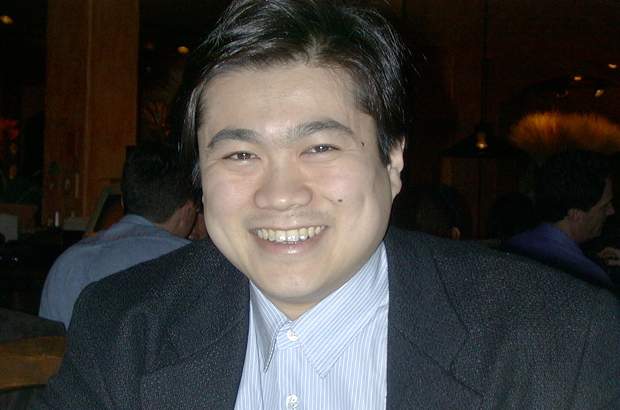
By 2013, Ito began concertedly inserting Epstein into MIT circles despite him being “disqualified” in the university’s donor database, telling colleagues that Epstein had been fully vetted. A key figure at this time was the co-founder of LinkedIn, Reid Hoffman, who sat on Ito’s MIT Media Lab advisory council. Ito turned to Hoffman to help manage Epstein’s relationship with the Media Lab – arranging to meet both men on campus to discuss fundraising.
Hoffman and Ito have since apologised for their connection to Epstein.
Between 2013 and 2017, Epstein donated $525,000 to the Media Lab. Other MIT recipients aligned with the Edge network had already benefitted from his money – including £100,000 to AI pioneer Marvin Minsky in 2002 and $225,000 to the quantum physicist Seth Lloyd.
In April 2015, Byline Times can reveal from the House Oversight corpus, Ito forwarded Epstein an internal summary of a major shift underway in Bitcoin’s governance. Its core code was maintained by “five core developers” and around a hundred contributors, Ito explained to Epstein – but “only the five core developers decide what changes are made to the core code”. The Bitcoin Foundation, which had financed the project’s infrastructure, had just imploded. The collapse came at a pivotal moment: Bitcoin’s next upgrades would determine whether it became a global monetary platform or remained a niche experiment.
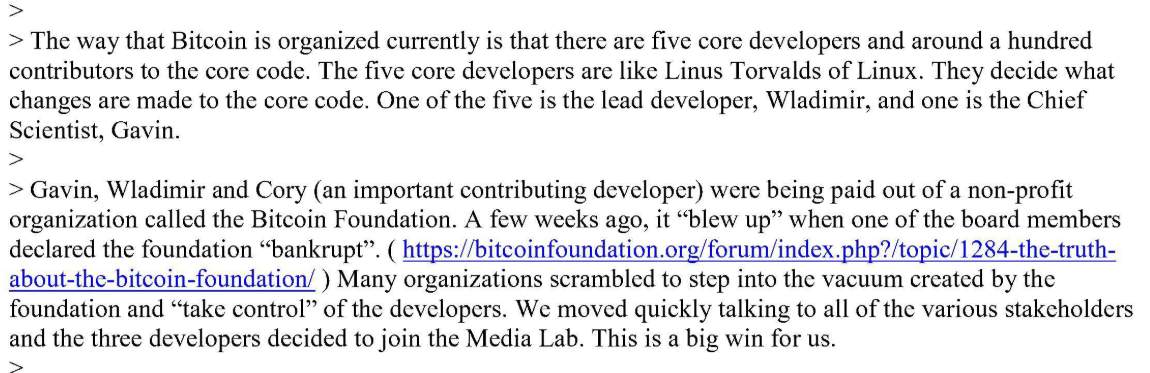
Into that vacuum, Ito wrote, the Media Lab had “moved quickly”, persuading three of the five programmers – “lead developer, Wladimir”, “Chief Scientist Gavin”, and a third key engineer “Cory Fields” – to join MIT. “This is a big win for us,” Ito told Epstein.
In a short note attached to the message, Ito was more direct: “Used gift funds to underwrite this, which allowed us to move quickly and win this round. Thanks.” Epstein replied: “gavin is clever.”

The substance of the exchange was clear. With the Bitcoin Foundation in collapse, MIT’s Media Lab had positioned its own ‘Digital Currency Initiative’ as the new institutional centre of gravity for Bitcoin’s development. It did not ‘control’ the cryptocurrency – miners, node operators and contributors retained decisive power – but, for the first time, the main home and paymaster for most of the core developers was an academic lab partially underwritten by Jeffrey Epstein.
A few months later, this new institutional leverage intersected directly with Silicon Valley’s most influential founders. LinkedIn co-founder Reid Hoffman, who sat on MIT Media Lab’s advisory council, invited Ito and Epstein to an August 2015 dinner in Palo Alto with Elon Musk, Mark Zuckerberg and Peter Thiel – the PayPal co-founder and driving force behind Palantir. Hoffman later said the meeting was arranged at Ito’s behest.
The gathering placed Epstein at the same table as the figures who would go on to champion Bitcoin and the wider crypto ecosystem as tools to bypass national sovereignty via decentralisation – just months after MIT, using Epstein-funded “gift funds”, had recruited the majority of Bitcoin’s core maintainers.
Zuckerberg, who was also copied on a 2011 Edge Foundation confidential email list with Epstein and other Silicon Valley founders (including Jeff Bezos, Elon Musk, Sergey Brin, Larry Page and many others), had previously attended an Edge Billionaires’ Dinner in 2008.
In October that year, Epstein would continue to engage with the MIT Media Lab on the Bitcoin project. Joi Ito arranged a meeting between Epstein and students leading the Digital Currency Initiative to discuss Bitcoin, also attended by Edge Foundation member and AI pioneer Daniel Hillis. Hillis had also been copied into the December 2011 email list with Epstein and other Silicon Valley founders.
The substance of these conversations about MIT’s work on Bitcoin has never been disclosed.
This elite enthusiasm for crypto would only intensify over the following decade. Peter Thiel has argued that “Bitcoin will never be controlled by the government, unlike ‘woke companies’,” insisting that public equities were now “quasi-controlled by the government in a way that Bitcoin never will be”.
Elon Musk, when asked earlier in 2025 whether his newly launched America Party would support Bitcoin, answered bluntly: “Fiat is hopeless, so yes,” framing crypto as a decentralised counterweight to state monetary power.
Mark Zuckerberg – who has repeatedly attempted to integrate crypto infrastructure into Meta’s platforms – has said that the technology underpinning Bitcoin reflected a belief “very strongly in trying to decentralise and put power in individuals’ hands.”
Epstein was, in short, helping underwrite the institutional node through which many of Bitcoin’s most consequential changes would be proposed, tested and released. And it placed him, via Ito and Hoffman, inside the same social and intellectual circle beginning to frame Bitcoin not simply as a financial asset, but as the bedrock of a new political architecture designed to route around democratic states. Epstein was not the author of this ideology, but he was moving inside the very circles where these ideas were being cemented into Silicon Valley’s emerging political identity.
Epstein and Thielworld
By the time of that August 2015 Palo Alto dinner – where Epstein sat with Elon Musk, Mark Zuckerberg and Peter Thiel at Joi Ito and Reid Hoffman’s invitation – Epstein had already begun cultivating Thiel directly.
Hoffman had introduced the two men the previous year, and their correspondence shows an easy familiarity.
In May 2014, Epstein emailed Thiel, “That was fun, see you in three weeks,” confirming not only that they had already met, but that another meeting was scheduled.
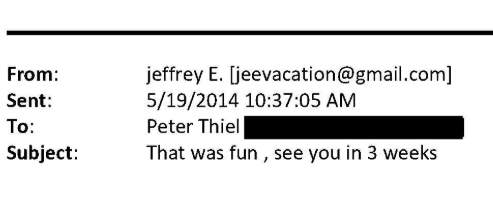
Emails released by the House Oversight Committee show the two remained in casual contact over the years that followed.
By 2016, Epstein had invested $40 million into Thiel’s venture capital firm Valar Ventures, which finances some of the fastest-growing fintech companies in the world.
That year, Thiel endorsed Trump from the main stage at the Republican National Convention, pledged $1.25 million to support his campaign and went on to join the president-elect’s transition executive committee. He advised Trump on technology and national security policy and had immediate influence over appointments to the Pentagon, the White House and the wider federal bureaucracy.
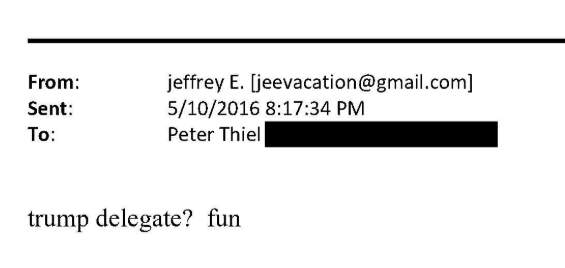
In one 2016 message, Epstein wrote to Thiel with a wry jab:
“trump delegate? fun”
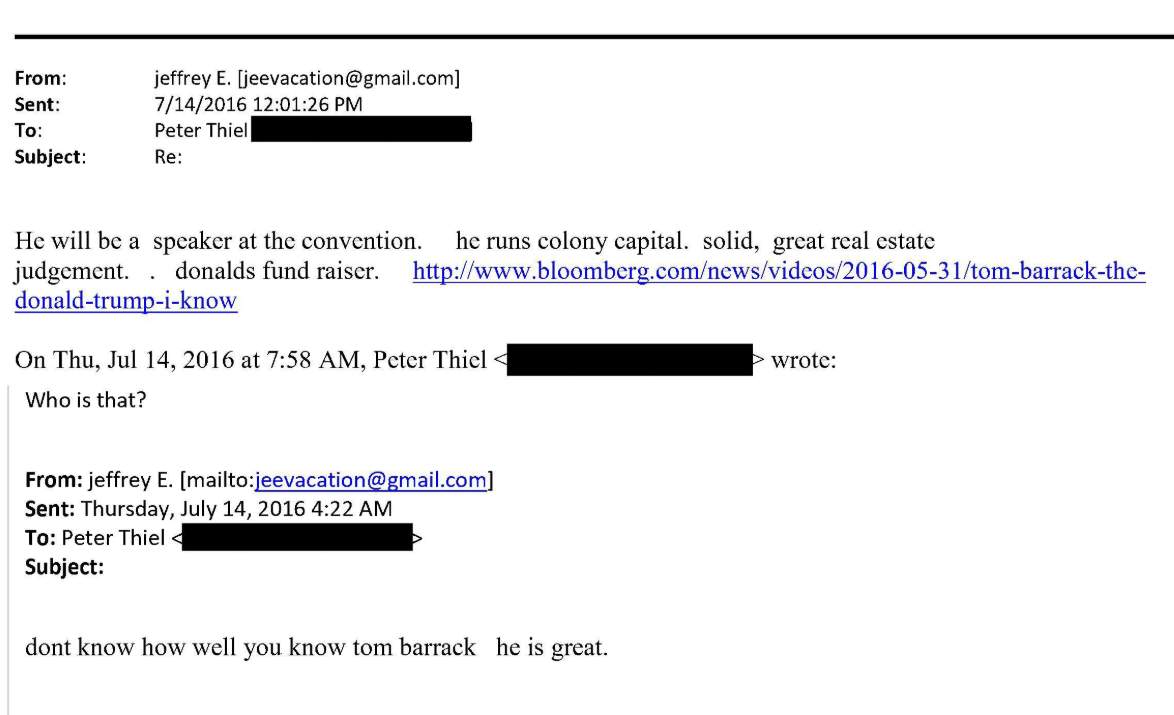
In another exchange that year, Epstein forwarded material about Tom Barrack, the real-estate mogul and Trump confidant who would later chair the Presidential Inaugural Committee. Epstein described him as a serious player in Trump’s orbit – nudging Thiel toward a closer awareness of the power structure forming around the man he just endorsed.
The contact did not stop once Trump took office. In at least one exchange from 2018 – nearly two years into Trump’s presidency – Epstein wrote to Thiel:
“Are you enjoying LA?”
Thiel responded:
“Can’t complain thus far.”
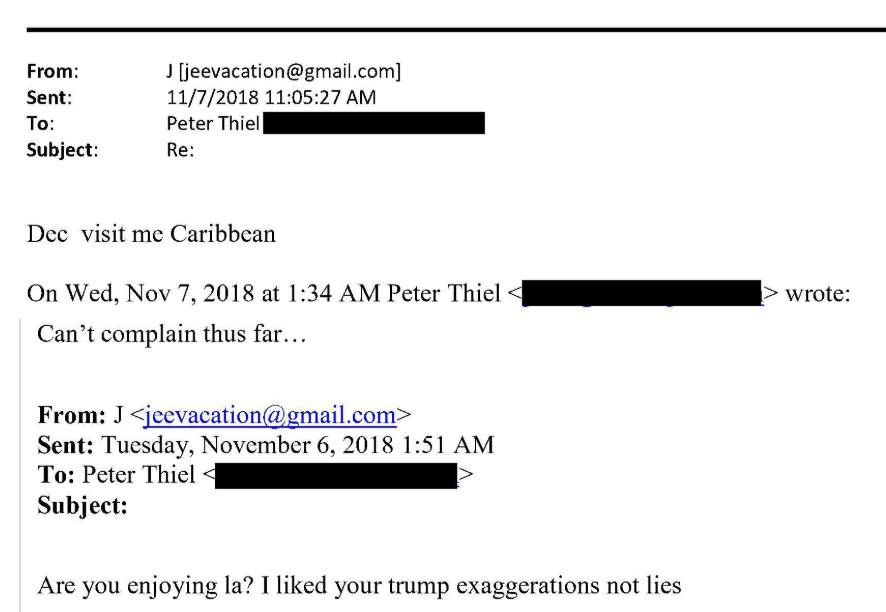
Epstein replied with another invitation – this time a suggestion that Thiel should visit him in the Caribbean that December.
By this point, Thiel’s protegés – including Michael Kratsios – had been elevated into senior roles in the Office of Science and Technology Policy and the White House. And Thiel’s companies were deepening their relationships with the national security state.
Thiel was also ramping up investments in the cryptocurrency that Epstein had underwritten a few years earlier. In October 2017, Thiel had declared that people were “underestimating” Bitcoin and that it had “great potential left” – comparing it to gold as a secure, reserve form of money, noting its limited supply and the security of its underlying math.
Shortly after, and during his continued engagement with Epstein, Thiel’s Founders Fund began purchasing Bitcoin, investing between $15 million and $20 million when the price was below $30,000. By March 2018, Thiel was describing Bitcoin as a “deeply contrarian” investment. Four years later, Founders Fund exited nearly all its cryptocurrency positions, selling for a reported $1.2 billion profit just before the market crash later that year. A month after that bonfire sell-off, Thiel delivered a fiery speech about how the financial “gerontocracy” – a society run by old people – is holding back Bitcoin’s potential as a “revolutionary youth movement”. He went on to declare: “The central banks are going bankrupt. We are at the end of the fiat money regime.”
The newly released emails show Epstein repeatedly presenting himself as being in close contact with Trump’s circle in private messages during this period – and in some cases demonstrating insider knowledge he could not have had without real access.
As Byline Times previously revealed, the clearest evidence of access to Trump’s political inner circle came in March 2019, in a series of emails to Steve Bannon. In those exchanges, Epstein relayed assessments of Donald Trump’s emotional state, factional disputes inside the West Wing and upcoming personnel moves – insider details that only became public months later. The timing and specificity of Epstein’s descriptions indicate that he was receiving sensitive information from individuals inside the President’s orbit.
The newly disclosed email correspondence between Peter Thiel and Jeffrey Epstein confirms that the convicted child rapist and accused serial sex trafficker were in regular contact during Thiel’s involvement in Trump’s inner circle – shortly before Epstein revealed to Bannon sensitive information on internal White House politics that would only become public months later.

How Epstein Infiltrated the Silicon Valley Network Behind Trump’s New Tech Order
Documents show Jeffrey Epstein was not cast out after his child sex-crime conviction but remained embedded in a confidential inner circle of Silicon Valley founders with strategic influence on the modern world, including Musk, Bezos, Brin, Page, Gates and Zuckerberg
Peter Thiel was contacted for comment through the Thiel Foundation, but no response was received.
A decade after his conviction, Epstein had found a channel into the centre of American political power – through the same Silicon Valley–Thiel networks that were defining the Trump project. His access was no accident: it was part of the structure that had carried him this far.
This was Part 2 of a three-part investigation. Part 3 traces how the same networks carried a far darker ideology into Silicon Valley’s AI elite.