
 Subscriptions
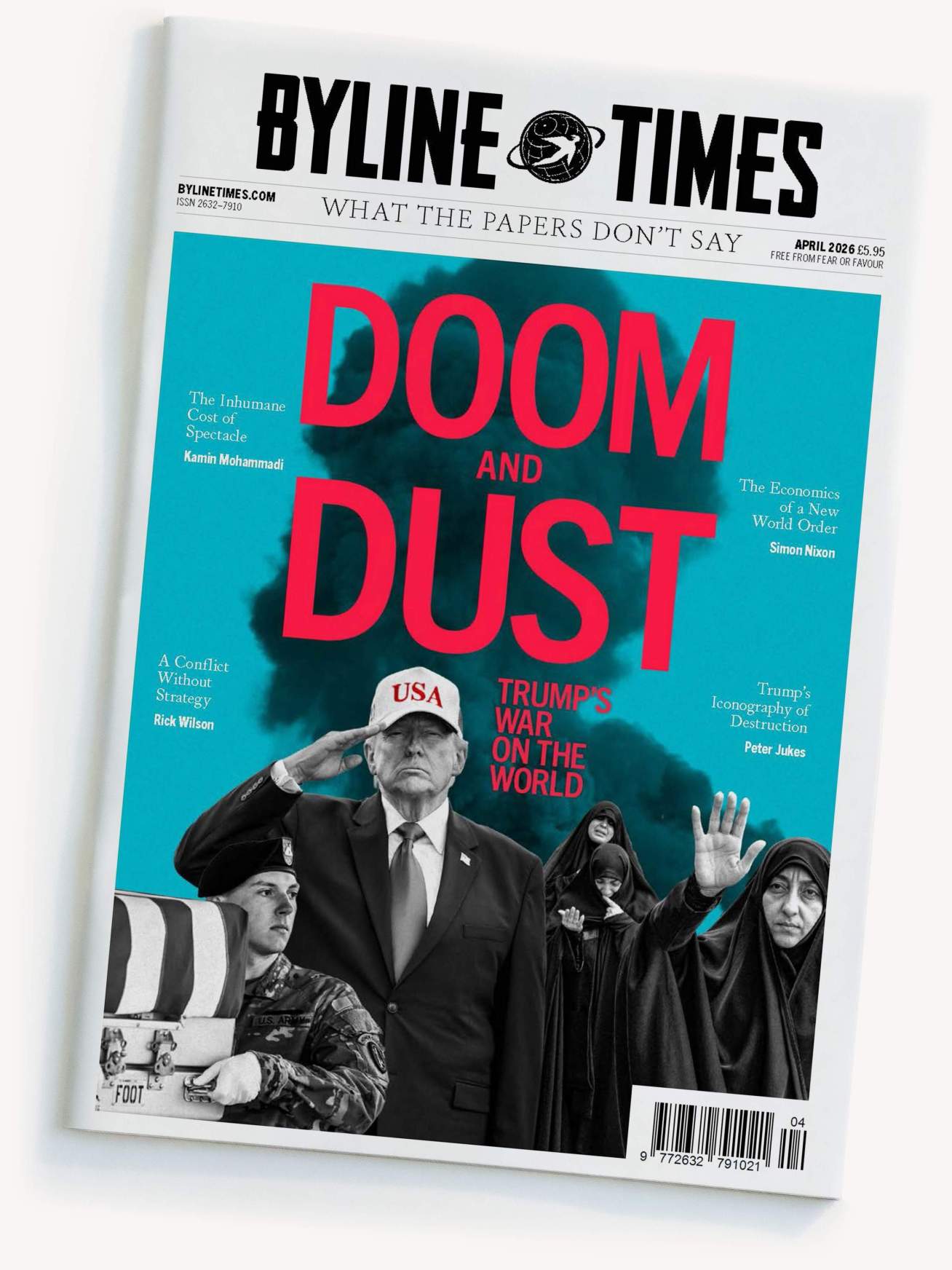
Read our Monthly Magazine
And support our mission to provide fearless stories about and outside the media system
The Faena Miami Beach hotel gets thousands of five-star reviews online. It is arguably the most luxurious hotel in the city – certainly up there with the Miami Beach Edition. So, if you were the US Representative for Florida’s 13th congressional district and in town on the weekend of 25 October this year, looking for a Russian businessman sanctioned by the US Government for his links to the Kremlin, the Faena was the place to be.
It was also where Donald Trump’s personally appointed peace envoy walked in with business ties to the very Kremlin-linked financial networks he was supposed to be negotiating against.
The Envoy who Walked in With Two Hidden Conflicts
Byline Times can reveal that Steve Witkoff entered this meeting carrying two conflicts of interest: his real estate empire has been financed, in part, by a former adviser to President Vladimir Putin’s right-hand man on money and investment; and several of his Florida and New York developments have drawn on investment vehicles linked to post-Soviet networks now intertwined with Russia’s political elite.
These financial entanglements starkly contradict the narrative that Witkoff’s apparent willingness to support Moscow’s position stems from inexperience. Long before he picked up the phone to Kremlin officials, he was already moving through business circles shaped by the same interests he was now claiming to mediate.
In fact, as long ago as 2011, the Kremlin’s sovereign investment fund had recruited a Wall Street billionaire close to Trump as an adviser – and the same financier’s firm later became one of Jared Kushner’s biggest lenders, providing hundreds of millions of dollars for prime New York properties. Years before the current “peace plan” emerged, Trump’s son-in-law, Jared Kushner and a Kremlin-backed fund were already moving in a shared financial orbit.

Nigel Farage’s ‘Project 2029’: The Pro-Trump Lobbyist Pushing His Agenda Into the UK
A Trump-aligned anti-abortion lobbyist who hosted Nigel Farage’s meeting with a 6 January rioter in Florida has been funding and advising the Reform leader while pushing Project 2025’s hard-right agenda into Britain
Inside the Faena Meeting and the 28-Point ‘Peace’ Plan
At the Faena in October, Kirill Dmitriev, head of the Russian Direct Investment Fund (RDIF) – the Kremlin’s sovereign investment vehicle – was joined by President Trump’s special envoy, Steve Witkoff, and, Jared Kushner. The choice of venue was doubtless a good one – it is a self-proclaimed “exclusive sanctuary”, defined by “decadent design, luxe amenities, and legendary hospitality.”
It also happens to be co-owned by a close business associate of Steve Witkoff’s: the Ukrainian-born, British and American citizen billionaire Len Blavatnik, whose fortune grew out of post-Soviet deals with one of Vladimir Putin’s closest oligarch allies. Blavatnik was sanctioned by the Ukrainian Government in 2023.
These men were meeting at the Faena to finalise a 28-point peace plan for ending the war that the Russian President, Vladimir Putin, launched in Ukraine. Soon after the meeting, the plan landed like a FAB-3000 glide bomb on the international diplomatic community, prompting the Ukrainian President, Volodymyr Zelenskyy, to warn on television: “Now, Ukraine can face a very difficult choice – either losing dignity or risk losing a major partner.”

The Back-Channel Calls to Moscow
It has since emerged that, ten days before the Faena meeting, Witkoff held a call with President Putin’s senior foreign policy adviser, Yuri Ushakov, on 14 October. A leaked transcript published by Bloomberg shows Trump’s envoy coaching the Kremlin aide on how to pitch a “Gaza-style” peace plan to President Trump and reassuring him that Trump would give him “space and discretion” to get a deal. A second transcript, dated 29 October, captures a follow-up conversation between Ushakov and Kirill Dmitriev, the Kremlin’s equivalent special envoy, in which the two men discuss a 28-point plan that would entrench Russian control over occupied territory in Ukraine while presenting it to Washington as a US-branded initiative.
Those calls have already been poured over elsewhere as evidence of Witkoff’s deference to Moscow. What has not been examined is who he was by the time he made them: a Trump envoy whose business had already been financed by a former adviser to Dmitriev.

GB News Downplay Revelations About Trump’s Epstein Links as Presenters Echo White House Spin
The channel was criticised by media reform campaigners for its “fawning” interview with the President as it dismissed revelations of his extensive ties to Jeffrey Epstein
Witkoff’s New York Empire and Russian-Linked Capital
Having started in the 1980s at the real estate law firm Dreyer & Traub, where Donald Trump was a client, Witkoff left lawyering in the 1990s and moved into real estate in his own right, establishing the Witkoff Group in 1997. Among his first big-ticket purchases was the iconic Woolworth Building in Manhattan in 1998 for about $137 million.
At the same time, Len Blavatnik was using his New York-based holding company, Access Industries, to buy up former state assets in Russia being privatised by the Government, in particular accumulating shares in aluminium smelters. In the early 2000s, the sale of the Russian oil company TNK to BP netted him and his co-owners billions of dollars – money that would go on to seek safe Western assets, including prime New York and Florida real estate. Blavatnik’s wealth was built in partnership with Viktor Vekselberg’s Renova Group – one of Putin’s closest oligarchic power blocs – establishing an investment ecosystem that would later overlap with Witkoff’s own projects.
Anxious to capitalise on such foreign investment, the Kremlin created the Russian Direct Investment Fund (RDIF) in 2011 and Putin installed Kirill Dmitriev as its chief executive. This was not just any fund – it was Russia’s sovereign wealth fund, set up to co-invest alongside foreign partners in strategic Russian companies and later described by the US Treasury as a “slush fund” for Vladimir Putin when it sanctioned the fund after the 2022 invasion of Ukraine. Dmitriev now also serves as Putin’s special envoy for investment and economic cooperation – appearing regularly at the President’s side at investor summits.
From RDIF to Blackstone to Kushner – and Back to Witkoff
Before international sanctions bit, Putin’s money man Dmitriev could call on a panel of foreign advisers: among them, the New York tycoons Leon Black and Stephen Schwarzman. Their advisory roles did not prevent them from doing business back home . One of those pieces of business would be a substantial refinancing of Steve Witkoff’s flagship tower, tying his company directly into the orbit of Dmitriev’s former foreign advisers.
Schwarzman, the billionaire chair of Blackstone, sat on the international advisory board of Putin’s sovereign wealth fund – the RDIF – from 2011 until 2014. During that period, Blackstone made large loans to Jared Kushner’s family firm, eventually becoming one of the Kushner Companies’ biggest lenders with more than $400 million in financing across at least four New York deals. In 2015, his firm’s money would also flow into Witkoff’s most famous asset.
Steve Witkoff’s business was expanding, and in 2015 the Witkoff Group secured a $256 million refinancing of the Woolworth Building from Blackstone. This came less than a year after Schwarzman quietly left the RDIF advisory board around September 2014 following Russia’s annexation of Crimea, creating an obvious conflict of interest for a man who would later present himself as an honest broker between Trump and the Kremlin.
In short, Trump’s ‘peacebroker’ in Ukraine has received investment from a former advisor to Vladimir Putin’s now-sanctioned sovereign wealth fund – which is run by Putin’s pointman on the Ukraine negotiations.
Florida, Blavatnik and the Faena Nexus
By the time sanctions on Russia hardened after the 2022 escalation of the war, New York tycoons were finding it harder to work with Russian capital. Florida, by contrast, was booming – and Miami had quietly become a second political and financial hub for Donald Trump and his allies.
Witkoff did not turn his back on New York, but his financial ties to the former adviser to Putin’s sovereign wealth fund continued: this year he secured a further refinance deal on the Woolworth Building with Blackstone for $278.9 million.
At the same time, his Florida expansion placed him ever more deeply inside Len Blavatnik’s orbit – through joint ventures such as the Belgrove Resort & Spa in West Palm Beach, and the Ocean Terrace redevelopment in Miami Beach which, though not associated with Len Blavatnik’s ventures Access Industries and Access Real Estate, is linked to his young brother Alex (who is a chairman of Access Industries). It was a pattern of co-investment that aligned Witkoff’s projects with capital shaped by the post-Soviet oligarch networks now sanctioned by the United States.
And at the centre of that network sat the Faena – co-owned by Blavatnik and chosen as the venue where Witkoff, Kushner and Kirill Dmitriev met to try to design a path out of a war launched by Dmitriev’s own President. Dmitriev even found time, according to Russian state media, to present Floridian Republican congresswoman, Anna Paulina Luna, with flowers and a box of chocolates bearing Vladimir Putin’s face. The theatrics may have been trivial, but the symbolism was not: the Kremlin’s top dealmaker was working the same Miami corridors as Trump’s most trusted messenger.
Meanwhile, since 2020, the Faena hotel brand co-owned by Blavatnik has been in a global strategic partnership with the French hospitality group Accor. The partnership covers Faena-branded properties only; neither Blavatnik nor Access Industries has any ownership, control or revenue connection to Accor’s wider operations. Accor, however, continues to operate more than fifty hotels across Russia despite the invasion of Ukraine. Blavatnik has said he was never an associate of Vladimir Putin, met him only once with no further contact after 2000, and fully divested from all Russian assets in 2022.
What happened at the Faena was not an aberration. It was the predictable outcome of a system that has long blurred the lines between politics, capital and foreign influence – a system in which a developer whose business intersected repeatedly with Kremlin-linked money could be handed a diplomatic role with no scrutiny at all.
Witkoff did not need to cross a line in Miami. The line had already been erased long before he arrived.
The White House, Stephen Schwarzman and Len Blatvanik did not respond to requests for comment.