
 Subscriptions
Read our Monthly Magazine
And support our mission to provide fearless stories about and outside the media system
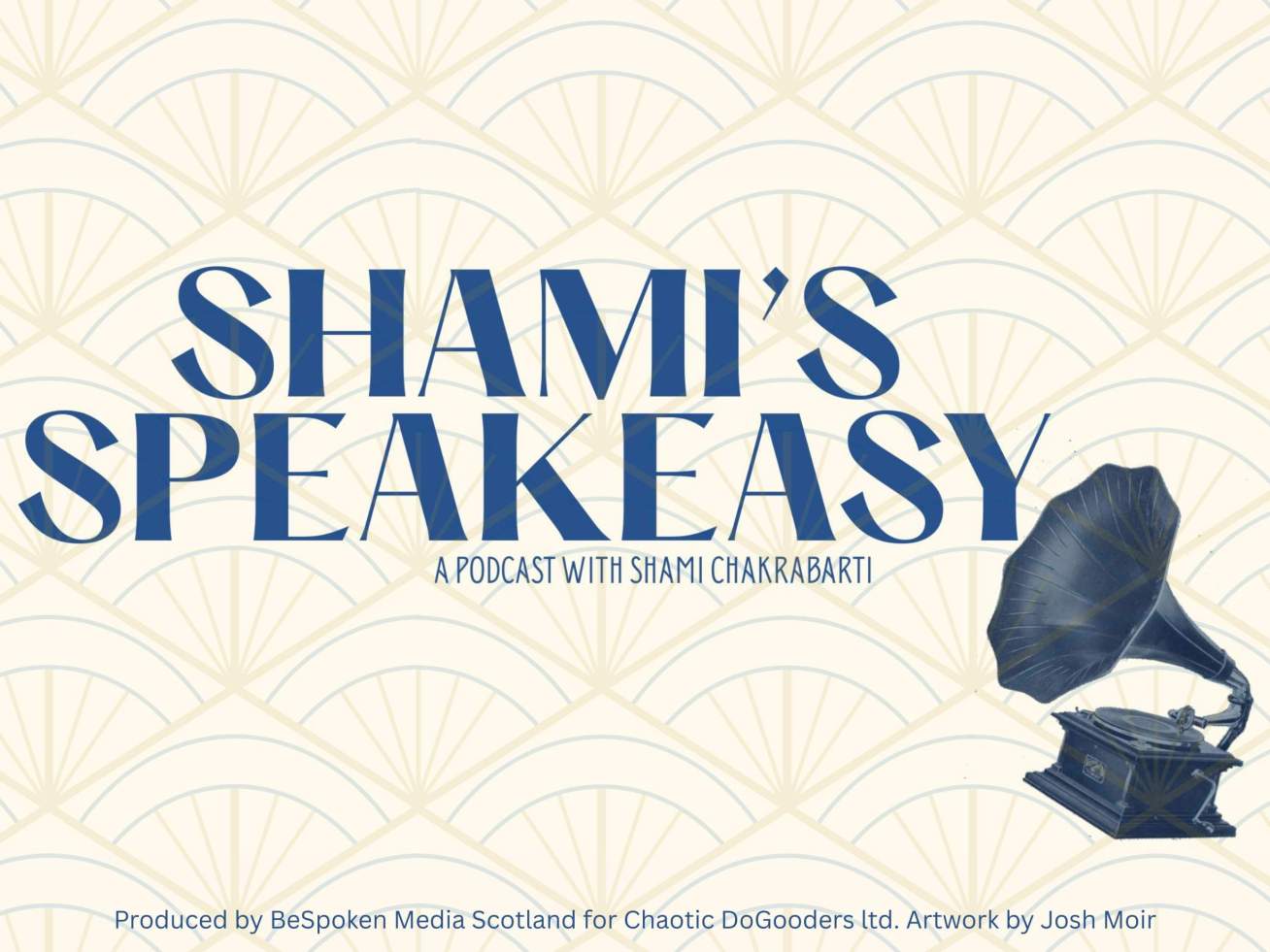
What is the idea behind the podcast and why are you launching it now?
SC: My dear friend and colleague, Mairi Clare Rodgers, said I should experiment with a podcast that creates a space for people to discuss, in long-form, in a comfortable, non-combative way. We are at this moment, culturally, politically – a scary moment – that feels a little bit too much like the 1930s, and that is where the concept of the ‘speakeasy’ came from. There are some very, very polarising things happening on the streets, in mainstream politics even, and people who are interested in resistance need a place to be themselves, to talk critically in a comfortable environment, and that’s the concept behind the podcast.
Do you think there is any exaggeration in comparing this moment to the 1930s? Why do you believe that politics and society are at such a point again?
I hope I am exaggerating but, to my mind – I’m 56 years old and have been quite politically aware since my childhood – I think this is the scariest moment in terms of the rise of the far-right, not just in the UK but internationally.
The populist hard men can beam themselves in from Silicon Valley to a demonstration in central London, can inspire and organise online. Wealth and power is more concentrated than ever – and if you have got wealth and power, and you want to hang on to it in the face of legitimate grievance on the part of millions and millions of people on the planet, the far-right strategy is to divide. It’s an old trick, which helps the wealthy and the powerful – but it doesn’t end well for anybody else.
When you see a pattern developing around the world of these hard, supposedly charismatic, leaders who claim a direct line to the ‘will of the people’, and therefore want to cut across institutions which they consider elite and corrupt, whether it is parliaments and other legislatures, this is what makes it feel like the 1930s to me. And it is not just rhetoric anymore – it is not just the attack on these institutions and on ‘activist lawyers’ and ‘unelected judges’ and ‘the blob’ – we are now seeing it on the streets, spikes in hate crime, and a toxicity of discourse where there isn’t room for reasonable disagreement or discussion.
There isn’t enough of a consensus about the rules of the game. In the end, for me, the difference between a democrat and a populist of left or right is whether you respect fundamental rights and freedoms and the rule of law. When you don’t, anything goes.
You talk to people of different political persuasions in the podcast. Why is this so important at a moment like this?
The podcast is a series of interviews with people with different democratic political persuasions from me. We’ve got [former SNP Scottish First Minister] Nicola Sturgeon. I’m obviously not a Scottish nationalist – I believe in self-determination, but I would be very sad to see the fracturing of the United Kingdom at a time when, it seems to me, that the planet needs more collectivism rather than fragmentation – but she also speaks about progressive politics, her belief in human rights, her concerns about the climate emergency. So hopefully listeners will hear a reasonable discussion between people with different politics, but with things in common.
She speaks personally about the price of being a very senior woman in politics, which I felt quite moved by because I’ve seen it with other friends and colleagues, like Diane Abbott. The price that people pay for choosing that path, which is not a path I’ve ever been on because I’m an unelected peer… They pay a price in the bruising hatefulness, the misogyny.
We have Charlotte Owen [the then 30-year-old who was appointed as a Conservative peer in 2023] who had a terribly bruising experience when she was first appointed to the House of Lords by Boris Johnson as a former Number 10 special advisor. She faced a really disgusting barrage of misogynistic innuendo and abuse. There were young chaps in the same cohort who were also appointed to the Lords, but the same fuss wasn’t made about that. We have lots of political differences, but what we agree on is Charlotte’s successful campaign, and I hope it will continue, against deepfake pornography.
There are moments of questioning and discussion and debate in these podcasts based on shared values, even where there are differences of opinion – and I think that this moment calls for this. If your challenge is coming from the far-right, you need a popular front which needs to be broad enough to go from the left of the left to liberal conservatives who believe in the rule of law and fundamental rights of freedom – people like Charlotte, for instance. The tent has to certainly be that broad if what you’re doing is taking on a far-right funded by the super-wealthy.
How human do you think our political culture is? Whether it’s the media, the established press, or politicians, the way in which they attempt to communicate with people – ‘I think this is what the public really wants’ – does not seem to be framed in a way that is about how people actually are and what they are preoccupied with in their lives.
We have global challenges with local implications – poverty and inequality, war, conflict, migration as a result of the climate emergency – and you either ultimately reach for collective responses that do require some redistribution of wealth and power, or you divide and rule. And if you choose the divide and rule path, or even if you don’t actively choose it but you just think it’s inevitable and so you tilt in that direction or keep your head down, then that division will become more and more toxic and hateful.
The next step for Nigel Farage is ‘well, it’s not just about newcomers – it’s about repatriating people who are already here, rescinding their long term leave to remain’. Where does it go? Anybody who is different – which can potentially be anyone for one reason or another – is now vulnerable to this toxicity.
Do you lean into it, as I think this ‘Blue Labour’ movement, which is apparently very influential, does – ‘flag and country’ and ‘none of this woke stuff’? That’s all very well, but where are your blue red lines? When do you stop being Labour? When are you just blue? And who are you prepared to throw under the bus? And which values of solidarity and rights and freedoms are you prepared to surrender while you lean into your perception that working people are actually anti-woke and racist and anti-rights and freedoms?
I think it’s fundamentally misguided – because if you want Faragism, why would you choose the light alternative that is just a bit horrible to refugees and isn’t about pulling out of the European Convention on Human Rights (ECHR) but maybe just derogating from it?
The issue of race and identity has again come to the fore in recent months, but it only seems to be discussed in the UK in the context of immigration, patriotism, protests, integration, and the flying of the St George’s and Union flags. We are not having real, complex, expansive conversations about what I prefer to term ‘identities’ in the UK. The journalist and author Gary Younge is one of your guests on the podcast – what did you unpick on this topic with him?
We both agree that humans have multiple identities, and when you try to take that away and make identity binary and singular, you are really dehumanising someone. I try out on Gary, with some trepidation, my theory that there are only two ways of approaching identity: the ‘military checkpoint’ model or the ‘supermarket checkout’ model.
The military checkpoint model of identity is what other people tell you it is – it’s on your papers or it’s on your face; somebody in a uniform is standing at the checkpoint deciding who you are based on your papers or your appearance and they decide, on the basis of that singular identity that they ascribe to you, whether you pass or you don’t. This model is increasingly fashionable to too many people in this political moment.
The alternative model is based on what’s in your basket when you go to a mini-supermarket to pick up maybe five items as you rush home on a Friday evening – and that changes. Obviously the big caveat is this is all subject to what you can afford. But subject to that, sometimes you might put taramasalata in the basket, or an instant curry, or some cheese, or a bottle of wine, or a can of beer.
Imagine people in the queue behind you looking in your basket and making assumptions about you on the basis of what’s in it. It’s a close friend’s birthday one week and you splash out on a bottle of champagne – you might not be a particularly wealthy person, and maybe somebody makes assumptions about you based on that. And then different assumptions are made when it’s a Newcastle Brown ale, or the next week. Subject to the big caveat, what goes into and comes out of the basket is constantly changing, and it can reflect different parts of your life, your experience, your aspiration, your choice.
Isn’t that the model that everyone would want for themselves and their family and their friends? Identity is not just about ethnicity.
Shami Chakrabarti has been a Labour peer in the House of Lords since 2016. ‘Shami’s Speakeasy’ podcast is available now to listen for free on Audible
Hardeep Matharu is the Editor in Chief of Byline Times