
 Subscriptions
Read Our Monthly Magazine
And support our mission to provide fearless stories about and outside the media system
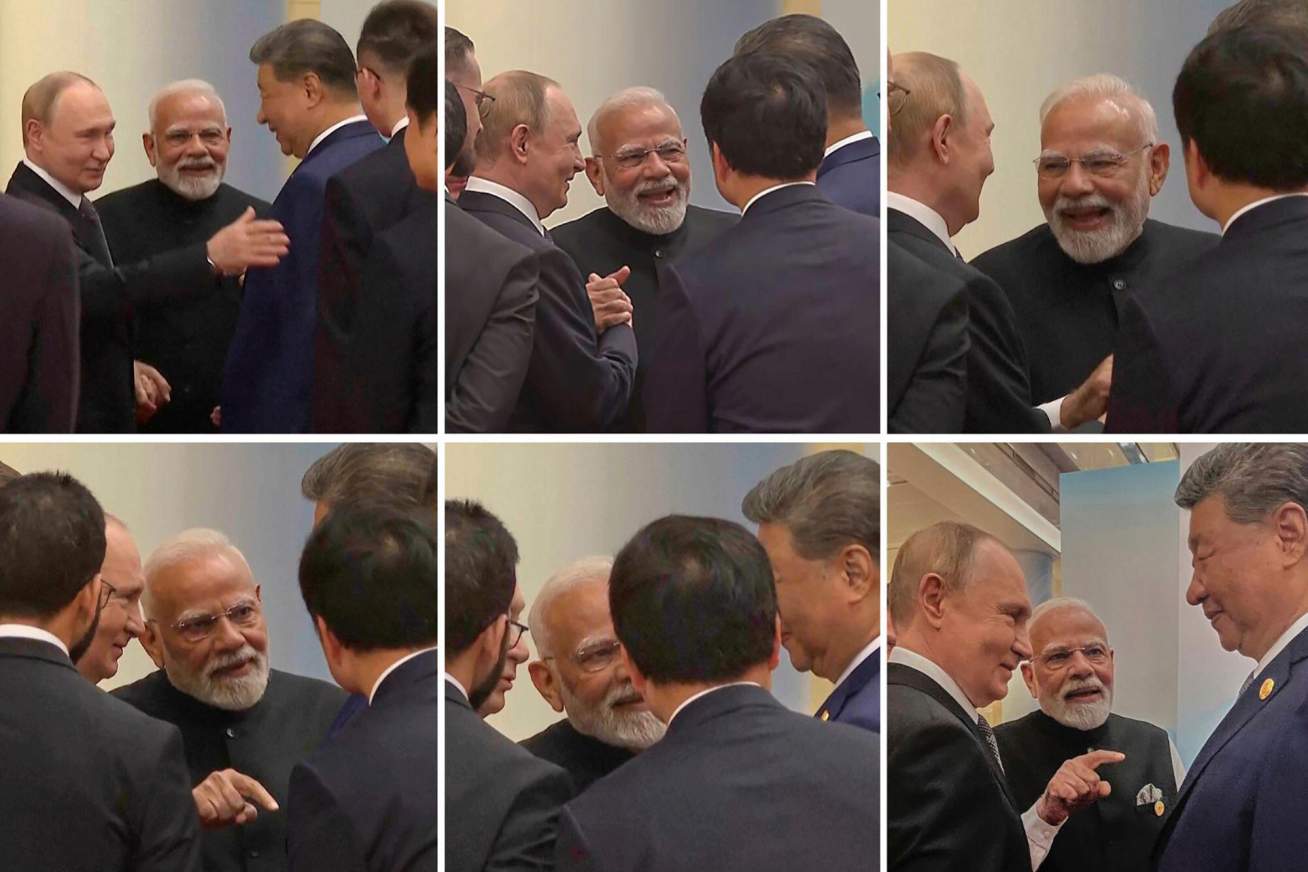
Following the disturbing pictures of Indian Prime Minister Modi, leader of the world’s biggest democracy, chumming it up with authoritarian leaders, Chinese Premier Xi and Russian President Putin, at the Shanghai Cooperation Organisation Summit in Tianjin, China, in late August, one political wag in the US joked that it could have been worse: “Donald Trump could have been there as well!”
More serious commentators worried that the gathering of the trio, representing three of the world’s nuclear powers, and almost half the world’s population, was deliberately intended as a message – that the US-led world order was no longer the only show in town, and that they were determined not to be pushed around by the West.
In the US, national security experts interpreted Modi’s warm embrace of Xi and Putin as a deliberate display of displeasure over Trump’s decision to impose hefty tariffs on India over its continued purchase of Russian oil, and Trump’s clumsy handling of the military flare-up in May between India and Pakistan.
India has always resented outside efforts to mediate in its longstanding conflict with Pakistan over Kashmir, and rejected Trump’s claims that he had ended the latest clashes by threatening to cut off trade with either party if they continued fighting.
They also took great offence at Trump’s decision to invite Pakistani army Chief of Staff, Field Marshall Asim Munir, to the White House in June.
According to former National Security advisor John Bolton, this was the first time a Pakistani military leader has been hosted at the White House with no civilian leaders present.
Writing in the Wall Street Journal, Bolton described how Trump’s approach outraged India, because it harked back to the era of a “hyphenated” US India-Pakistan policy, rather than each country being treated on its merits, without reference to the other.
US foreign policy experts worry that Trump’s continued efforts to pressure India to stop buying Russian oil and gas, most recently by lobbying European countries to impose up to 100% tariffs on trade with India, will push India away from the US, into the arms of China, undermining Washington’s biggest strategic goal, which is to contain rising China.
Another example of Indian defiance of Washington came last week, when India decided to send 65 soldiers to take part in the quadrennial Russian-led military exercises with Belarus, known as ZAPAD, in mid-September.
I recently spoke to two national security analysts living in Asia to get their perspective on events. How serious was the rift between the US and India? What was driving US policy in Asia? Following the recent declaration by Trump on a Truth Social post that he would meet Xi at a regional summit in Korea in October, followed by a visit to each other’s country next year, could there even be a bait and switch, whereby the US would abandon its traditional allies, and forge a separate “G2” partnership with China?
Indrani Bagchi, CEO of the Ananta Aspen Centre in India, and former Associate editor of the Times of India, said Indians viewed the second Trump administration with deep dismay.
In his first term, Trump had taken several welcome steps from their perspective, including raising the level of the Quad (a strategic partnership between the US, India, Japan and Australia) to leader level, imposing tariffs on China, and calling out China’s unfair trading practices. They knew there was a risk of tougher US policies on tariffs and immigration, but all had still seemed well when Modi met Trump in February.
But everything changed following the clashes between India and Pakistan in May. Trump’s claims that he had ended the conflict completely threw India, because India was always intending to end the tit for tat exchanges, and while Vice President Vance and Secretary of State Rubio had engaged with Indian officials, there had been no direct interaction between Trump and Modi.
Trump had failed to treat India as the victim and Pakistan as the aggressor, because India had only taken military action in response to a terrorist attack. Adding insult to injury, Pakistan then became the first country formally to nominate Trump for the Nobel Peace Prize.
Relations “went completely south” after Modi asked Trump to stop taking credit for the ceasefire and also refused to endorse Trump’s Nobel nomination.
Following the shock of Modi’s public appearance with Xi and Putin at the SCO Summit, there had been some efforts to dial back tensions.
Bagchi described US-India relations as no longer “white hot, though still at a level of simmering discontent”. She also rejected the suggestion that India was making a strategic pivot away from the US.
Nevertheless, Trump’s churlish treatment, alongside his failure to impose tougher sanctions on China for its purchase of Russian oil, had fuelled a sense that India needed to repair its own relations with China, which had been particularly tense following a clash along their disputed border line in 2020, resulting in deaths on both sides.
China had its own difficulties with the US and also wanted a rapprochement with India. Separately, India and Russia continued to value their relationship, particularly given Russia’s historical role as India’s main defence supplier: “they serve a purpose for us, we serve a purpose for them”. So, all three countries had their reasons for wanting to mount a united front at the Summit.
Bagchi said India’s biggest nightmare was that one day the US and China might make common cause, leaving India “as collateral damage”. She said other US allies in Asia were feeling equally worried, given the mixed signals coming from Washington.