
 Subscriptions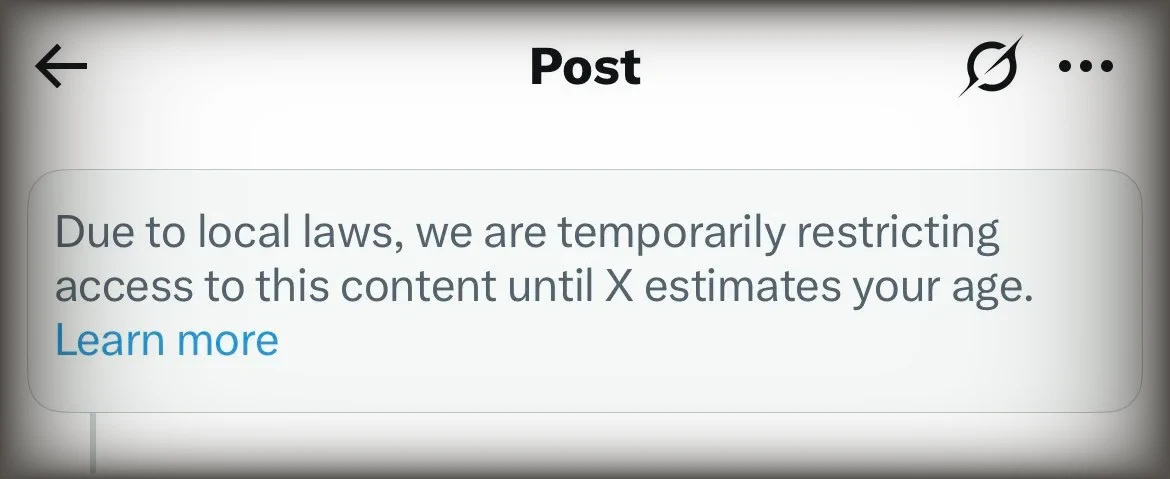
Read our Monthly Magazine
And support our mission to provide fearless stories about and outside the media system
Digital rights advocates, legal experts, and online content creators have told Byline Times that the Online Safety Act’s new age authentication measures are “censoring” public interest activism online — as well as sweeping up unrelated content far beyond the Act’s stated scope.
Byline Times has confirmed that posts about war crimes, genocide, and humanitarian crises have been age-restricted on Elon Musk’s ‘X’ (formerly Twitter) and Reddit. But so too have more benign corners of the internet, hidden from unverified users behind opaque moderation systems.
The Act imposes a series of new duties on platforms, including an obligation to shield children from “harmful” content. To access restricted posts, users must verify their age — effectively dividing the internet into two tiers. But companies, interpreting Ofcom’s guidance and the law’s broad definitions, are left to determine which content gets gated.
“The scope for so-called ‘harmful content’ is subjective and arbitrary,” Paige Collings, Senior Speech and Privacy Activist at the Electronic Frontier Foundation (EFF) said.
“Because the OSA threatens large fines or even jail time for any non-compliance, platforms are forced to over-censor content to ensure that they do not face any such liability. Reports are already showing the censorship of content that falls outside the parameters of the OSA,” Collings adds.
Digital rights groups warn that these systems are not only compelling platforms to filter content for children – they’re reshaping the overall experience of the entire internet. The new default web will impact how users of all ages communicate and collaborate online.
A growing number of posts, forums, and news content related to Palestine, queer identity, or harm-reduction practices have quietly been age-gated. Sometimes it’s graphic content, and sometimes it isn’t.
Read our Monthly Magazine
And support our mission to provide fearless stories about and outside the media system
‘Platforms Already Have a History of Over-Moderating Pro-Palestine Voices’
Byline Times has identified multiple examples of Palestine-related content — including protest footage and news commentary — being locked behind age-gates.
Some of these feature graphic imagery, which may trigger moderation protocols. Reddit communities like /r/israelexposed and /r/ukraineconflict have been restricted. So too have videos on ‘X’ showing police clashing with pro-Palestine protestors.
But others appear more innocuous. Footage from a televised speech about genocide by Dutch-Palestinian author Ramsay Nasr was age-gated. The Reddit community /r/aljazeera — a news aggregation page unaffiliated with the broadcaster — was also blocked.
“All the evidence I’ve seen on my timeline suggests that the Online Safety Act has nothing to do with porn and everything to do with restricting information on Palestine,” Rangzen, a vocal activist with over 40,000 followers on ‘X’, told Byline Times.

An ‘X’ screenshot sent in by Rangzen, which he explained shows age-gated comments on a video he posted about a Palestine protest.
Campaigners at Open Rights Group and journalists at BBC Verify have both confirmed numerous other examples of political and public interest content being censored behind age gates. In some cases, their investigations prompted companies to take age-gates down – implying that they may have been done erroneously or via fallible AI tools.
The European Legal Support Centre (ELSC), which aims to end arbitrary restrictions and criminalisation of Palestine advocacy in Europe and Britain, has been following the Act’s implementation closely.
“Pro-Palestine content often involves sharing graphic images or videos to highlight violence and humanitarian crises, such as the ongoing situation in Gaza, said Carolina Xavier Santos, legal researcher at the ELSC.
“This kind of material plays a critical role in exposing and denouncing crimes on the ground, but it could easily fall under the Act’s rules on graphic violence,” she said. “Platforms may interpret it as harmful content and restrict its visibility, even when it is shared for legitimate advocacy and informational purposes.”
She added: “Platforms already have a history of over-moderating pro-Palestine voices using their terms of service and automated systems that lack the nuance to distinguish between hate speech and political expression. With the Online Safety Act in place, this issue could become worse – platforms might pre-emptively remove or suppress legal political content out of fear of violating the Act and incurring heavy fines.”

A Year Since the UK Riots, Elon Musk’s X Is Still ‘Profiting From Anti-Muslim and Anti-Migrant’ Hate
Report finds X is still failing to take down calls for violence against Muslims and migrants despite the messages “clearly violating” the platform’s own rules
‘Outside of Scope’
Even aside from politically contentious topics, social media companies have opted to age-gate content that likely wouldn’t be in scope of the Act.
Bluesky’s direct messaging function, for example, is only available to those who provide identification.
“I can’t send a private message to a friend here on Bluesky without verifying my age. Not violence, not porn, nothing illegal. Just a ‘hi, mate how’s your ….coming along?’” wrote John, a Bluesky user, in response to an earlier Byline Times story about the OSA.
Spotify now requires age assurance to listen to select songs and music videos which the company deems inappropriate.
Reddit has categorised a wide range of content as potentially harmful — including forums that “promote or romanticise depression, hopelessness, and despair.”
“These definitions could be open to broad interpretation,” said Open Rights Group Platform Power Programme Manager James Baker. “Will we see content relating to Goths, Emos, the Brontes and Sylvia Plath being inaccessible to under 18s?”
Reddit has age-gated support groups like /r/stopsmoking, /r/safesexph, and even — briefly — /r/cider, a hobby community discussing the ins and outs of fermentation.
LGBTQ+ author Talia Bhatt told Byline Times that her author page was delisted on gaming site Itch.io to comply with the OSA. It raised concerns for Bhatt over what biases go into Government and corporate decision-making when it comes to removing certain kinds of content.
“As I’d expected, content by LGBT creators is susceptible to being declared ‘adult’ and ‘sexual’ by default, especially in a media environment like the UK’s, where trans people are constantly declared a ‘fetish’, and political actors consider the very presence of trans women in public an affront to be curtailed,” Bhatt said.
“LGBT existence is sexualized, declared ‘obscene’, and subject to censorious regulations under the guise of ‘protecting children’ because our existence is deemed unacceptable by heterosexual society, and subject to suppression and erasure.”
The Wikimedia Foundation is currently challenging the Online Safety Act in court, warning it threatens “global accessibility and integrity of free knowledge.” It has raised the prospect of having to block access entirely in the UK.
Elon Musk Has Already Built an Interplanetary Colony: It’s Called X
Caroline Orr explains how Trump has enabled the algorithmic capture of social media platforms, resulting in stealth censorship
‘Take Away Big Tech’s Power Instead’
The Government and Ofcom maintain that the Online Safety Act poses no threat to free speech online.
“The Act is not designed to censor political debate,” a Government spokesperson told Byline Times. “It does not requires platforms to age gate any content other than those which present the most serious risks to children such as pornography or suicide and self-harm content.”
Ofcom echoed this, a spokesperson telling Byline Times that there is “no requirement to restrict legal content for adult users,” and that platforms must “carefully consider users’ rights to freedom of expression.”
Where some outspoken critics, like Reform UK’s Nigel Farage, reject the idea of digital regulation wholesale, others simply claim that there are better ways to truly take on Big Tech.
“Children deserve a more intentional and holistic approach to protecting their safety and privacy online – not this lazy strategy that causes more harm that it solves,” said Paige Collings of the Electronic Frontier Foundation.
“Rather than weakening rights for already vulnerable communities online, politicians must acknowledge these shortcomings and explore less invasive approaches to protect all people from online harms. We encourage politicians in the UK to look into what is best, and not what is easy.”
Tech critic and author Cory Doctorow argues that the Act is forcing both small and large platforms to shut down independent forums and consolidate around Big Tech platforms like Facebook, which have the resources to comply with its surveillance and moderation demands.
“Fundamentally, the lesson here is that we can’t fix Big Tech by making it use its power more wisely – the only way to fix Big Tech is to get rid of it, to make it smaller, to take away it’s power.”