


Read Our Monthly Magazine
And support our mission to provide fearless stories about and outside the media system
A damning new survey reveals that less than a quarter of people are still satisfied with the NHS, with satisfaction levels around social care also hitting an all-time low.
Satisfaction levels around social care were the worst ever recorded, the Nuffield Trust noted, with just 13% of people questioned thinking they were acceptable.
The annual analysis by the King’s Fund and Nuffield Trust in the past year’s British Social Attitudes Survey (BSA) – carried out by the National Centre for Social Research (NatCen) in 2023 – and released March 27, makes grim reading for anyone who values the NHS and wants it to survive and thrive.
In the survey’s 41-year history, this was the first year that less than a quarter of people were “very or quite satisfied” with the NHS. This peaked in 2010, in the last year of the Tony Blair/Gordon Brown government when 7 out of 10 people were satisfied. The fall to 24% was from 29% in 2022, and 53% as recently as 2020.
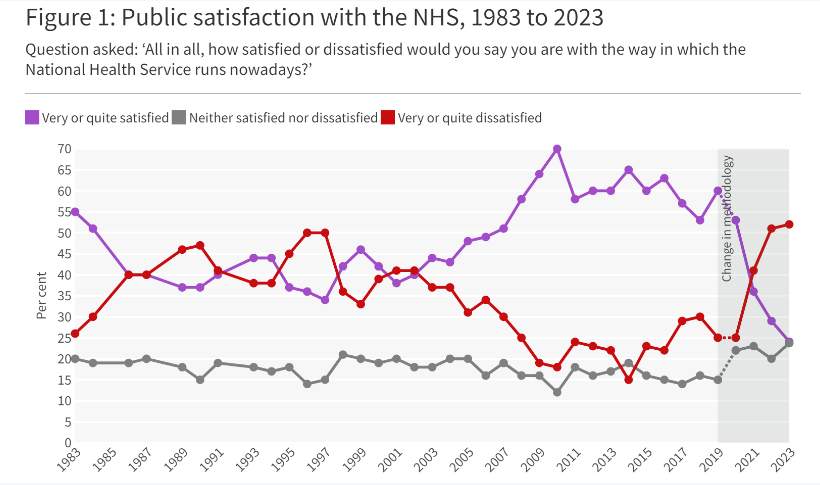
The top reasons for respondents’ dissatisfaction were long waits for GP or hospital appointments, 71%, staff shortages, 54%, and a view that the Government does not spend enough on the health service, 47%.
Respondents’ top priorities for change were making it easier to get a GP appointment, 52%, and increasing the number of staff in the NHS, 51%. Improving waiting times for planned operations, was next at, 47%, and in A&E, 45%.
Every year since 2015, a majority of respondents have said the Government does not spend enough on the health service, but this has hit a new peak of 84%.

Broken Promises on Fixing Social Care Laid Bare
‘Years of fragmented funding and the absence of a clear roadmap has brought the adult social care sector to its knees’ according to the chair of the Public Accounts Committee
Almost half of respondents, 48%, would support the Government increasing taxes and spending more on the NHS, with that view most prevalent in people with the highest household income, while 42% felt taxation and spending should remain the same. Some six per cent wanted cuts.
Of those satisfied with the the level of service, the top reason was because the NHS care is free at the point of use, 66%, followed by it having a good range of services and treatments available, 53%, and the quality of care, 52%.
The BSA results come just weeks after the annual NHS Staff Survey which mirrored public attitudes.
The 2023 survey, which received a massive response rate of over 50%, showed that 30% of respondents felt burnt out by their work, and 34% found it emotionally exhausting. Just over half, 57%, said their organisation took positive action on health and wellbeing.
Less than half felt able to meet the conflicting demands of their work, and only a third felt their workplace had enough staff for them to do their job properly. A quarter said that they never faced unrealistic time pressures.

Family Speaks Out for NHS Overhaul to Prevent Deaths of Severely Ill ME Patients
Millie McAinsh’s family sought help when the ME sufferer could no longer eat – only for her to to be sectioned
These are just the conditions to create “moral distress” where staff are coming to work every day, unable to deliver the professional standard of care they want to, knowing they are letting patients down but constrained by a system lacking resources, capacity and staff.
A quarter of NHS workers said that they’d been subject to harassment, abuse, or bullying from members of the public, and another 28% had experienced it from managers or colleagues. Only half of those workers said that they’d reported such incidents.
Only 54% of those surveyed believed their organisation acted without discrimination and with fairness regarding career progression, yet we still have ridiculous weaponisation by the right of culture wards about equality, diversity and inclusion policies, training and a handful of designated staff to manage this clearly needed work.
It is especially concerning after a whole series of public care failings, scandals and inquiries and both a professional duty of candour and transparency (for clinical staff) and a statutory duty of candour for organisational leaders) that only 62% of respondents felt safe speaking up about concerns affecting patient safety in their organisation, and 50% believed that those concerns would be listened to or acted on by managers.
Most concerning of all was the finding that only 61% of respondents would recommend their organisation as a place to work, and only 64% would recommend it as a place for their friends or family to receive care.
Is it any surprise that the NHS has such a retention problem, with so many clinical staff leaving or signalling an intent to leave?
