
 Subscriptions
 Newsletter offer
 Newsletter offer
Subscribe to our newsletter for exclusive editorial emails from the Byline Times Team.
For how much longer is the former Trump campaign manager and co-founder of Cambridge Analytica going to be allowed to subvert our politics and stoke division in our communities?
Sharing a platform with Liz Truss at the annual Conservative Political Action Conference (CPAC) in Maryland last week, and talking about the forthcoming Rochdale by-election, Steve Bannon described Tommy Robinson as a “hero” and Truss – the shortest-serving Prime Minister in UK history – appeared to agree with him. “That is correct,” she said.
This is not the first time Bannon has praised the founder of the English Defence League, whose real name is Stephen Yaxley-Lennon. Four years ago, while Robinson was serving a 13-month prison sentence for contempt of court, Bannon called him “the backbone” of the UK. But it is the first time such a senior Conservative has endorsed him.
Deputy Conservative Prime Minister Oliver Dowden attempted to make excuses for Truss this weekend, saying she might not have heard Bannon correctly. But even if Truss, who is still a Conservative MP, didn’t understand she was supporting a multiply-convicted British criminal and subversive activist, she should have known that she was sharing a stage with a multiply-convicted American criminal and subversive activist – Steve Bannon himself.
Bannon, as Grant Stern first revealed in this newspaper five years ago, was investigated and indicted for fraudulently using funds raised for his ‘Build the Wall’ US-Mexico barrier project in 2020. Outgoing President Donald Trump granted a last-minute pardon for his federal offences in 2021, but Bannon still faces state-level charges in a trial in New York later this year. He was also found guilty of two charges of criminal contempt for his role in the January 6 insurrection at the US Capitol.
This is where Bannon’s role in both American and US democracy really matters: his vociferous attempts to destroy it on both sides of the Atlantic.

Trumpocracy in the UK: Government Links with Steve Bannon and the Mercers
The links between an opaque think tank, the Conservative Government and major figures in the Trump campaign can be revealed in this first part of a special Byline Times investigation
At CPAC, sharing a stage with right-wing activist Jack Posobiec, Bannon agreed that he wanted to “overthrow” democracy because they “didn’t get all the way on January 6”.
Bannon also revealed that he has similar designs on the UK. He urged Truss to join forces with the Reform Party, headed by Richard Tice, and told a Mirror reporter that his old friend Nigel Farage would be installed as prime minister as a part of a “nationalist uprising”.
While this intervention may have taken some by surprise, it is merely the culmination of over a decade during which Bannon has attempted to subvert British politics. Given that history, what can we expect next?
‘My Weapons’
A large part of Steve Bannon’s impact on politics on both sides of the Atlantic is his use of social media and digital campaigning to change the culture of debate – the very frame of reference and facts we use to debate politics. He has referred to this ‘information warfare’ as “flooding the zone with shit”, and the combination of disinformation and digital targeting as “his weapons”.
Cultivating these tactics goes back to 2013, when Bannon allied with the billionaire hedge fund owner Robert Mercer to run the Breitbart publications and co-found the now-defunct data analytics firm Cambridge Analytica involved in the great Facebook hack and micro-targeting scandal. The company was a spin-off of a strategic military outfit, SCL, which was used to deradicalise civilians and insurgents in combat zones.
The British element in Bannon’s campaign can be traced to his long friendship with Farage – although the ‘Cambridge’ in Cambridge Analytica has more specific roots.
In 2013, Bannon attended the 10th anniversary conference of the Young Britons’ Foundation (YBF) at Churchill College, Cambridge University, just as he was setting up his new company.

An offshoot of the Young America’s Foundation, the YBF was founded by lawyer Donal Blaney (currently in a legal dispute with this newspaper acting on behalf of GB News presenter Dan Wootton). Both the YBF, and its American counterpart, appear to have been funded by the Mercer Family – which also backed Cambridge Analytica and Bannon’s Breitbart.
By this point, the YBF had become a centre of right-wing US-style Republican thinking and antipathy towards the EU. Its co-founder was (the now ennobled) Daniel Hannan, a leading Brexiter and Conservative MEP. On its advisory board was Matthew Elliott, who helped set up the Tufton Street network of opaquely funded libertarian think tanks, and was the chief executive of the official Vote Leave campaign during the Brexit Referendum (he has also been elevated to the House of Lords).
Speakers at the YBF’s 10th anniversary event included Paul Staines of the Guido Fawkes site; and Douglas Murray who spoke on jihad, Islamism, Israel, and the ‘War on Terror’. Bannon shared a platform with Harry Cole, then head of news at Guido Fawkes, and Raheem Kassam to discuss digital campaigning. Kassam went on to both edit the London edition of Breitbart and act as Farage’s aide for the next few years (he went on to co-host Bannon’s War Room podcast).
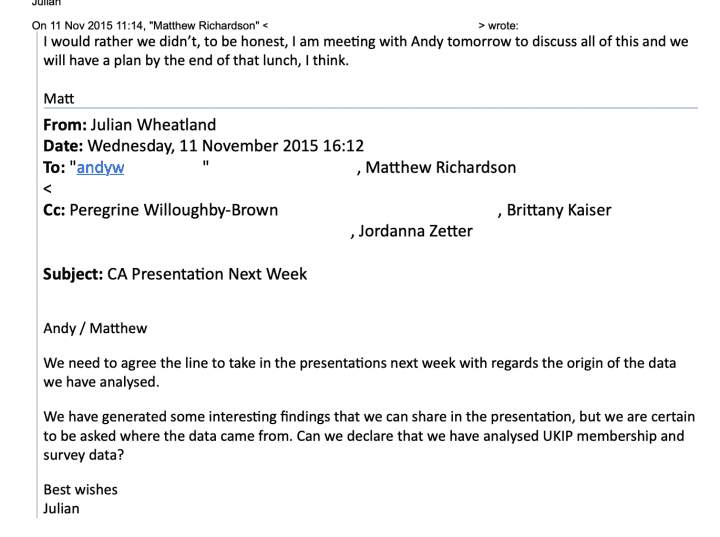
Also present was the then executive director of the YBF, Matthew Richardson, who was also reported to be Mercer’s legal representative in the UK at the time. He went on to become the secretary of Farage’s UKIP and signed a deal with Bannon in the run-up to the EU Referendum so that Cambridge Analytica could process UKIP data for the targeting of the unofficial Leave.EU campaign, fronted by Farage. (Richardson now works with Rebekah Mercer and helped set up their social media site, Parler).
The YBF would be closed two years later, amid allegations of sexual misconduct and bullying around the suicide of the young activist Elliott Johnson.
Cambridge Analytica wouldn’t last much longer. According to its former head of research, Chris Wylie, the company set up a temporary office in the English university town around the time of the YBF conference at Churchill College. Soon, it was working with Cambridge academics to establish a research project to psychologically profile voters – which would end up illegally harvesting the personal data (and even personal messages) of up to 87 million Facebook users to be used for political targeting.
Though many argue about the impact of psychometric targeting and online messaging, both the Brexit and Trump votes were swung by small margins. In 2016, Cambridge Analytica’s chief executive Alexander Nix boasted that digital targeting was the key to the success in both results. Though it did not use Cambridge Analytica directly, the Vote Leave campaign used the company’s Canadian offshoot, AIQ, and its Project Ripon database to target swing voters with billions of online ads – often unlawfully paid for – in the last days before the EU Referendum.
When Carole Cadwalladr revealed the Facebook hack and Cambridge Analytica’s role in Brexit and Trump in the Observer in 2018, it wiped billions off the value of Mark Zuckerberg’s social media company, and Cambridge Analytica was closed and its offices raided by law enforcement.
But Steve Bannon had already left Breitbart and Cambridge Analytica by then – and had even bigger fish to fry.
Russia and Islamophobia
Like his friend, Nigel Farage, Bannon is keen to talk of the need to protect Europe’s ‘Judaeo-Christian’ culture (as if that had not been one of pogroms and the Holocaust), while marginalising or monstering the third branch of the three great Abrahamic religions: Islam.
His embracing of the ‘Great Replacement’ conspiracy – that Europe is being overrun by Muslim ‘invaders’ – has infected the worldview of many right-wing parties across the continent. This includes elements of the UK’s Conservative Party, which have been unafraid to advance these fearmongering narratives.
The latest example is the former Conservative vice-chair Lee Anderson’s recent comments about London Mayor Sadiq Khan handing the city to “Islamists”, echoed by former Home Secretary Suella Braverman in the wake of public protests in London over the Israel-Hamas War.
Activating xenophobia, particularly around Islam, was one of the key themes used by both leave campaigns during the EU Referendum in 2016 when, triggered by Russian military activity in war-torn Syria, hundreds of thousands of refugees started fleeing to Europe. Then Prime Minister David Cameron accused Vladimir Putin of deliberately “weaponising” refugees to destabilise Europe.
Farage’s Leave.EU campaign used its notorious ‘Breaking Point’ poster to spread fear about ‘invading’ Muslim migrants, while recycling Russian fake news about Muslim violence in its online ads. Meanwhile, the Vote Leave campaign, fronted by Boris Johnson and Michael Gove, wasn’t much better, falsely suggesting that 80 million Turks were about to swamp Britain and the EU.