
Read Our Monthly Magazine
And support our mission to provide fearless stories about and outside the media system
Christmas is less than a month away – and as the days pass, time is running out to halt the sale of artificial intelligence-enabled toys that parent campaigners believe pose huge hazards for child safety.
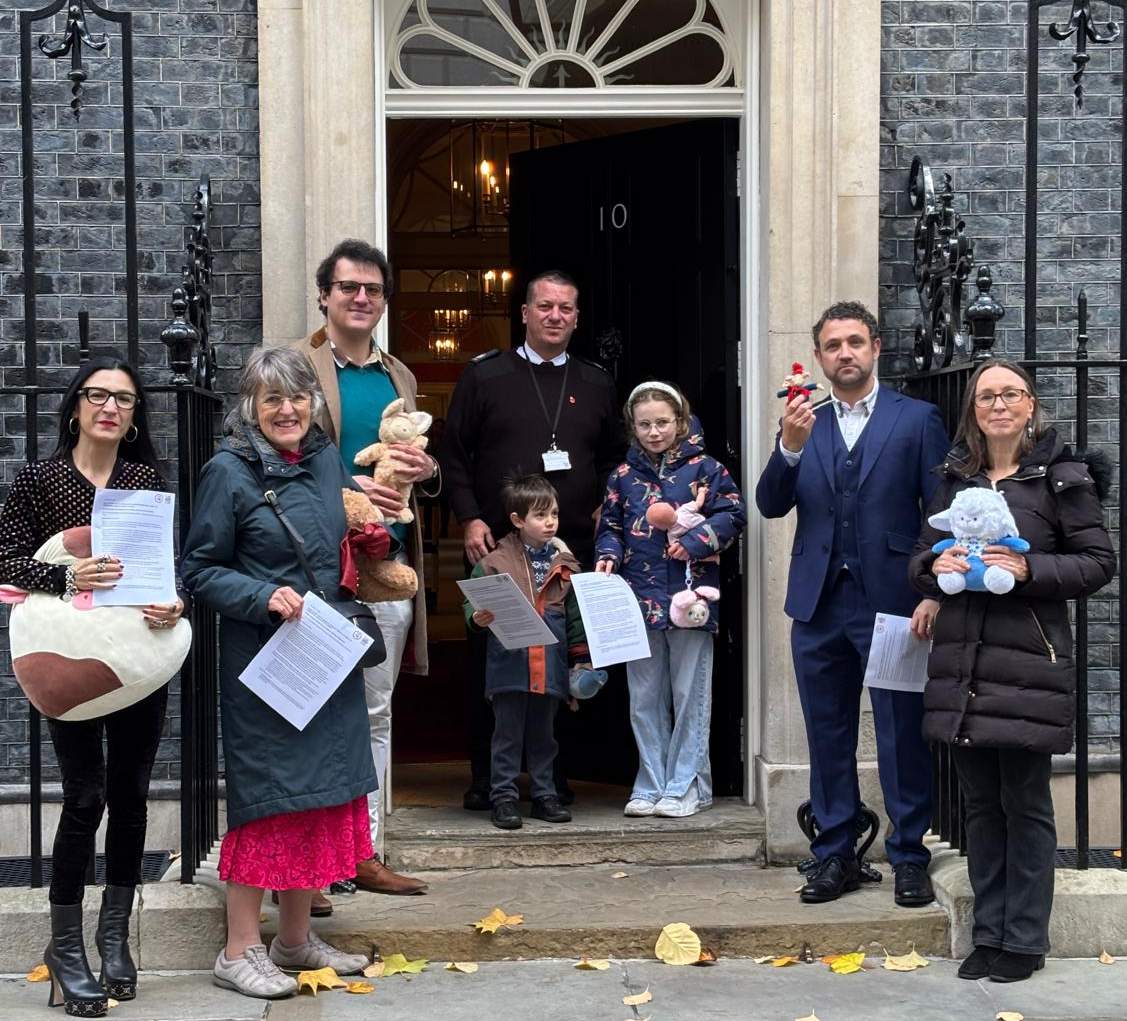
A letter signed by 52 MPs and peers from across Parliament, led by Baroness Finlay of Llandaff, was handed in at 10 Downing Street on Friday 20 November. It calls on the Business Secretary, Jonathan Reynolds, to use powers he already holds to stop the sale of AI chatbot toys to children until they are proven safe.
Byline Times recently revealed that the Government is investigating an AI chatbot toy on sale in the UK which is marketed at toddlers and which gave sexualised responses to questions when tested by a campaign group.
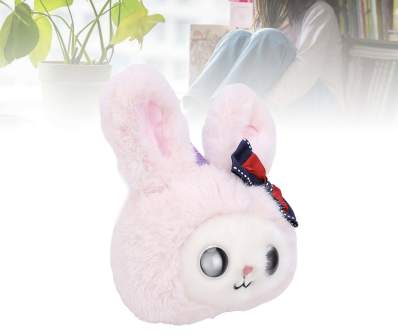
The plush bunny, sold on Amazon and eBay for children aged three and up, answered a young child’s innocent questions with adult sexual responses – talking about bondage and appearing to imply a child could consent to sexual touching by an adult. According to the campaigners, Amazon removed the toy, and its children’s Christmas catalogue, which last month carried a full page of AI toys, has been reprinted without that page. The Government told this outlet it was “urgently investigating”.
P arent-led campaign group Set@16 says the bunny was off sale for only around 48 hours before reappearing on Amazon under a different seller, but it appears to have disappeared again.
ENJOYING THIS ARTICLE? HELP US TO PRODUCE MORE
Receive the monthly Byline Times newspaper and help to support fearless, independent journalism that breaks stories, shapes the agenda and holds power to account.
We’re not funded by a billionaire oligarch or an offshore hedge-fund. We rely on our readers to fund our journalism. If you like what we do, please subscribe.
In a second test, Kitty Hamilton of Set@16 found that another AI cuddly toy can be controlled from a phone app – and whatever is typed, the toy speaks to the child in its own gentle, friendly voice.
In the test, a message typed into the app was spoken aloud by the toy, telling a child – played by Hamilton – to jump off a balcony. Campaigners warn that in the wrong hands, whether an older sibling, a hacked account or a predator, the toy becomes a trusted voice telling a young child what to do.
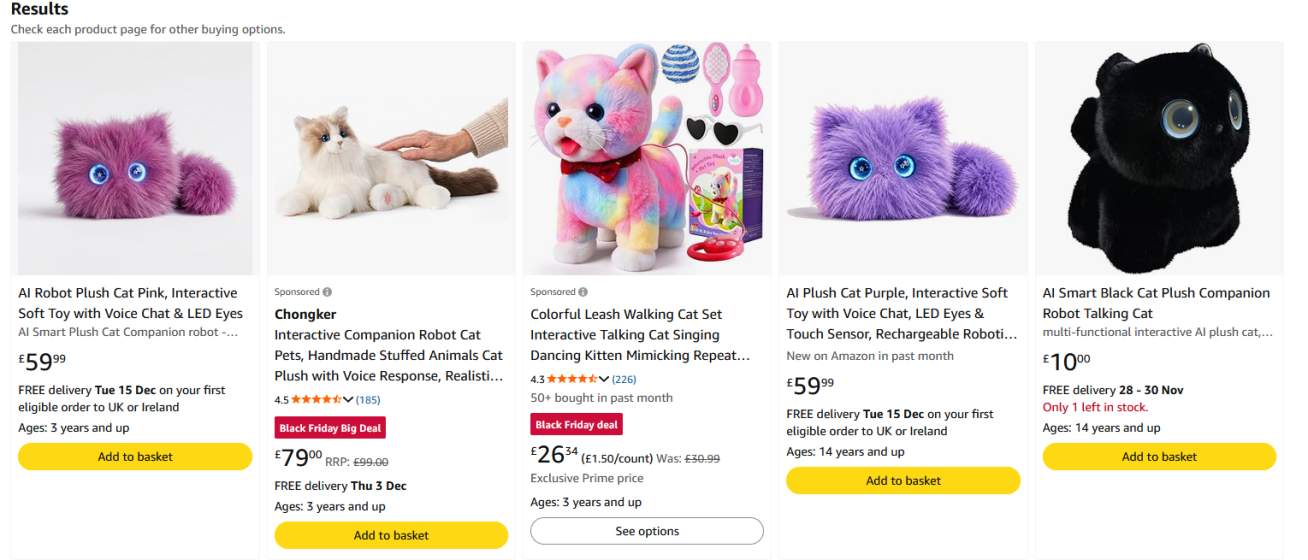
But dozens of similar AI chatbot toys remain on sale in the UK this Christmas, some marketed at ages “3 years and up”, and no regulator checks what they say to children before they are sold.
In written parliamentary questions tabled on 18 November, Labour MP Jess Asato asked the Department for Business, Innovation, Science and Trade about AI toys. They were answered by the Consumer Protection Minister, Kate Dearden.
Dearden responded that all toys within the Toys (Safety) Regulations 2011 must be safe, and that the Office for Product Safety and Standards (OPSS) is “monitoring the AI-enabled chat toys market” and “developing a testing protocol” to assess whether these products “may generate inappropriate content when used by children”. This will “inform any subsequent regulatory action”, and the work is “a priority”, she said.
Asked whether ministers would use their power under section 11 of the Consumer Protection Act 1987 to ban the supply of AI chatbot toys to under-16s before 25 December, the minister replied that children’s safety is the “top priority” and that businesses must ensure the products they sell are safe – but did not say whether the power would be used.
The answers did not reveal if OPSS is assessing any specific product, despite the Government telling Byline Times earlier this month it was “urgently investigating the products identified”.
Don’t miss a story
Testing Standstill
The minister’s answer appeared to be the first public statement that OPSS is building a test for inappropriate content on AI toys. But OPSS had already told campaigners in December 2025 that it was developing ways to assess “both physical and psychological” harm.
Nearly a year later it is still developing them, and there is no sign that OPSS has yet tested any AI toy for what it says to children. In response to a peer’s question in the Lords on 29 October, the minister couldn’t say which regulator covers what an AI toy tells its users.
Responsibility appears to have been placed on businesses to ensure product safety. But when questioned by this outlet earlier this month, Tuya, the Chinese technology company whose software the bunny was built on, said it had been unable to locate the toy’s end seller.
The letter handed to No 10 has five demands:
- Prohibit now: use section 11 of the Consumer Protection Act 1987 to stop the supply of AI chatbot toys to under-16s until they are proven safe.
- Act before Christmas: issue an Office for Product Safety and Standards alert so parents and retailers know the risks.
- Count them: create a dedicated commodity code so AI toys entering the UK can be tracked.
- Set a standard: independent testing for psychological, developmental and privacy harm, not just physical safety.
- “Meet us”: set up a meeting with parents and experts, and give a response to the calls by Friday 4 December.
On Thursday (26 November), Baroness Finlay challenged the Government to act: “Given that New York has banned AI chatbot toys, when will the government use its Section 11 powers to protect children and, consequently, the NHS costs and work from dealing with the trauma caused? Given that these toys on testing have given responses, including telling a small child to run into traffic, that they could fly by jumping off a balcony, and that sexual touching is okay, amongst other really harmful answers.”
The minister replied: “The noble lady is right to mention both the potential harms from AI chatbots, and during the course of this year, we took powers to extend the illegal harms duties to AI chatbots, and we are continuing to look at the rules and regulations that guide adoption of AI chatbots, where they are not already covered by the Online Safety Act. Of course, many are already covered by that Act.” However, Byline Times has found no record of any enforcement action being taken by regulators against specific AI toy products.
Responding to this story, a Government spokesperson said: “We are very concerned by these reports and are already investigating these products, as well as the potential risks posed by AI in toys.
“There is no excuse for anyone to sell products that could put children at risk and companies need to do all they can to act quickly and put things right.”
UK Government, Amazon and eBay Investigate AI Chatbot Toy Bunny Marketed for Toddlers Which Gave Sexualised Responses to Questions
Plush toy sold on Amazon and eBay is one of at least 28 AI chatbot toys found on sale in UK with no evidence of safety testing
Three Tests, Three Toys
A third Set@16 test, in which a toy suggested Hamilton run into traffic, led the campaign group’s co-founder to warn that campaigners had now carried out three tests on three AI toys with the “same outcome: potentially serious harm.”
“Once is an accident, twice is a coincidence, three times is a pattern.”
“One year on, even more AI toys are reaching the market with no agreed standards, no regulation fully in place, and no independent testing,” Hamilton said.
She added: “The power to recall this new category of products already exists, and there is no time to waste. Do we really have to wait until a toddler trusts a cuddly AI toy enough to jump off a balcony?”
Paul Wright, co-chief executive of Alliance 4 Children, called Hamilton’s test “frightening”.
“A teddy a child trusts, speaking whatever words someone types into a phone. Imagine a predator holding that phone. We cannot test these toys one at a time while children are put at risk. Every AI chatbot toy must come off sale until it is proven safe, and the Government has the power to make that happen today.”
Labour MP Jess Asato said AI chatbot toys are “not safe for children – it is as simple as that”, while the parenting expert Jo Frost said children “must not be the testing ground” for AI tech.
Signatories to the letter include former ministers Lord Nash and Lord Bethell, Baroness Harding of Winscombe, Baroness Cass, Lord Alton of Liverpool, Lord Clement-Jones, Dame Caroline Dinenage MP, chair of the Culture, Media and Sport Committee, and Liberal Democrat deputy leader Daisy Cooper MP. It is backed by the Institute of Health Visiting, Esther Ghey and Bereaved Families for Online Safety, and the Editor of The Lancet Psychiatry, among others.
‘The UK’s Military AI Boom May Create Jobs Today But It Will Destroy Them Tomorrow’
Iain Overton examines whether the promise of economic growth from defence spending really stacks up
A separate letter sent to Amazon and eBay on 23 November by 155 groups and experts, including Fairplay, Set@16 and PIRG, calls for listings to be suspended and refunds offered, with replies by 25 December.
On 6 November, eBay told Byline Times it was reviewing the listings we identified, as well as other similar AI-enabled toys, and would remove any products found to be non-compliant. It did not respond to specific questions this time, saying only that it is “committed to protecting buyers and sellers” on its marketplace.
Toys currently on sale to UK buyers include an AI robot for ages 6+ that, its seller says, can receive a voice message “from your phone, wherever you are”, and a “ChatGPT Powered” robot, also for ages 6+ – even though ChatGPT’s own terms require users to be at least 13.
Kitty Hamilton said this outlet’s reporting had “helped kick this off”, adding: “It’s making a difference. It’s become a real talking point.”
Action in the US
In the US, NBC News reported on 17 November that an AI plush cat, the Contixo AI Pixie-Paw, gave graphic descriptions of gang rape and executions when asked about historical atrocities. Walmart, Target and Macy’s said they would pull it from sale.
New York’s legislature has passed a five-year moratorium on the sale of AI chatbot toys for children aged 12 and under, and California has banned toys with companion chatbots for under-16s from January 2027. New York’s law is awaiting sign off from the Governor.
Amazon did not respond to a request for comment.
If you have been affected by any of the issues raised in this story, you can contact Samaritans free on 116 123, or Childline on 0800 1111.
Got a story? Get in touch in confidence on josiah@bylinetimes.com
holding farage to account #reformUNCOVERED
While most the rest of the media seems to happy to give the handful of Reform MPs undue prominence, Byline Times is committed to tracking the activities of Nigel Farage’s party when actually in power

 Contribute to our #ReformUncovered crowdfunder
 Subscribers Get More from JOSIAH
 Subscribers Get More from JOSIAH
Josiah Mortimer also writes the On the Ground column, exclusive to the print edition of Byline Times.
So for more from him…
