


Read Our Monthly Magazine
And support our mission to provide fearless stories about and outside the media system
An incoming far-right authoritarian Government would face few constraints on its power to undermine democracy in the UK, according to an eye-opening new report from constitutional experts.
Martin Stanley, a former senior civil servant, has written a report for the Constitution Society on how the civil service might – or should – react to the election of a manifestly authoritarian or anti-democratic government. Stanley was previously Chief Executive of what is now the UK’s Better Regulation Executive, the Postal Services Commission and the Competition Commission.
His conclusions, seen first by Byline Times, make for worrying reading about the readiness of British institutions to respond to an incoming authoritarian Government.
Former Boris Johnson aide Dominic Cummings has previously set out how a Reform Government might overpower ‘the deep state’ if it comes into power in 2029, writing:
“What they’re terrified of is Nigel Farage doing some kind of Doge-type thing and saying ‘Right I’m going to bring in 20 hotshots, fire all the permanent secretaries, put them in charge of this, use the actual powers of the PM, close departments, open them, fire people, and then pass a whole series of primary legislation, repeal the Human Rights Act, repeal the Equalities Act, reform how judicial review works, bin the Climate Change Act.’”
He explained that with legislation ready, “you win [power] on the Thursday, and on Monday morning these bills start hammering through into parliament [in one year]. And you also make clear to the House of Lords that if anyone thinks they can f**k around, we’re going straight at the King, we’ll appoint 600 new peers, and it’ll be blitzkrieg on you guys.”
Stanley’s analysis suggests that is all eminently possible.
ENJOYING THIS ARTICLE? HELP US TO PRODUCE MORE
Receive the monthly Byline Times newspaper and help to support fearless, independent journalism that breaks stories, shapes the agenda and holds power to account.
We’re not funded by a billionaire oligarch or an offshore hedge-fund. We rely on our readers to fund our journalism. If you like what we do, please subscribe.
He points to a 1983 Reith lecture by Sir Douglas Wass, former Permanent Secretary to the Treasury, noting that “the civil service cannot be thought of as an in-built safeguard against what some people might call the excesses of a radical or reforming government.”
Sir Douglas said: “The energetic pursuit of Ministerial objectives is something that must be required of officials. And this obligation on civil servants transcends by far any qualms they may feel about the rightness of policy.” It remains true today, Stanley writes.
The Armstrong Memorandum, first published two years later, codifies that principle, saying: “When, having been given all the relevant information and advice, the Minister has taken a decision, it is the duty of civil servants loyally to carry out that decision with precisely the same energy and good will, whether they agree with it or not.”
This would include deeply anti-democratic or illiberal measures.
A “malign” Government – of left or right – could also amend the Constitutional Reform and Governance Act, which sets out how much of the civil service and courts are run, in “very little time”.
It could “eliminate selection on merit, and it would not be difficult for ministers to seize control of the Civil Service Commission,” which oversees senior appointments. “Control of the Commission would allow the recruitment principles to be speedily altered (if necessary) so as to facilitate the immediate recruitment of Dominic Cummings’ ‘20 hotshots’, as well as of politically loyal and sympathetic supporters into the lower ranks,” Stanley notes.
The new Government could also dramatically increase the number of (political) special advisors, who advise ministers alongside civil servants, in a way that hugely dilutes the influence of impartial officials. There is no cap on SpAd numbers in law.
Don’t miss a story
The Hungarian Precedent
Stanley points to the example of Orban’s Fidesz party taking power in Hungary in 2010. “The top four hierarchical levels of central government bureaucracy were almost entirely purged,” he says. One Hungarian civil servant recounted to researchers of that time that appointments “clearly shifted to personal loyalty from 2010 on. Political loyalty is the starting point.”
“At the very minimum, you should not be seen as rejecting it. When I hire someone, they check their Facebook profile; if the candidate likes opposition-type stuff, then forget it.”
Reform UK said in September this year that it would reduce civil service numbers by 220,000 (from 520,000 to 300,000) – “presumably much faster than the [Hungarian] 2010-15 precedent mentioned above,” the paper notes.
Lessons for Nigel Farage’s party might be taken from the experience of a Hungarian civil servant cited in the paper: “In 2010, [Fidesz] started to eliminate the resistance … They brought in partisan loyalists. They are stupid as hell. They used to be out pasting up billboards [during the electoral campaign], but they execute the central orders they are given.”
Unions would likely offer resistance to this – the Public and Commercial Services Union has already started building a strike fund. “But there is nothing in the law or constitution which would constrain such ambitious plans,” Stanley writes.
As recent (albeit controversial) sackings of permanent secretaries in charge of departments have shown, a Government can relatively easily scrap the top tier of Whitehall and replace with their own chosen appointees.
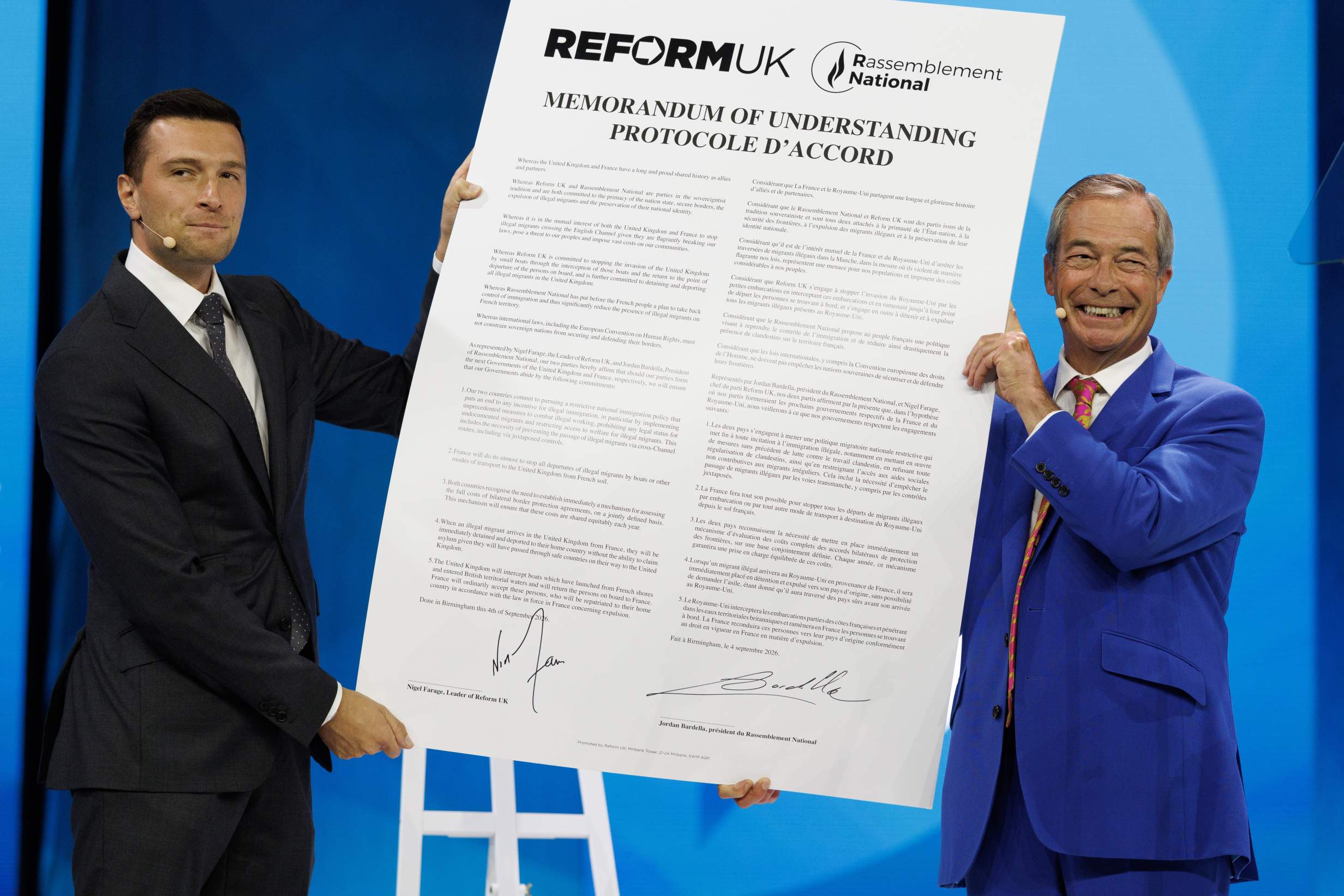
Reform UK Named ‘Authoritarian-Leaning’ Party in Index of Far-Right Cooperation Across Europe
Experts say Farage’s pact with Marine Le Pen’s National Rally is part of a pattern of far-right parties lending each other legitimacy before taking power
To Reform’s right, Restore Britain’s Rupert Lowe tweeted on 29 July 2026: “Fantastic to see [US health official Anthony] Fauci held to account by politicians [in the US Senate] … A Restore Britain Government will do the same to Chris Whitty,” the UK’s Chief Medical Officer for England and Chief Medical Adviser for the UK.
“Shortly afterward [Lowe] tweeted that he wanted ‘a high-ranking official in the Home Office’ to know that they would be prosecuted if they were to place asylum seekers ‘into a British community’,” the Constitution Society paper adds.
Andy Burnham’s recent establishment of Number 10 North also shows that Government departments can “relatively easily” be modified or even abolished. Legislation is not necessarily needed for this to happen.
An incoming authoritarian Government could also simply ignore impartial civil service advice, while “Guidance and the orientation of the civil service can be changed with relative ease,” for example by modifying the Civil Service Code (which currently enshrines, in theory, its independence and impartiality – though there is no mention of ‘democracy’ in it).
In the US, President Trump gave Elon Musk and DOGE unprecedented power to change government – despite the theoretical protections of the United States’ codified constitution.
The Trump-friendly Supreme Court has also allowed the President to sack senior appointees to what were previously seen-as independent agencies, such as the Federal Trade Commission.
The American political scientist Brian Klaas has observed that ‘corruptible people are disproportionately drawn to power, disproportionately good at wriggling their way into it and disproportionately likely to cling onto it once they’ve got it’. Klaas is a professor in global politics at University College London.
His observation applies here as much as in the US.
Threatening the Constitution
“Every incoming government operates a spoils or patronage system in which friends and supporters are appointed to public sector jobs, and government money is funnelled towards companies and regions chosen for political rather than meritorious reasons,” the Constitution Society paper argues. Britain has got lucky so far.
It goes on: “Ministers may suspend the operation of particular rules, especially during an emergency. And they are entitled to take decisions that favour their political tribes, their constituencies and their financial supporters.”
“Pure corruption is illegal but civil servants are certainly in no position to act as police officers against democratically elected leaders. That responsibility falls onto the media and public opinion collectively.” Are these safeguards enough?
“The civil service would not and could not do anything other than help incoming ministers introduce a wide range of radical (and potentially immoral and/or damaging) policies including those governing the management etc. of the civil service itself.
“But a truly malign government could go further and threaten the foundation of our constitution.”

The DOGE Reckoning: Congress Is About to Put Elon Musk’s Government Takeover on Trial
Elon Musk is finding out the hard way that not everyone can be bought by the highest bidder, reports Caroline Orr Bueno
That includes the power to pass huge rafts of legislation without much parliamentary scrutiny – so-called Henry VIII powers, the use of the Royal Prerogative (giving PMs enormous control over treaties and military matters), declare emergencies and more.
The civil service would also “be very reluctant to challenge a malign government that had a strong electoral mandate.” Even if that mandate was to essentially abolish British democracy.
Sir Douglas Wass suggested in his 1983 Reith lecture that civil servants should resign to avoid implementing “unlawful, unconstitutional, or which involve some great affront to human values”. Though a Reform or Restore Government may see that as no bad thing.
The paper also points to the decision of Byline Times writer – and former diplomat – Alexandra Hall Hall in 2019 – when she resigned from the Foreign Office because she felt that she was asked to lie about the likely consequences of the UK leaving the EU Single Market and Customs Union. Similarly, Richard Haviland – a civil servant of 25 years – resigned in 2019 because of ‘[Theresa May’s] refusal to be honest with the British population about the implications of [her post-Brexit referendum policy] choices’.
Such a move can make a statement but may not shift Government policy, and indeed that may not be the intent.
Perhaps one spark of optimism can be found in recent memory. When Dominic Cummings and Boris Johnson mused about defying a Brexit law, Deputy Cabinet Secretary Helen MacNamara pushed back.
Stanley cites the journalist Tim Shipman: “[MacNamara] was determined to ensure that the Government complied with the law and warned Cummings and Johnson that the civil service would not protect them if they failed to comply: ‘The police don’t work for you in that situation … they work for me … They work for us. It’s not your building. These aren’t your people. The police work for the Queen. We all work for the Queen.’ The idea was quietly dropped.”
“But such defiance is very rare,” the Constitution Society paper adds.

Reform’s Plans to Import Trump’s Authoritarian ‘Project 2025’ Blueprint to the UK
Far from defending British independence, Reform and its by-election candidate Matt Goodwin are taking blueprints – and cash – from a global network of American hardliners
Could It Happen Here?
Stanley also discusses how the ‘Overton window’ of acceptable political discourse has now shifted, beyond even Enoch Powell’s 1968 ‘Rivers of Blood’ speech. “Comments by numerous current American and British politicians are much more extreme than anything said by Mr Powell and Co.”
“It is not hard to imagine a malign government taking steps to curtail the rights currently enjoyed by non-white immigrants, women and others. Current judicial guardrails could easily be demolished.”
In the case of mass deportation campaigns, “it is hard to imagine that our civil service would be any more robust, in reacting to any affront to human values, than its American counterpart,” when faced with something like Trump’s weaponised Immigration and Customs Enforcement (ICE).
Stanley’s conclusion for the UK is blunt: “Could it happen here? Definitely.” He didn’t add, but may as well: “With rockets on.”
The defence to this, for Whitehall at least, is for “senior officials [to] make it clear that they would not be complicit in implementing policies which might damage the electoral process, require civil servants to break the law, threaten judicial independence, threaten the freedom of the press and/or require civil servants to speak other than the truth.”
“In taking this principled stance, the civil service should indicate that it would expect strong support from the Electoral Commission, the judiciary, the police and the media.”
How likely that is, is for readers to judge.
The paper, The Civil Service and a Malign Government, is published by the Constitution Society today (19 November). It contains an introduction from Professor Andrew Blick, Director of the Constitution Society and Professor of Politics and Contemporary History at King’s College London.
Got a story? Get in touch in confidence on josiah@bylinetimes.com
holding farage to account #reformUNCOVERED
While most the rest of the media seems to happy to give the handful of Reform MPs undue prominence, Byline Times is committed to tracking the activities of Nigel Farage’s party when actually in power





 Contribute to our #ReformUncovered crowdfunder
 Subscribers Get More from JOSIAH
 Subscribers Get More from JOSIAH
Josiah Mortimer also writes the On the Ground column, exclusive to the print edition of Byline Times.
So for more from him…
