Read our Monthly Magazine
And support our mission to provide fearless stories about and outside the media system
That greatest of fictional detectives, Sherlock Holmes, once said that “it has long been an axiom of mine that the little things are infinitely the most important.”
This is also the case when it comes to getting a gauge on how bullish the mood is in British defence spending right now.
For it wasn’t the hyper-testosterone-geek names of ‘Menace-T’, ‘Omen’ and ‘Thunder’ that had been slapped on the AI-enabled weapons of the Californian defence technology firm Anduril that caught this correspondent’s attention when visiting the Farnborough International Airshow, one of the world’s largest aerospace and defence exhibitions, earlier this week.
Instead it was the quality of the hand-soap in the toilets, the retro surfboard stickers that were being handed out to all comers and the cans of imported iced green tea bearing the slogan “Lattice for Mission Autonomy” that stood out as markers of just how much money is being spent on AI-enabled weapons right now.
For in this Hampshire village, the world’s largest arms companies have arrived with their branded gifts, their empty marketing campaigns (‘Advancing the Future Together’ or ‘We’re all on a journey’ were highlights of blandishments) and their promises of eternal safety at the right price.
Certainly they have arrived without any sense of moral doubt. Elbit UK, the British subsidiary of the Israeli arms company, offered bowls of cashew nuts beneath promotional films of its weapons systems blowing things sky high. They declined to answer questions about allegations surrounding its role in what the UN has described as genocide in Gaza.
Rafael, the Israeli state-owned defense technology company, was also there, and its taciturn minder refused this correspondent access to its pavilion. He then went behind the glass doors and took photographs of yours truly. No doubt they will be shared with Shin Bet, the Israel Security Agency.
Organisers expect record attendance this year. The number of international pavilions have increased by a third. Across an exhibition space spanning some 78 football pitches, blue-suited white male executives, British military officers and Middle-Eastern ministers mingled beside aircraft displays and scale models of missiles and drones.
It’s all aboard the gravy train for defence, and governments are arriving with increasingly large chequebooks. Britain is among those preparing to spend.
The Labour Government has committed itself to increasing defence spending to 2.5 per cent of GDP by 2027, with serious discussion already underway about raising that figure to three per cent before the end of the decade (though the new Prime Minister is currently non-committal on that).
Defence, once a difficult sell in Whitehall, has become one of the few areas of public expenditure where politicians compete to promise more. The double resignations of Defence Ministers under Sir Keir Starmer will, no doubt, weigh heavy on Prime Minister Andy Burnham’s mind. Perhaps this is why he gave one of those rebels, John Healey, the keys to 11 Downing Street as our new Chancellor.
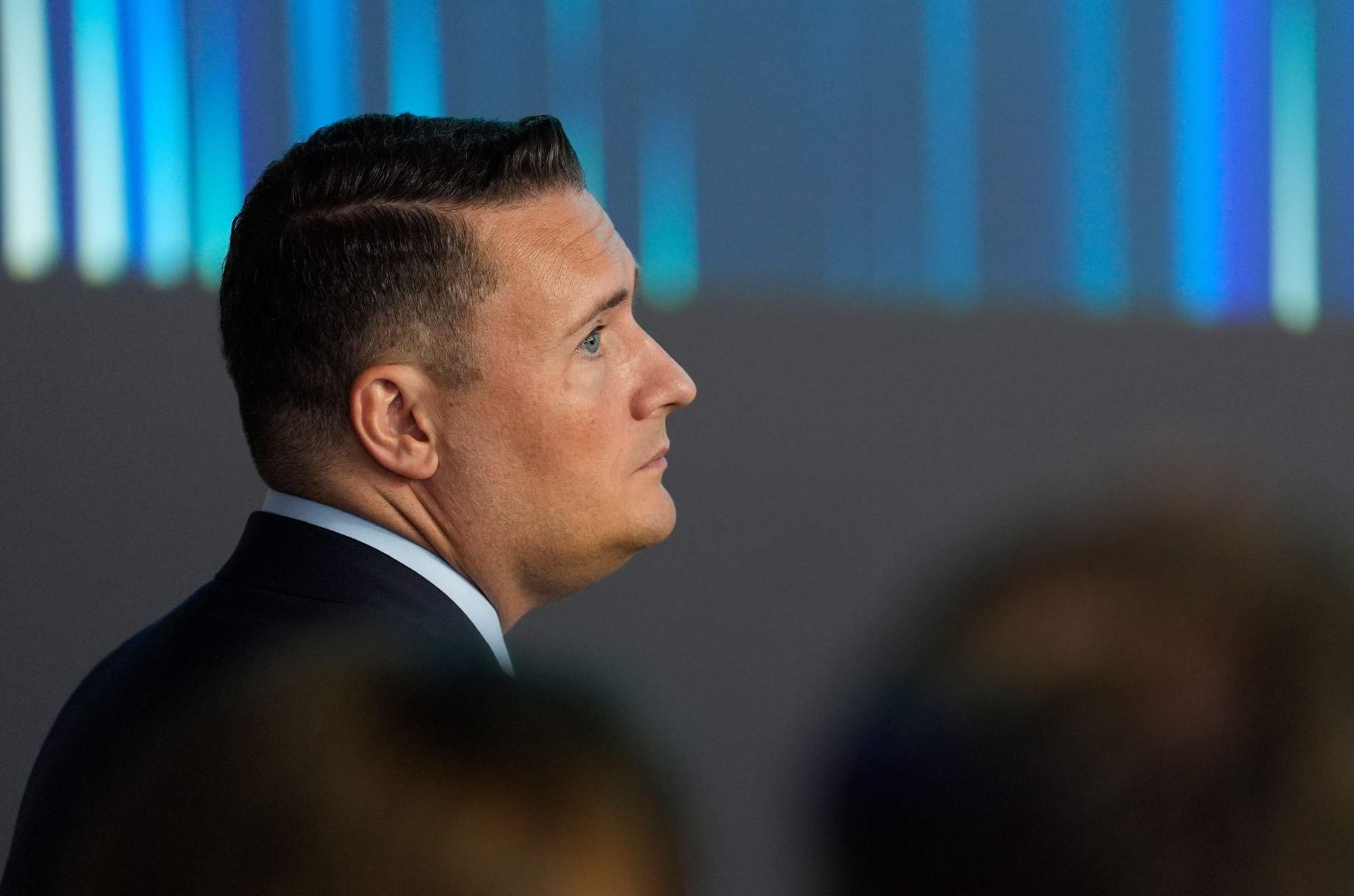
On Wednesday, the new Defence Minister Wes Streeting unveiled Brontanax – BAE Systems’ autonomous collaborative combat aircraft (CCA) wingman that aims to fly alongside RAF fighter jets – at the air show. Each is estimated to cost north of £30m. These are eye-watering amounts compared to how much, for instance, Ukraine spends on its drones.
To justify these spending commitments, Britain’s political language has become increasingly martial. The public is told that the country must “wake up” to daily threats. Russia is described as an aggressive and expansionist power. China is increasingly framed as the defining strategic challenge of the twenty-first century. Military chiefs warn that Britain faces a more dangerous world than at any point in their living memory.
Certainly, there are reasons for concern.
Over the past year, the United Kingdom has faced a succession of increasingly assertive Russian-linked military and intelligence activities, including covert submarine operations in and around British waters, repeated harassment of HMS Prince of Wales by Russian maritime patrol aircraft, the alleged use of lasers by the intelligence vessel Yantar against RAF pilots monitoring its movements, and multiple Russian strategic bombers near UK airspace.
But acknowledging those dangers is not the same as concluding that every additional billion pounds spent on defence, every overseas deployment, or every new military commitment necessarily makes Britain safer.
Indeed, before committing ever larger sums to defence, shouldn’t Britain’s buyers at Farnborough ask a more fundamental question: what exactly are they spending their money defending?
Britain is one of the most geographically secure nations on earth: an island surrounded almost entirely by allies, protected by NATO’s collective defence guarantee and armed with around 225 nuclear warheads carried aboard continuously deployed ballistic missile submarines. It possesses one of the world’s most sophisticated intelligence networks and has not faced a credible threat of invasion since 1940.
Yet Britain’s defence posture bears surprisingly little resemblance to that of a nation principally organised around territorial defence. Rather it’s as if the Empire never ended.
Why, for instance, does Britain maintain approximately 145 military sites across 42 countries? Why did we recently deploy personnel to around 171 nations around the world through exercises, training missions and operations? How does our overseas military estate, stretching from Oman to Kenya, Belize to Brunei, really protect this sceptr’d isle?
These questions are not asked. Yes, Britain increasingly describes itself as a middle power operating in an era of constrained public finances, but then it continues to maintain strategic ambitions more commonly associated with a global power.
That ambition carries costs – costs that our nation might not be able to afford.
Defence is now among the largest areas of public capital investment, second only to transport. It is broadly equivalent to the combined budgets of the Home Office and the Ministry of Justice. It comfortably exceeds annual spending on housing and local government. And the bill is rising.
And, please, be in no doubt. Britain’s expanding defence budget is not simply enriching contractors; it is sustaining a system with a powerful interest in its own growth.
The chief executives of Britain’s five largest defence firms received an average of £5.2 million in 2024, some 138 times the salary of the median British worker.
The press are – some might argue – useful idiots in this emboldened military industrial complex. Nearly 60% of retired senior military figures quoted in the British media on defence matters were, on at least one occasion, presented as independent experts without disclosure of their commercial ties to the defence and security industries. Invest in defence, they tell the nation, without it being made clear they are also asking the nation to invest in them.
So what really emerges here in Farnborough is that British defence has become something close to political Teflon. It shapes the national conversation on security while remaining remarkably resistant to scrutiny. Successive governments justify higher spending by invoking jobs, growth and national resilience, yet it remains very unclear how much of that prosperity extends beyond a relatively small circle of major contractors, consultants and former officials whose fortunes rise alongside the defence budget.
Polling certainly suggests the public remains unconvinced. Earlier this year, polling company Ipsos found that only 37% of Britons support increasing defence spending, while 40% believe current levels are sufficient and 15% favour reductions. At the same time, significant numbers oppose cuts to healthcare, welfare and other public services to fund military expansion.
Even people here at Farnborough remain unconvinced that any but the big defence players will benefit from the national boost in defence spending.
As Elise Littlejohn, of Bruntons Aero Products, told Byline Times, she sees promises for defence spend hikes “advertised on the news, but it’s not clear where to go to bid on these contracts. The expectation is that these big contracts won’t trickle down to companies like ours.”
ENJOYING THIS ARTICLE? HELP US TO PRODUCE MORE
Receive the monthly Byline Times newspaper and help to support fearless, independent journalism that breaks stories, shapes the agenda and holds power to account.
We’re not funded by a billionaire oligarch or an offshore hedge-fund. We rely on our readers to fund our journalism. If you like what we do, please subscribe.
In a similar vein, Andrew Weir, Chief Executive of the Midlands Aerospace Alliance, said that there is a tendency for Ministry of Defence contracts to “go back to existing suppliers, making it harder for new companies to enter. Defence is seen to be a closed shop and (for new comers) it’s very difficult for them to see how to diversify into defence.”
Reasonable people can disagree about whether Britain should spend more on defence. Russia’s aggression is real, as are cyber attacks, threats to undersea infrastructure and growing instability across Europe. Yet Britain’s greatest vulnerabilities increasingly lie in its digital networks, energy systems and supply chains. It’s less clear how postings in Kenya, Oman, Belize and Brunei protect the UK.
So, perhaps, before Britain commits itself to spending £80 billion a year on defence, it owes itself an honest answer.
Is it defending its territory, people and critical infrastructure, or is it preserving a global military posture that has been inherited from another age?
Until that question is answered, Britain risks spending more on defence than at any point since the Cold War without ever deciding what, precisely, it is trying to defend. And, judging by the expensive hand soap here at Farnborough and that sweet smell of defence profits that it imprints on your hands, few here have much interest in asking it.