

Read Our Monthly Magazine
And support our mission to provide fearless stories about and outside the media system
The Drone Siege and Ceasefire
After Ukrainian forces liberated Kherson on 11 November 2022, Russian troops retreated across the Dnipro River to the occupied left bank, from where they continued attacking Kherson. Russian forces used Ukrainian civilians in Oleshky and surrounding villages as human shields to protect their military positions from attack by Ukrainian forces, holding them hostage. From December 2025, they started using a new tactic: a drone siege. By mining and controlling all access roads by drones, they prevented evacuation and cut off access to food, water and medicine. By March 2026, the situation had deteriorated dramatically.
Several rounds of negotiations failed as the Kremlin would not allow evacuations. In September 2026, the public outrage became too strong for the Russian Government to keep ignoring the situation. Pope Leo XIV’s intervention and contact with Putin was a pivotal point.
From 27 October to 1 November, a humanitarian ceasefire took place following mediation involving Melania Trump. Some food and medical supplies were delivered and about 800-900 Ukrainian civilians were evacuated to Ukraine and Russia. Approximately 1,000 civilians remained in the Oleshky community where the humanitarian crisis remained unresolved.
The Potemkin Village Operation
Moscow used the ceasefire to its advantage as the Russian evacuation plan had two major components, forming what Russians call a mnogokhodovochka, a multistep operation.
The Kremlin intended to use a propaganda tour to repair its image by whitewashing Russian war crimes and shifting responsibility for the humanitarian catastrophe onto Ukraine.
Additionally, the ceasefire was planned to earn the Kremlin points with the Trump administration. Melania Trump as a negotiator provided the White House with a diplomatic success story shortly before the US midterm elections.
The Oleshky ceasefire turned out to be the longest since the start of the Russian full-scale invasion in 2022; in the US, the audience easily took the local ceasefire in the Kherson region for a major cessation of combat action. In reality, the Russian forces continued mass attacks on the rest of Ukraine.
Russia brought four American journalists from the staunchly pro-Trump Newsmax agency along with Russian state and military-linked media into the occupied area, with the occupational authorities controlling access to the town.
Yet, due to the early disclosure, independent reporting and coordinated public scrutiny, the Kremlin info and psy-op failed. Residents managed to report that Russians were cleaning streets, removing garbage and corpses, painting public spaces and preparing the town for cameras, thus exposing the staged tour preparations.
By the time the Russian propagandists’ reports were released, the world was already prepared and the false narratives failed to spread internationally.
The last act of the propaganda spectacle took place in the White House on 5 November, after the US midterms proved to be a triumph for Democrats.
At the first US interaction with Russia after the elections, Putin’s US-sanctioned envoy Kirill Dmitriev handed a white-clad Melania Trump a child’s drawing with the inscription “I Love Melania”. The child was allegedly evacuated to Russia.
The Ukrainian side awarded Mrs Trump the highest state honour for women for her “significant personal contribution to humanitarian support for Ukraine”. Melania Trump, in return, sent letters to Putin and Zelenskyy.
The Trojan Horse Operation
White suits notwithstanding, Russia predictably used the humanitarian ceasefire in Oleshky to deploy over 1,000 troops, according to the 34th Separate Marine Brigade “Borysfen”. As documented by Sky News footage and reported by Ukraine’s General Staff, Moscow reinforced its military positions.
Several hundred Russian infantrymen have arrived in local settlements and are awaiting orders to attack. Russian forces also brought in artillery, weapons, UAVs, watercraft, electronic warfare (EW) systems and experts, drone operators, communications personnel and reconnaissance units, fuel, food and other supplies sufficient for several months. According to Ukrainian military sources, Russian forces have moved equipment and ammunition into Oleshky hospital, exploiting its continued use to treat civilians and the expectation that Ukrainian forces will not strike it.
Before the ceasefire, Ukrainian forces had expanded their zone of control in the occupied territories of the Kherson region on the eastern bank of the Dnipro River, pushing Russian troops back and disrupting their logistics.
According to Yaroslav Moroz, head of the Unmanned Systems Unit of the 34th Marine Brigade, Russian forces used the ceasefire to return to positions from which Ukrainian troops had pushed them out over the previous six months, advancing approximately 20 kilometers closer to the line of contact. Russian troops have now established numerous drone launch and landing sites, increasing the threat to Kherson.
As of early November, Ukrainian Marines had not observed large-scale Russian assaults. Ukrainian troops repelled all isolated attempts to advance and neutralised the Russian personnel involved. They continued holding positions on the islands in the Dnipro River and the occupied left bank of the Kherson region and have advanced deeper into Russian-occupied territory and established a presence in a settlement on the left bank. Ukrainian commanders expect Russian assault operations to begin when weather conditions are conducive for drone operations.
According to the 34th Marine Brigade, Russian drone launch sites are located 5–15 kilometers inside the occupied left bank of the Kherson region. Since Ukrainian Marines prevented Russian troops from reaching some positions on foot and disrupted Russian logistics, the Russians started digging trenches and underground tunnels. Tunnelling occurs along approximately 20–30% of the eastern bank frontline, and they are usually short, only 50–150 meters long. According to Alim Kerimov, chief of staff of the 34th Separate Marine Brigade, Russian troops have achieved limited success with tunnels, but Ukrainian forces generally destroy them upon detection.
Russian forces have shifted toward positional and hybrid warfare, combining aerial and artillery strikes, FPV drone attacks and attacks on civilians.
In 2025, Russian forces conducted up to 700 assault sorties, alongside boat-based operations involving approximately 200 boats.
In 2026, Russian assault activity declined to approximately 150–200 sorties per year, with approximately 22 boat-based sorties.
In August 2026, the Prydniprovskyi sector saw the record 26,000 Russian drone attacks, according to the 30th Marine Corps of the Armed Forces of Ukraine.
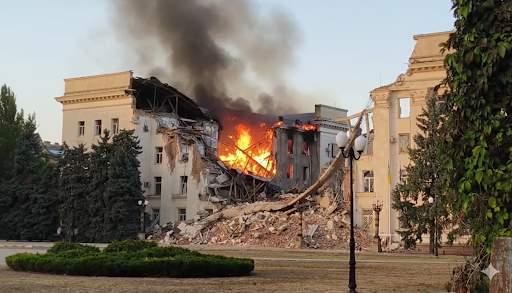
Since the ceasefire ended on 1 November, Russian drones have struck medical facilities, a maternity hospital, multiple administrative and residential buildings and civilian vehicles in Kherson.
Oleshky: A Microcosm of Ukraine
Oleshky has lived through starvation, sieges and mass murder before. The medieval settlement of Oleshshia appears in chronicles in 1084, associated with trade routes connecting Kyivan Rus to Byzantium. Cossacks, fleeing the Russian Empire, established the Oleshky Sich in 1711.
The Bolsheviks renamed it to Tsiurupinsk in 1920s, after a Bolshevik official responsible for starvation: during Stalin’s Holodomor, Soviet authorities confiscated grain and other food supplies and prevented starving peasants from fleeing Ukraine.
During World War II, the town was occupied by the Nazis who executed hundreds of Jews in October 1941.
Since the start of the Russian full-scale invasion and occupation, the nature and culture of the Oleshky community are being destroyed. In the aftermath of the Russian destruction of the Nova Kakhovka Dam, the floodwaters devastated a big part of town. The exact number of victims is still unknown. The famous painted house of Polina Raiko, a pride and joy of Oleshky, was nearly destroyed by the flood. Oleshky’s pine forests are burning. The biggest desert in Europe, Oleshky Sands, is inaccessible.
Little-known until recently, Oleshky is a microcosm of Russia’s war against Ukraine, with nearly every layer of the country’s history compressed into one small town: pre-Russian existence, Cossack heritage, imperial conquest, historical erasure, Holodomor, Holocaust, Soviet repression, Russian military occupation, ecocide, drone warfare, starvation, propaganda, and, most recently, international diplomacy involving no less than the White House.
Four years after the liberation of Kherson, Oleshky remains occupied, its civilians trapped and its territory used to launch attacks on the liberated city across the river. While the Kremlin’s Potemkin village failed to deceive the world, its Trojan horse plan brought Russian troops and weapons closer to Kherson. Will it define the next chapter in the two cities’ history?