

Read Our Monthly Magazine
And support our mission to provide fearless stories about and outside the media system
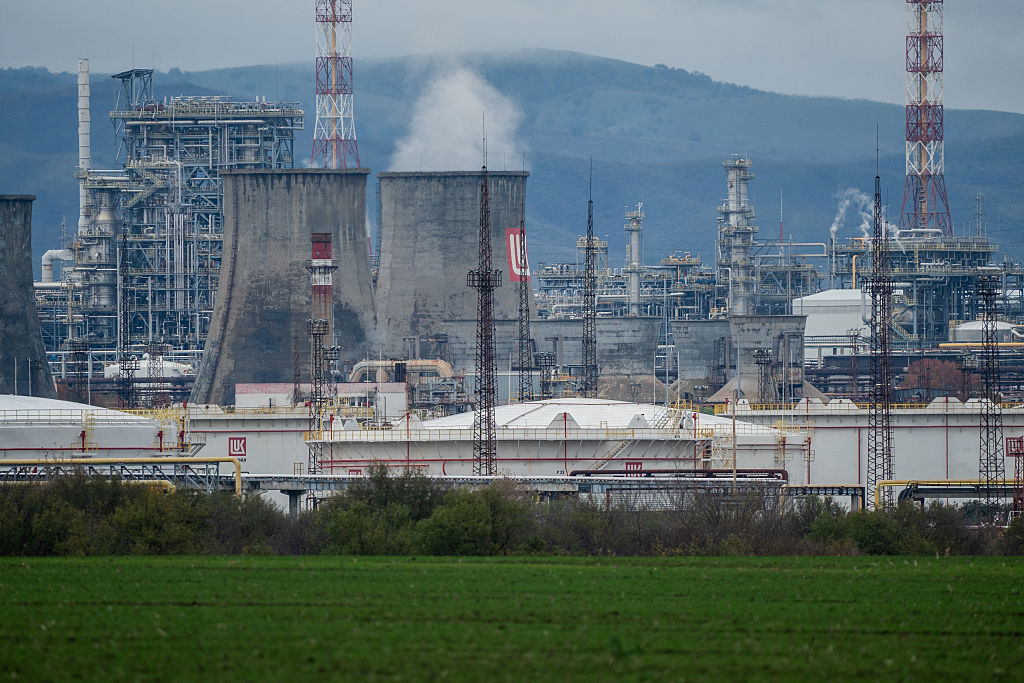
The UK Government is pushing its Bulgarian counterpart to sell the biggest refinery in the Balkans, owned by Russian energy giant Lukoil, to a buyer connected to London and Washington, according to several letters seen by Byline Times.
As the US and the Kremlin discuss the future of Lukoil and its foreign assets, the UK Government has quietly sought to steer one of Lukoil’s biggest EU assets into the hands of a British-linked buyer.
With its vast business footprint, Lukoil has long been, and remains, a soft power tool for Russia. The potential sale of Lukoil’s global assets has become a key part of the negotiations between American officials and Moscow to end Russia’s war in Ukraine. The New York Times reported earlier this month that the two sides have discussed a proposed deal that would see a group of Middle Eastern businessmen, along with American investor Todd Boehly and an arm of the US Government, take control of the Russian oil giant’s assets.
One of those assets is the Bulgarian Neftochim refinery, which Lukoil has owned since 1999, making it a geopolitical tool in south-eastern Europe.
Since Russia’s invasion of Ukraine in 2022, the EU has sought to crack down on imports of Russian oil. However, Bulgaria’s Lukoil subsidiaries have received waivers that allow them to continue operating while the Bulgarian Government looks for a buyer for the refinery. Negotiations with Azerbaijan’s state-owned oil company SOCAR have been ongoing for several years, and Kazakhstan’s oil and gas company KazMunayGas has also expressed interest at various points.
ENJOYING THIS ARTICLE? HELP US TO PRODUCE MORE
Receive the monthly Byline Times newspaper and help to support fearless, independent journalism that breaks stories, shapes the agenda and holds power to account.
We’re not funded by a billionaire oligarch or an offshore hedge-fund. We rely on our readers to fund our journalism. If you like what we do, please subscribe.
Sanctions Waivers in London and Washington
The UK Treasury’s Office of Financial Sanctions Implementation (OFSI) has granted a waiver to Lukoil’s Bulgarian subsidiaries that continues to allow them to operate while negotiations proceed. However, the waiver is set to expire on 29 October, and the OFSI has not yet indicated whether it will issue another extension.
A spokesperson for His Majesty’s Treasury said: “The UK and our international partners have implemented the most severe package of sanctions ever imposed on a major economy and they’re working. This licence comes with strict conditions that stop any money getting to the Russian parent firm – ensuring Lukoil’s profits from these markets eventually cease.”
Meanwhile, the Trump administration has made several recent decisions that allow the sale of Russian oil to continue. On 9 October, Washington announced a deal under which the US will buy 300,000 tonnes of diesel fuel from Russia, as fuel prices have surged following the US war in Iran.
Then on 15 October, the US Treasury Department announced a six-month extension of the waiver on Lukoil sanctions, including the Bulgarian entities, until 24 April 2027.
A Potential UK Buyer
In June, Nathaniel Copsey, the British ambassador to Bulgaria, wrote to Bulgarian Prime Minister Rumen Radev encouraging him to find a professional management team to help run Lukoil’s business in the country. The team would help to secure the largest amount of crude oil from BP at the lowest possible price. The letter also noted that Southbank, a little-known British energy investment firm led by a former Shell executive, would be involved in a deal with BP. It is unclear whether the Bulgarian Government has engaged further with BP on a possible deal.
In August, Minister of State Stephen Doughty wrote to the Bulgarian Ministry of Foreign Affairs that sanctions-compliant safeguards should be put in place to prevent the continued sale of Russian crude. He added that the Foreign, Commonwealth and Development Office would like Bulgaria to engage with bidders, including “Domenico/Apollo”. That appears to be a reference to the American investment giant Apollo Global Management and a little-known London-based private investment firm called Domenico Capital, which was started in 2024 by financier Francesco Ciardi.
Byline Times has obtained a letter written in September from Domenico Capital to Radev, noting that the investment firm had previously made an offer for the refinery in December 2024, which Lukoil rejected. Domenico’s team has nonetheless made another trip to Sofia, the Bulgarian capital, in a second bid to purchase the refinery, which they said would place the company under “American and British control”.
It is unclear whether the Bulgarian Government has acted on the UK’s requests and engaged further with Domenico Capital on its offer. Asked about a potential deal, Ciardi told Byline Times: “No comment for now.”
An Apollo spokesperson said the firm was not considering the investment.