
 Subscriptions

Read Our Monthly Magazine
And support our mission to provide fearless stories about and outside the media system
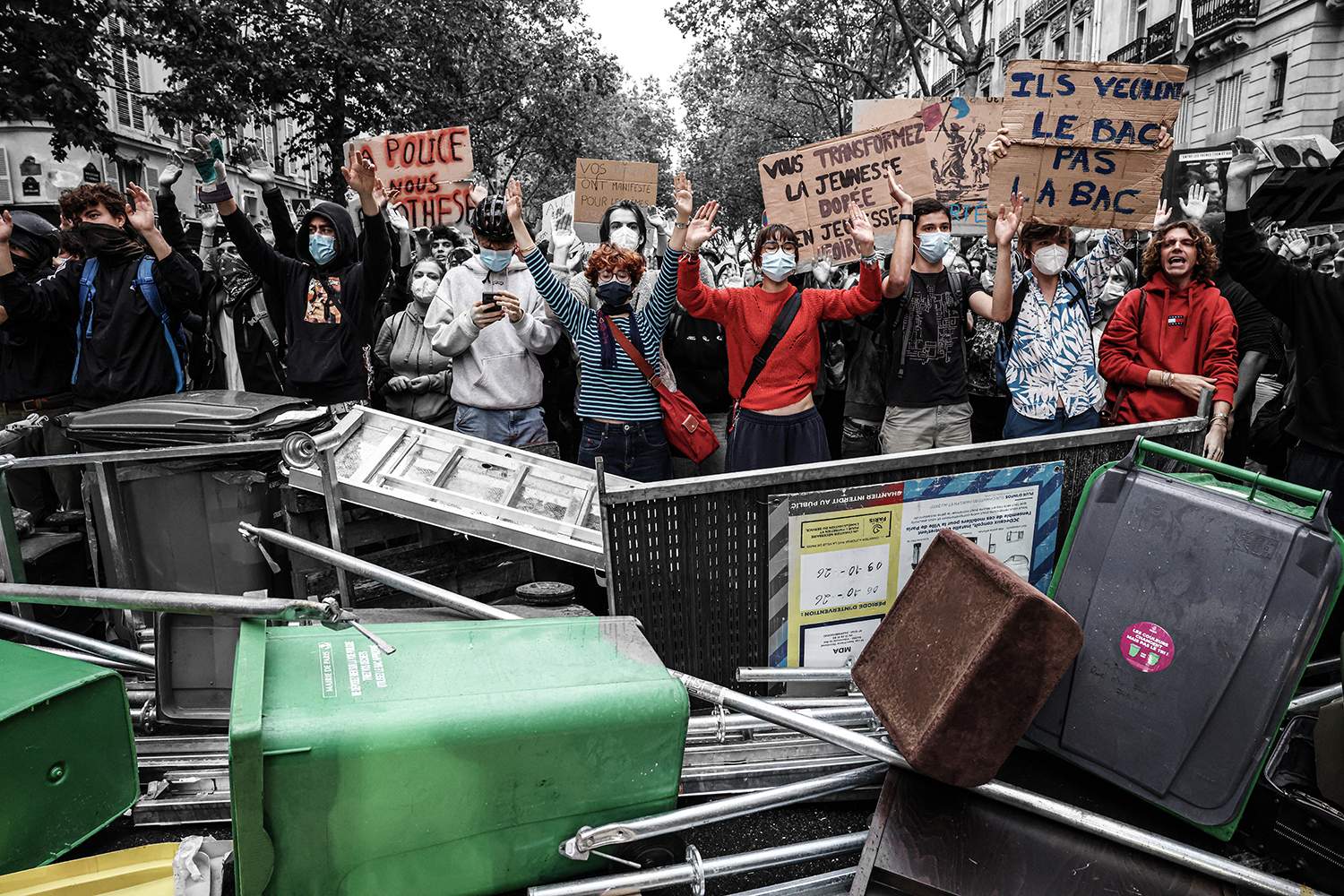
Bins were piled up in front of the Lycée Claude-Monet in the 13th arrondissement of Paris when I arrived. Students milled around, standing on top of them, some performed dances. Others had placards and banners. This was not part of some elaborate drama class performance, it was in fact a ‘blocus’, part of the largest wave of student protests in France since May 1968.
The current protest wave in mainland France began in Lycée Antoine Saint-Exupery in Creteil, on the outskirts of Paris, and has since spread to schools and universities across the country. Between closures and ‘blocuses’ – the tactic in which students pile bins, chairs, lime bikes and other obstacles to create an improvised barricade – at least two thirds of French high schools have experienced some kind of disruption, according to a statement by education minister Édouard Geffray last week.
At Lycée Saint-Exupery, one of the main demands was for the government to fill vacant teaching and support posts.
Chloe,17, a protester at Lycée Claude-Monet, told me that students in the banlieue were protesting because their buildings were crumbling and they have no teachers”.
The 2026 budget removed 4000 teaching posts from the beginning of the academic year in September.
She added: “In Paris we have some privilege, but it’s not perfect. We are lacking some teachers too”.
The Far-Right Billionaire Who Is Buying Up French Culture
Vincent Bollore is helping push France to the right as he gathers a growing empire of publishing houses, newspapers, and film studios across the country
Self-awareness about their own position and solidarity between students was a recurring theme. Speaking to me in a cafe in the 13th arrondissement, Camille, 17 from Lycée Gabriel Fauré acknowledged that her school sits broadly in the middle of the pack in terms of affluence, and said: “the birth of the movement in schools more deprived than ours made us think. Yes we have some privileges, but we are also subject to things that are far too normalised, and which shouldn’t be”.
“For example the middle school building [Gabriel fauré combines middle and high school] is in an absolutely catastrophic state and needs to be renovated”.
Nathan, also from Lycée Gabriel Fauré, added: “we are comparatively lucky to have a good team of teachers who check on us and support us (including in our protest) this is not always the case in some schools where, when a student starts to fall behind, the teachers say well hard luck to those who are falling behind, but I’ve got to carry on working with those who can keep up”.
Another of the factors that has made students start thinking more about their conditions of education, was the sweltering heatwaves in June of this year, which hit French cities particularly hard.
Camille said “we endured a very hot summer this year. We want cooling systems for our school because this summer we were 35 students per class with a classroom temperature of 32 degrees. It’s very difficult to work properly in these conditions”.
According to Nathan: “the majority of high schools in France are ‘thermal sieves’ that means that they’re cold in the winter and hot in the summer. Too cold in the winter to work properly, too hot in the summer to concentrate properly”.
“This summer, a student doing the French baccalaureate exam fainted because of the heat”.
One of the demands across the movement is the abolition of the Parcoursup platform, through which students apply to university. Students are ranked based on marks and teachers comments’ and they are either rejected or accepted by the courses and universities to which they have applied. The platform has been criticised for alleged bias and lack of transparency in how decisions are made.
Another girl at Claude-Monet, who was also called Chloe, told me: “It’s really biased. If you’re in a good school you’ll have more chances [of being accepted to university] if you’re in Paris you’ll have more chances. Also they don’t read the letters you write, they don’t read anything. It’s basically an AI doing the job and making the decisions about people’s futures”.

How French Activists Are Leading an ‘Urgent’ Fight Against the Surging Far Right
Melissa Chemam details the multifaceted resistance mobilising against far-right groups, Islamophobia and racism across the Channel
Chloe also referred me to a viral incident in which an 18 year old tricked the platform, submitting a recipe for a cake instead of her cover letter and still received an offer to study law.
Something teachers in France have repeatedly raised as an issue is the so-called ‘Blanquer Reform’, brought in in 2018 by then education minister Jean Michel Blanquer, which means students are continuously tested throughout the year in a way that counts towards their final grade.
“In our school system, marks have become more important than actually understanding. There is an enormous amount of pressure put on students, especially with the uncertainty about our future that it brings. This can lead to depression among students and anxiety about coming to school”, said Camille.
Students aren’t just protesting for their own rights, but for the rights of some of the staff, as well as more teaching posts, one of the emergency measures students are demanding be put in place includes “the recognition of AESH” (SEND support staff) meaning that SEND support staff are given better pay and professional status. Pupils who need an AESH are meant to have one to one support, though this is often not the case in French schools.
Claire, a student from Gabriel fauré said: “AESHs are indispensable. They don’t just help physically disabled students, but also people with dyslexia or dyscalculus or autism. They are indispensable because they help children socialise in class and pursue their studies normally. Because they are normally students.”
She added: “whether it’s in primary school, high school etc. AESH are insufficiently valued by the state and are sometimes badly treated by teachers who don’t think they’re important. They are very underpaid”.
Passionately gesturing as he spoke, Nathan explained the message they were trying to send to the French Government:
“If we blockade it’s not because we don’t like school. On the contrary, we intend to learn, we intend to study, but we need better conditions to do so. We intend to succeed.”